
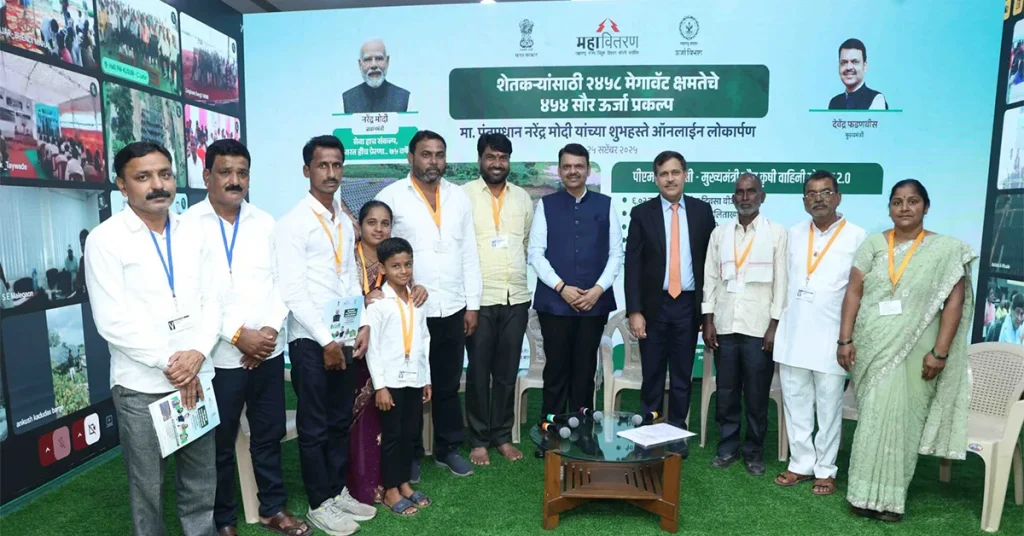
Solar energy is becoming a key driver for the agricultural revival in Maharashtra. Chief Minister Devendra Fadnavis has taken concrete steps to ensure a sustainable supply of solar energy to the farmers during the daytime for sufficient irrigation. For decades, agriculture in Maharashtra has suffered from poor irrigation, which can be attributed to unreliable electric supply besides scarcity of water. With the matured technology for the generation and distribution of solar energy available now, Devendra Fadnavis took a historic decision to empower the farmers of the state with this sustainable natural resource. The idea behind this involves setting up solar energy generation parks and distributing power through the existing agri-feeders. On September 25, in the presence of Prime Minister Narendra Modi and Chief Minister Devendra Fadnavis, 454 solar energy projects with a combined capacity of 2,458 MW were inaugurated online. This is a revolutionary initiative in the sense that besides bringing about positive changes in the lives of millions of farmers and improving the rural economies, these projects will be a big step towards reducing dependency on fossil fuels and carbon emissions, not to mention the boost to the solar energy sector within the state.
600,000 Farmers Receive Electricity During the Day
Chief Minister Devendra Fadnavis’s government has effectively implemented revolutionary schemes such as ‘PM KUSUM C (Mukhyamantri Saur Krishi Vahini Yojana 2.0) and ‘PM KUSUM B (Magel Tyala Saur Krishi Pump Yojana). The objectives of these schemes are firstly to provide stable daytime electricity to the state’s farmers to establish uninterrupted irrigation facilities, and secondly, to create an extra income opportunity for the farmers through selling surplus power. Through these government solar schemes, more than 646,000 solar agricultural pumps have been installed across the state to date. As a result of these initiatives, approximately 2.095 million acres of land have been brought under irrigation coverage. Under the ‘Mukhyamantri Saur Krishi Vahini Yojana 2.0,’ nearly 600,000 farmers are now receiving ample electricity for agricultural purposes throughout the daytime. This has enabled farmers to irrigate their lands during the daytime instead of night. Earlier, farmers would be forced to irrigate their lands during night as the electricity supply was somewhat better at night, However, doing so, they would have to face wild animals often. After this solar energy initiative was implemented, there has been an increase in agricultural productivity.
Thanks to Chief Minister Devendra Fadnavis’s visions and executive prowess, a long-standing agricultural challenge has been resolved with some improvement in the quality of life for the farmers. This change is sometimes manifested by the farmers through their expression of relief and happiness. Recently, during a program attended by the Prime Minister, farmers from the districts of Nashik, Akola, Jalna, Pune, Dhule, and Satara shared how these solar power projects have transformed their farming practices.
Farmers’ Accomplishment Stories
Sunil Kakulate of Satana Taluka in Nashik brought his 40 acres of land under irrigation by harnessing solar energy. While his annual income has increased by ₹2 lakh, this initiative has generated employment for 50 to 60 people. Gopal Mahalle of Satara district has generated an annual revenue of ₹5 lakh for his Gram Panchayat through the PM-KUSUM (Component-C) / the Chief Minister Solar Agricultural Feeder Scheme 2.0. This has also improved the power supply situation in the 1,700 homes in his village. Since the farmers now receive electricity during the day, they are able to rest at night. Chandu Pavara (from Wakwad), a farmer in Shirpur Taluka of Dhule district, has installed a 7.5 HP solar agricultural pump in his farm. This enables him to make use of the solar electricity he is entitled to receive during daylight hours, to cultivate crops such as maize, wheat, and groundnuts. Meanwhile, Tai Kishore Sawant, a farmer residing in Bapkal village of Jalna district, stated that after she installed a 3 HP solar pump for her 2-acre farm, with an abundant water supply available now, the yield of her soybean crop has significantly increased. She also utilizes the surplus electricity to power her home via an inverter. Madhuri Dhumal (from Mai Vasti Peth) in Ambegaon Taluka of Pune district has established a 10 MW solar power project across 10 acres of land under the PM-KUSUM Yojana / the Chief Minister Solar Agricultural Feeder Scheme 2.0. Now she is earning an annual income of up to ₹15 lakh from her agricultural produce. The Chief Minister’s decision to use solar energy for the farm sector has yielded a great amount of optimism and enthusiasm among the farmers.
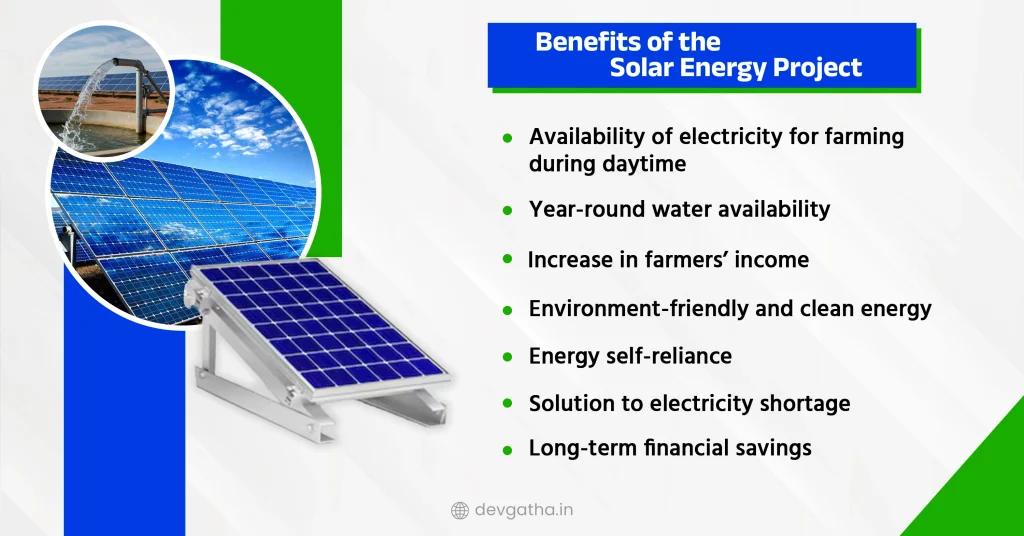
Irrigation is the lifeline for agriculture. With that in order, thanks to the PM-KUSUM – C and the Chief Minister Solar Agriculture Channel 2.0 schemes, the farmers in Maharashtra are not only looking to boost their productivity but also growing diverse crops to manifold their income. Besides, the schemes have generated employment opportunities in the villages. While the Gram Panchayats have begun generating revenue by selling electricity, the villages, farms, and farmers are gradually becoming self-reliant in terms of energy. This whole thing is directly benefitting the rural economy and propelling farmers towards greater self-sufficiency.
Chief Minister Devendra Fadnavis views solar energy as far more than just an alternative energy source; rather, he is actively working to leverage it as a catalyst for the socio-economic advancement of farmers. The provision of daytime electricity for agricultural operations is not merely boosting productivity; it is also enhancing the safety and security of farmers’ lives. There are many hazards and risks associated with working in the fields during night to irrigate crops, not to mention the general perils of working after dark. All these problems have been effectively eliminated. During the inauguration of these projects, Prime Minister Narendra Modi appealed to the farmers present to adopt Zero Budget Natural Farming. He expressed his conviction that the synergistic integration of natural farming practices, solar energy, and modern technology could render agriculture in Maharashtra a more sustainable, profitable, and environmentally friendly future, and he directed the government to prioritize efforts in this direction.
What is Zero Budget Natural Farming?
In a ‘Zero Budget Natural Farming (ZBNF),’ cultivation is carried out without using chemical fertilizers, pesticides, or external inputs. ‘Zero Budget’ implies that a farmer can engage in farming without incurring significant financial expenditure or taking out loans for agricultural purposes. This approach emphasizes maintaining soil health, reducing production costs, and enhancing sustainable agricultural output.
Overall, the agricultural sector in Maharashtra is undergoing a positive transformation driven by solar energy. Historically, farmers in Maharashtra received unreliable power, often in the middle of the night, which led to crop damage and perils for the farmers. Against this gloomy background, the Chief Minister Solar Agriculture Channel 2.0 is being seen as a game-changing scheme, as it is set to achieve multiple goals like empowering farmers with ample electricity, increasing farmers’ income, boosting rural economies, and significantly contributing to environmental protection.
Related articles: