
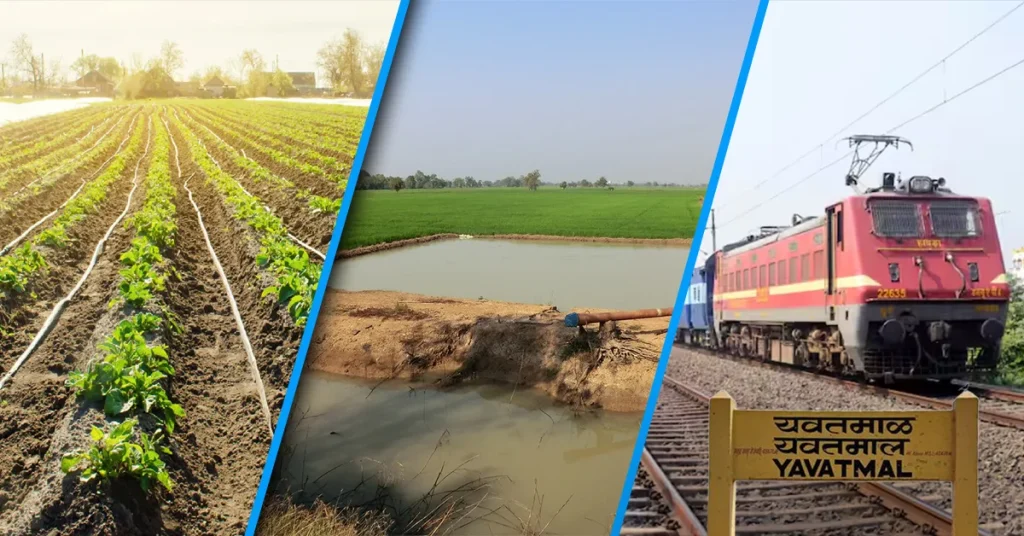
During the period from 2014 to 2019, Maharashtra saw a surge of development initiatives across the state by the Devendra Fadnavis government 1.0, with special attention on the regions reeling under severe agricultural issues. Yavatmal, which was one of the worst hit districts in Maharashtra due to droughts, unseasonal rains, and abysmal irrigation over the past few years, and recorded the highest number of farmer suicides in the state, received schemes on priority and specially designed to address these critical conditions. These were not meant for the announcements sake; the Devendra Fadnavis administration took concrete steps to improve the state of agriculture and that of the farmers, revitalize the local economy, and bring the district onto the development map. During its tenure, the government took decisive actions for Yavatmal’s all round development through the implementation of several major projects across sectors including agriculture, irrigation, water conservation (Jalyukt Shivar), water supply, health and education, women’s empowerment, roads, and railways. In this article, we will take a brief overview of the transformative journey of Yavatmal district under the Devendra Fadnavis government 1.0.
After taking the oath as the Chief Minister of the state in October 2014, one of the initial agenda of Devendra Fadnavis was to formulate and implement the specific projects/schemes for the economically backward districts. The Yavatmal district in Vidarbha with the highest incidence of farmer suicides posed a steep challenge to the new government, which rolled out several pilot schemes to alleviate the economic and psychological distress faced by the farmers of this district.
For the benefit of farmers, the State Government formulated a special scheme titled the ‘Late Motiramji Lahane Krishi Samruddhi Project’ (Agricultural Prosperity Project) with the aim of effectively addressing the agricultural crises and farmer suicides. An outlay of ₹1,150 crore was sanctioned for this project. Its scope encompassed soil and water conservation, sustainable agriculture, growing livestock supply chain and small-scale industries, improving education and healthcare infrastructure, and establishing a mechanism to facilitate the direct delivery of farmers’ produce to various markets. Another important initiative to this end, the ‘Baliraja Chetana Abhiyan’ (Farmer Awareness Campaign) implemented in the Yavatmal district, played a pivotal role in instilling confidence among the farming community. As a result of these focused initiatives, a gradual decline in farmer suicides was achieved. Where in 2015, 291 farmers committed suicide between the months of January and September, the figure came down to 190 suicides in 2016, indicating a 40 percent reduction in farmer suicides within the Yavatmal district. Furthermore, the ‘Ujjwala Scheme,’ the ‘Shubhmangal Vivah Scheme’ and the ‘Tejaswini Project’ were also launched. Through the ‘Ujjwala Scheme,’ LPG connections were provided towards women’s empowerment in vulnerable households including those affected by farmers’ suicides.
Parallel to these, the effective implementation of schemes such as ‘Jalyukt Shivar,’ ‘Galmukta Dam Galyukta Shivar,’ and ‘Shettale’ in the rural areas of the district ensured a thorough increase of the ground-water level and self-irrigation facilities for the farmers to stabilize the agriculture in the district. The progress achieved through these schemes was particularly impressive in the villages like Ganeshwadi (in Kalamb Taluka) and Chikani Domga (in Ker Taluka). In summer of 2017, a threefold increase in the yield of groundnuts generated an income of approximately ₹450 crore for the farmers of the district. Another significant decision taken by Chief Minister Devendra Fadnavis during this phase was to include the Yavatmal district in the National Dairy Development Board (NDDB) project. This decision was taken with the specific objective of fostering the growth of the dairy sector within the district.
Substantial Funds Available for Irrigation Projects
The irrigation infrastructure in the Yavatmal district went through major uplift, backed by substantial fund allocation by the Devendra Fadnavis government. During a State Cabinet meeting held in March 2019, an allocation of ₹3,517 crore was approved for the Bembla River Project. This initiative is set to provide irrigation facilities to an area measuring 45,818 hectares across five talukas of Yavatmal district. Furthermore, under the Baliraja Jal Sanjivani Scheme, the foundation stones for one medium-scale and 14 small-scale irrigation projects were laid in Yavatmal, for which a total fund of ₹738 crore was disbursed. These projects included the Wardha Barrage (Taluka Babhulgaon); Antarga Medium Project (Taluka Darwha); Hatwanjari Medium Project (Taluka Maregaon); Dahegaon Medium Project (Taluka Ralegaon); Mahadapur Medium Project (Taluka Jari Jamani); Kobi Medium Project (Taluka Kelapur); Pachpahur Medium Project (Taluka Jamani); Varud Medium Project (Taluka Yavatmal); and Mahagaon Medium Project (Taluka Darwha). Additionally, the list of projects comprised the Lakhwapur Medium Project (Taluka Yavatmal); Kohal Medium Project (Taluka Ner); Kharda Medium Project (Taluka Babhulgaon); Manpur Medium Project (Taluka Yavatmal); Dhingdoh Medium Project (Taluka Kalegaon); and Amdapur Medium Project (Taluka Umarkhed).
Improvements in Education and Health infrastructure
Significant decisions were also taken in the education and health sectors. In September 2018, approval was granted for the establishment of a Food Technology College in Yavatmal at a cost of ₹102 crore, with the creation of 130 posts. Approval was also given for the construction of a hostel for OBC girls with a capacity of 100 residents. In the health sector, funds amounting to ₹150 crore were allocated for the construction of a modern super-specialty hospital in Yavatmal. Furthermore, under the ‘Jeevandayee Yojana’ (Lifesaving Scheme), 20,000 free surgeries were performed in the district at a cost of ₹45 crore.
To strengthen the infrastructure of Yavatmal district, several road development projects and a major broad gauge railway line were approved by the Fadnavis government. During a State Cabinet meeting held in June 2015, a decision was taken to approve a revised cost estimate of ₹2,501.50 crore for the new Wardha-Yavatmal-Nanded broad-gauge railway line. The State Government’s share in the cost of this railway project was fixed at 40 percent. This project is expected to facilitate easier connectivity between the district and other regions. In October 2018, works worth ₹1,374.27 crore were sanctioned for the Wardha and Yavatmal districts through the National Highways Authority of India. In February 2019, the foundation stones of road projects worth ₹1,200 crore, approved under the Central Government’s Central Road Fund, were laid by Prime Minister Narendra Modi. In April 2018, an allocation of ₹52 crore was made to launch a drinking water supply scheme for Umarkhed, sourced from the Isapur Dam. Simultaneously, a fund of ₹2 crore was immediately sanctioned for water supply from the Bembala Dam. Under the Employment Guarantee Scheme, funds amounting to ₹193 crore were disbursed over a period of three years. During the financial year 2017-18, Yavatmal district topped the list of beneficiaries under this scheme.
From 2014 to 2019, scores of projects with tangible actions were undertaken, which proved invaluable in bringing about positive changes in the lives of farmers, women, students, and the youth of Yavatmal. The Baliraja Chetana Abhiyan, the Vidarbha Psychosocial Support and Care Program (VPSCP), various microfinance/self-help group initiatives, counselling and skill training have gone a long way to address the farmers’ woes. Underlying these achievements were the strong political will and planned implementation demonstrated by the government led by the then Chief Minister, Devendra Fadnavis.