
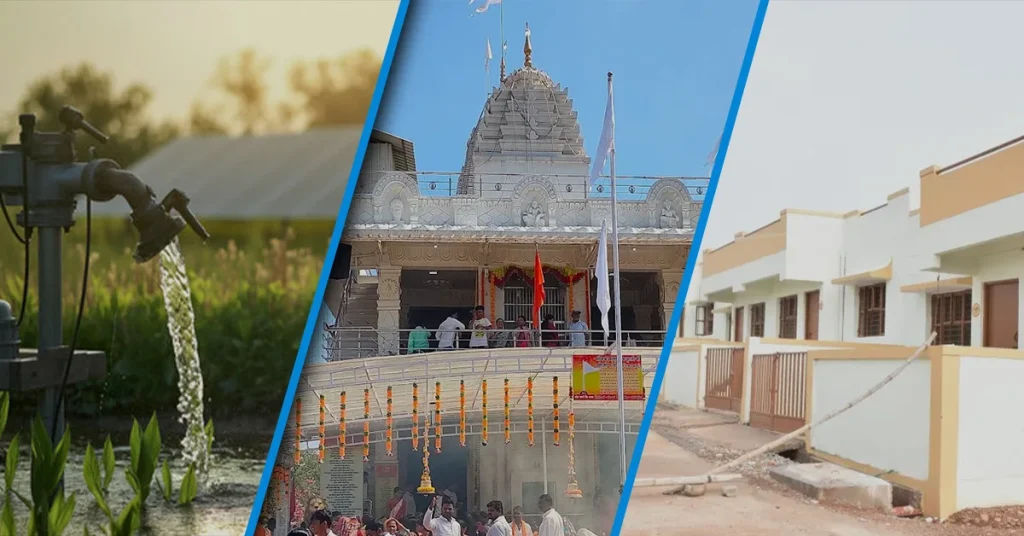
Washim district, located in the Vidarbha region, spans the watershed divide between the Tapi and Godavari river basins. Consequently, the district has historically been heavily dependent on dryland farming. Due to water scarcity, a lack of irrigation facilities, and a dearth of essential infrastructure, the people of Washim district endured significant hardships for many years. However, following 2014, the effective implementation of various government schemes began to bring about positive developments in Washim district. Devendra Fadnavis, serving as Chief Minister during that period, led the state from 2014 to 2019. This era marked a time when several pivotal steps were taken with focus on the state’s overall development. By prioritizing rural and drought-prone regions, Devendra Fadnavis made a sincere effort to deliver “development to every doorstep.”
A large number of initiatives such as the Jalyukt Shivar Scheme, Pradhan Mantri Awas Yojana, Ujjwala Yojana, various minor and major irrigation projects, the Washim City Water Supply Scheme, the Mukhyamantri Gram Sadak Yojana, and the Pohradevi Pilgrimage Development Project, etc. on one hand and advancements in the healthcare and education sectors on the other, have collectively contributed to enhancing the socio-economic quality of life for the people of Washim. It has been observed that local citizens successfully avail themselves of the benefits offered by these diverse government schemes. Their expressions of gratitude acknowledged the efficacy of the state government’s initiatives. Devendra Fadnavis implemented numerous schemes, initiatives, and projects at various levels to ensure the holistic development of Washim district. Prominent among these were initiatives focused on water conservation, irrigation, social welfare, accident insurance, women’s empowerment, health, education, road development, water supply, religious tourism development, and the implementation of the Gharkul scheme. Through this article, we will review the various schemes – the funds sanctioned, the execution of projects, and the tangible impact they have generated – implemented under the leadership of Devendra Fadnavis in Washim district between 2014 and 2019.
Jalyukt Shivar: Paving the Way for Water Security
Through the implementation of the ‘Jalyukt Shivar Yojana between 2015 and 2019, several villages in Washim district, which used to face severe drought situations earlier, attained water sufficiency. Ashok Dhere and Raju Chavan, farmers from Hivara Lahe, shared how water conservation efforts led to a rise in water levels within their wells. Koli village, which had previously lived perpetually under the shadow of drought, also underwent a complete transformation thanks to the ‘Jalyukt Shivar’ scheme. As a result of the scheme’s implementation, Koli village remained lush even during the month of October. The villagers attribute this remarkable transformation entirely to the Jalyukt Shivar scheme. In Dapora Khurd village of Manora Taluka, the deepening of five lakes brought 200 acres of agricultural land under irrigation coverage. Uttam Pund of Kamargaon spoke highly about the agricultural benefits obtained from the deepening of the Kapshi River. Meanwhile, Trimbak Khanjode of Varud noted that the construction of 11 barrages on the Painganga River (under the Painganga River Irrigation Project) is bringing the previously arid lands under the ambit of irrigation.
A Permanent Home Through the Gharkul Scheme
Through the Gharkul scheme, Manohar Telange of Bhamdevi received a permanent home under the Indira Awas Yojana, while the dream of Maroti Gore of Injori village of owning a permanent home was fulfilled through the Pradhan Mantri Awas Yojana. With increased fertility of agricultural lands through sustainable irrigation, farmers like Govinda Idole of Adoli began cultivating oranges and established orchards alongside their regular crops. Kailash Dakhore, a differently-abled farmer from Kondala, purchased a mini-tractor under the ‘Unnat Sheti, Samruddha Shetkari’ (Advanced Farming, Prosperous Farmer) scheme and took significant strides towards self-reliance.
Gopinath Munde Accident Insurance Scheme
Sujata Praghane of Nagalwadi received financial assistance of ₹2 lakh through the Gopinath Munde Accident Insurance Scheme, following the accidental death of her husband. Another widow from Bembam Kanta Vinod Jogi, also shared her positive experience after receiving the benefits of the Central Government’s Pradhan Mantri Ujjwala Yojana. Since the installation of a gas connection in Kanta’s home, her stress levels have significantly decreased. She no longer has to move about gathering firewood to light the hearth in her kitchen, and she has also been relieved of the health hazards caused by the smoke emitted from traditional wood-fired hearth. Furthermore, with the objective of constructing paved roads across the state’s villages, Devendra Fadnavis prioritized the implementation of the Chief Minister’s Gram Sadak Yojana (Village Road Scheme). Under this scheme, a paved road was constructed in Yevata, located in the Karanja Lad taluka of Washim district. The road, which was rutted and covered in mud during the monsoon season for many years, transformed into a durable asphalt road. As a result, the distance that previously necessitated travel by bullock cart is now covered by vehicular traffic providing a smoother and faster journey.
Long-stalled irrigation projects in Washim were given the green light.
After forming his government for the first time in 2014, Devendra Fadnavis promptly granted revised administrative approvals for the irrigation projects in the Washim district that had been stalled for years. This accelerated the pace of work on these projects. For instance, in 2015, revised administrative approvals worth several crores of rupees were granted for schemes, such as the Brahma Micro Irrigation Scheme (₹8.46 crore), the Khadki Scheme (₹13.15 crore), and the Kuttardoh, Hivra Khu., Gaywal, Kavthal, Shelu, Dastapur, Surkhandi, Dharpimpri, Ambapur, and Yevta schemes. These initiatives were significant in terms of eliminating the irrigation backlog in the Washim district. Next year in 2016, the Devendra Fadnavis government granted revised administrative approval amounting to ₹716.42 crore for 11 barrage projects, including the Varud Barrage on the Penganga River. This initiative paved the way for bringing 5,554 hectares of land in the Washim district and 2,136 hectares in the Hingoli district under irrigation coverage and water supply for the residents of surrounding villages. Furthermore, in 2017, a sum of ₹6.61 crore was immediately sanctioned for an urgent water supply scheme in Washim city.
Funds Worth Crores Sanctioned for the improvement of religious sites and healthcare facilities
In 2017, works worth ₹24.99 crore were sanctioned for the development of the Sant Sevalal Maharaj Pohradevi pilgrimage site, followed by the approval of additional works worth ₹75 crore in 2019. On December 3, 2018, Devendra Fadnavis laid the foundation stone for the Shri Sant Sevalal Maharaj Memorial at Pohargarh. Additionally, a development plan worth ₹10.50 crore was sanctioned for the Sakharam Maharaj Sansthan in Loni. Furthermore, in 2018, administrative approval amounting to ₹3.89 crore was granted for the completion of pending works at the 100-bed women’s hospital in Washim. Subsequently, in 2019, a revised sanction of ₹25.65 crore was issued. Meanwhile, on September 13, 2019, the Devendra Fadnavis government approved the upgradation of the Primary Health Center at Pohradevi into a Rural Hospital.
Model Degree College to be Established in Washim
Devendra Fadnavis laid the foundation stones for various development projects worth ₹235 crore in Washim, encompassing initiatives in the health and education sectors, as well as the development of both rural and urban areas. In the education sector, a grant of ₹12 crore was sanctioned on February 12, 2019, for the establishment of a Model Degree College in the Washim district. This college was approved under the Central Government’s RUSA scheme, and funds for its construction were made available through a collaborative partnership between the Central and State governments. In August 2019, a decision was taken to construct hostels for OBC students in Washim, Nagpur, Yavatmal, and Ahmednagar.
All schemes launched by the State Government delivered direct benefits to the district’s residents, across all classes and professions. The initiatives in diverse sectors were undertaken, such as accident insurance, housing, water conservation, irrigation, water supply, healthcare, women’s empowerment, and education, which reflected the progressive vision of the Devendra Fadnavis government then in power. The tangible development currently being witnessed in the Washim district is a direct result of the numerous beneficial initiatives implemented during this period.