
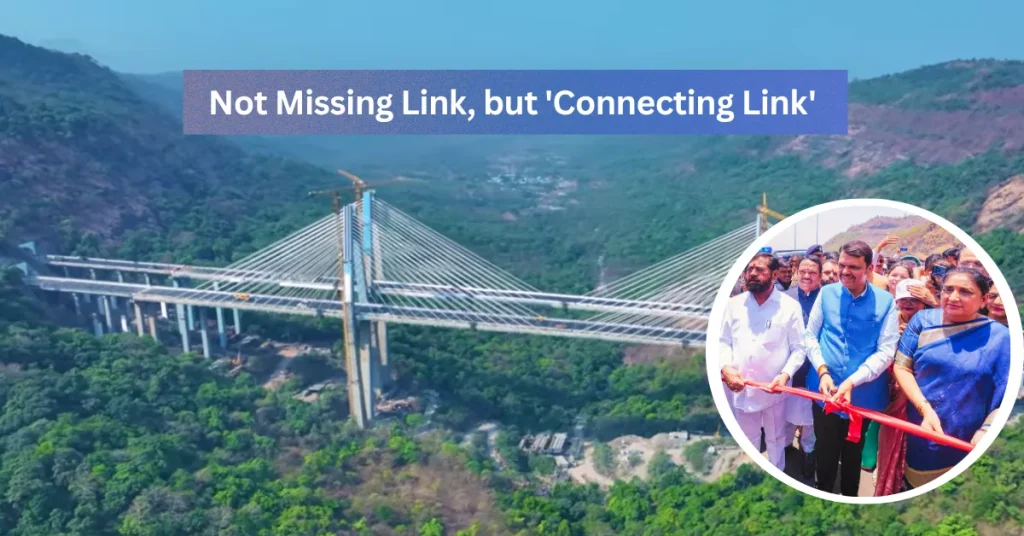
The Mumbai-Pune Expressway ‘Missing Link’ project, to translate a great vision into a wonderful reality, is finally complete. This is a 13.3 km long, eight-lane highway built through formidable terrain on mountains, aimed at making the road journey between the two cities significantly faster, safer, and more fuel-efficient. The ‘Missing Link’ will bypass the accident-prone Khandala Ghat on the Mumbai-Pune Expressway, reducing the total distance by 6 km and travel time by 30 minutes, which in effect will generate an additional revenue worth ₹70,000 crore for the government to scale up Maharashtra’s economic development. Built with an investment of ₹7,181 crore, the ‘Missing Link’ project has finally turned into a vital ‘connecting link’ bridging Mumbai and Pune.
Not a ‘Missing Link,’ but a ‘Connecting Link’
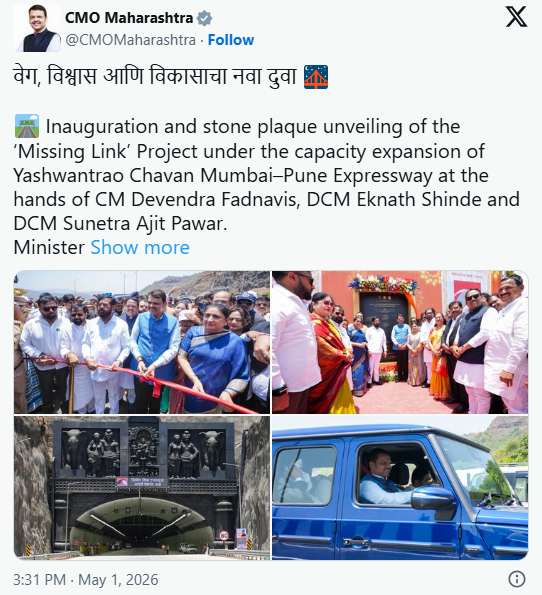
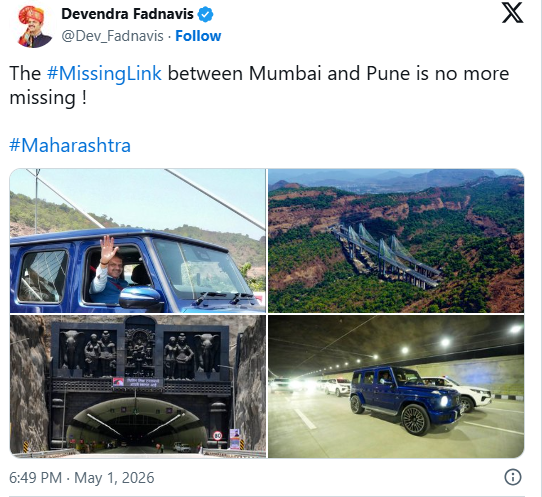
The ‘Missing Link’ on the Yashwantrao Chavan Expressway, also known as the Mumbai-Pune Expressway, stands as a testament to the road and bridge engineering prowess of the country. On Maharashtra Day (May 1, 2026), this vital stretch of road was inaugurated by Chief Minister Devendra Fadnavis. With this advanced and access-controlled section, the Mumbai-Pune journey will get way smoother, in stark contrast with the earlier experience of travelling slowly along the numerous bends, negotiating heavy traffic. Emphasizing the significance of this project, Chief Minister Devendra Fadnavis remarked that it would be more accurate to call it a ‘Connecting Link,’ rather than a ‘Missing Link.’ This project will not only reduce the travel distance between the two cities but will also serve as a potential economic multiplier, tentatively adding ₹70,000 crore to the state’s economy. Completed at a cost of approximately ₹7,181 crore, the construction of this rugged, beautiful 8-lane road overcoming steep challenges, has made it a technological wonder. The project has earned a place in the ‘Guinness Book of World Records’ due to its 22.33-meter-wide tunnel, recognised as the widest underground tunnel in the world.

The official certificate of recognition was presented to the Chief Minister by the Guiness World Records during the inauguration ceremony. This is a laudable achievement that speaks volume about the world class design and technologies employed in this project and also about the pace of progress in Maharashtra.
A Historical Context for a Historic Project
Deep within the remote valleys of the Sahyadris, where, long ago, the soldiers of Shivaji Maharaj accomplished historic victory at the battle of Umberkhind, the world’s widest tunnel has now been constructed. It was at this very site that Chhatrapati Shivaji Maharaj’s soldiers defeated the Mughals. Nearly 500 years later, our engineers have pulled off another historic win with their unwavering dedication and utmost efforts. This is a massive technological feat that speaks highly about India and its engineering standard.
Overcoming geographical Challenges with Cutting Edge Techniques
The ‘Missing Link Project’ was executed amidst extremely difficult geographical conditions and formidable natural challenges. To accomplish this extraordinary project, which involved several difficult tasks, including transportation of heavy machinery into the valleys and dense forests of the Sahyadri range, the specialized companies from seven different nations were enlisted. Key highlights of this project include the widening of the road between Khalapur and Khopoli to eight lanes, as well as the construction of two major tunnels and two viaducts diametrically between the Khopoli exit and Kusgaon. The Missing Link will benefit commuters in many ways; the distance between Khopoli and Kusgaon will be reduced by 6 kilometers, resulting in a time saving of at least 25 to 30 minutes. One of these tunnels passes 180 meters beneath Lonavala Lake; its excavation, which involved high risk, was completed with the utmost safety and precision using the New Austrian Tunnelling Method (NATM). Furthermore, a 650-meter-long cable-stayed bridge, a crucial part of ‘Missing Link’ built over the Tiger Valley, serves as a standout attraction of this project. Standing at an approximate height of 125 meters and supported by two towering pylons, each 182 meters high, this is India’s tallest bridge.
Smooth Travel with Top Class Safety
The ‘Missing Link’ will provide a great driving experience with world-class safety standards. Connectors connecting the two tunnels have been built every 300 meters, allowing for safe evacuation of passengers in case of an emergency. The entire stretch is equipped with a fire-extinguishing system, a water mist system, and 24-hour CCTV surveillance, each of the highest standard. An intelligent traffic management system has been installed to maintain traffic discipline. Drivers who violate the rules will be directly issued e-challans. This project will completely bypass the dangerous turns and the risk of landslides in the valley, which were earlier commonplace in the road journey between the two cities.
Mumbai-Pune Missing Link Timeline
1995
Based on a study by ‘RITES’, a recommendation was made for an alternative route through the ghat section. The Technical Advisory Committee approved the ‘Missing Link’ plan and the Detailed Project Report (DPR).
November 30, 2015
The Mumbai-Pune Missing Link project was approved during a meeting of the Cabinet Committee on Infrastructure.
September 20, 2016
Approval was granted for the construction of a new 8-lane road—featuring two tunnels and two viaducts—covering a 13.3 km stretch (the ‘Missing Link’) extending from the Khopoli exit of the Mumbai-Pune Yashwantrao Chavan Expressway to Kusgaon (near the Sinhgad Institute).
June 13, 2017
The Infrastructure Sub-committee approved the execution of the Missing Link project. During this meeting, an approximate cost of ₹4,797.57 crore, estimated based on 2015-16 rates, was also sanctioned for the project.
November 24, 2017
Approval was granted to commence work on the 13.3 km Missing Link project with a project cost of ₹4,797.57 crore. Approval was also granted for the establishment of a Special Purpose Vehicle (SPV) to meet the specific requirements of the project.
December 26, 2017
The ‘M. Geodata-LB Consortium’ was appointed as the General Consultant for this project.
August 24, 2018
The Environment Department granted approval for the Mumbai-Pune Missing Link.
August 29, 2018
On August 29, 2018, the Cabinet Committee on Infrastructure approved the draft for the Concession Agreement to be signed between the Maharashtra State Road Development Corporation and the Special Purpose Vehicle for this project; accordingly, it also approved the Concession Agreement and the revised cost of the project.
August 30, 2018
Under Package 1, M/s Navayuga Engineering Company was awarded the contract to construct two 8-lane tunnels, measuring 1.75 km and 8.92 km in length. Meanwhile, under Package 2, Afcons Infrastructure Limited was awarded the contract to construct two 8-lane viaducts, measuring 790 m and 650 m in length, including a cable-stayed bridge in one of the viaducts, as well as to widen a 6.5 km stretch of road between the Khalapur Toll Plaza and the Khopoli Exit from six lanes to eight lanes.
September 6, 2018
The Forest Department submitted a proposal for the utilization of 74.7102 hectares of land.
October 3, 2018
The concession agreement for the company tasked with construction of ‘Missing Link’ on the Mumbai-Pune Expressway, between Khopoli to Kusgaon, received official approval. The revised cost of the project was fixed at ₹6,695.37 crore.
March 2019
Actual construction work on the Mumbai-Pune Missing Link commenced.
July 12, 2025
On July 12, 2025, Chief Minister Devendra Fadnavis, accompanied by Deputy Chief Minister Eknath Shinde, inspected the progress of the Missing Link project. The Missing Link project on the Yashwantrao Chavan Mumbai-Pune Expressway stands as a marvel of engineering. Notably, one of the tunnels within this project is the longest in the country. Upon completion, this project is expected to reduce travel time between Mumbai and Pune by half an hour. On this occasion, Chief Minister Devendra Fadnavis specifically lauded the engineers and workers who labored on the Missing Link project under challenging conditions.
May 1, 2026
The inauguration of the Mumbai–Pune Missing Link was carried out on Friday (1 May) by Chief Minister Devendra Fadnavis, in the presence of Deputy Chief Minister Eknath Shinde and Deputy Chief Minister Sunetra Pawar. Within a few hours of the inauguration, the Missing Link was opened for traffic. Currently, heavy vehicles are prohibited on this route. This route has been constructed at an approximate cost of ₹7,181 crore using advanced technology. The 22.33-meter-wide tunnel in this project has been recorded in the Guinness Book of World Records as the widest underground tunnel in the world. With this project, Maharashtra has achieved another major milestone.
6 July 2026
Landslide Debris Cleared Promptly; Traffic Restored
The Lonavala and Khandala Ghat region witnessed continuous heavy rainfall, with 490 mm of rainfall recorded in Lonavala within 24 hours. Due to this extreme rainfall and strong winds, nearly 100 tonnes of soil, rocks, and debris slid down from a height of approximately 150 feet near the outer section of the entrance to Tunnel No. 2 of the Mumbai–Pune Expressway Missing Link Project.
The landslide damaged the retaining wall and deposited a massive pile of debris on the road. As a precautionary measure, the administration immediately suspended traffic on the Pune–Mumbai Expressway and the connecting link road, diverting vehicles to the old Mumbai–Pune Highway.
Meanwhile, the MSRDC’s disaster management team promptly reached the site and began clearing the debris. By around 10:30 PM, more than 100 tonnes of soil and rock debris had been completely removed from the roadway. Following the clearance and cleaning operations, two lanes of the Pune–Mumbai carriageway were reopened for traffic on a restricted basis.
Related articles:
- The Mumbai–Pune Missing Link project: the new engineering marvel to offer a faster, safer, and a more fuel-efficient journey between the two cities
- Infra Man Devendra Fadnavis: The Architect of the Greenfield Highway Mega-Project
- Shaktipeeth Mahamarg from Pavanar to Patradevi: Another development avenue for Maharashtra’s interior
- Samruddhi Mahamarg is all ready: the day of fulfillment of Infra Man Devendra Fadnavis’s dream for 25 years