
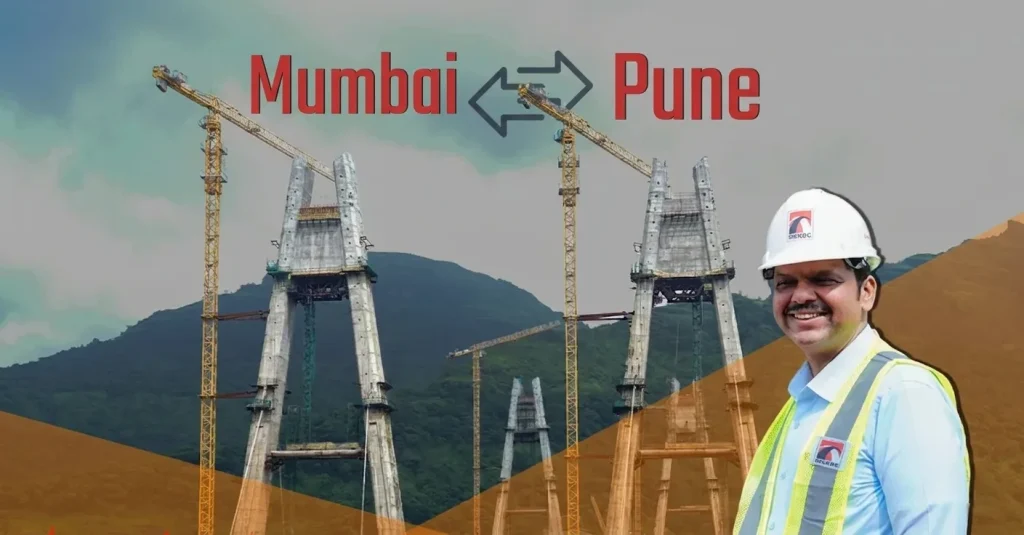
The Mumbai–Pune Expressway, one of the most critical and busiest highways passing through the Western Ghats, is also a constant source of pain for thousands of people plying between the two cities, due to its treacherous curves, landslides, and traffic congestion. Identifying the accident-prone ‘Khandala Ghat’ section as the epicentre of problems, Devendra Fadnavis launched the Mumbai–Pune Expressway ‘Missing Link’ project for a solution during his first tenure as Chief Minister. This extraordinary project, which is about constructing a 13.3 km, 8-lane access-controlled corridor bypassing the Khandala ghat, is nearing its completion. Pitted against the overwhelming challenges, such as the steep hills, deep valleys, and large lakes, the MSRDC came up with one of the most technically demanding road projects ever undertaken in India. The Mumbai–Pune Expressway ‘Missing Link’ connects Khapoli diametrically with Kusgaon, making ways through tunnels, viaducts, and a cable-stayed bridge. The stretch, which at some points passes beneath the Lonavala Lake and at other times crosses over the rugged terrains and the fearsome Khandala Valley, will be an engineering marvel and a spectacular new addition to Maharashtra’s key infrastructure list. Upon completion, it is expected to reduce travel time by 30 minutes. Starting with consistent efforts for approvals and funds, steadfastly overcoming technical hurdles, and bringing the project to fruition, the project cycle has reached its final stage thanks to the vision of inframan Devendra Fadnavis and his grit and is tentatively scheduled to open to the general public on May 1st.
Mumbai-Pune Missing Link Project Update
The Yashwantrao Chavan Expressway, which connects two vital cities of Maharashtra—Mumbai and Pune—is regarded as the state’s economic lifeline. However, sharp bends in the Lonavala-Khandala Ghat section and landslides during the monsoon season cause accidents and other impediments, which result in traffic jams for long hours on this route. For a long term solution to this issue, the then Chief Minister, Devendra Fadnavis, proposed in 2015 to build a road that would bypass the problematic areas on the said highway and also significantly shorten the journey time. Under his chairmanship, the Infrastructure Committee granted approval to the project on November 30, 2015. Subsequently, in 2018, the project’s execution received a significant boost through a Concession Agreement.
The Missing Link to Remove the Bottleneck in the Mumbai-Pune Expressway
Currently, while traveling from Mumbai to Pune, the old National Highway 4 and the Expressway merge between the Khalapur Toll Plaza and the Khandala Exit. This causes traffic from both highways (10 lanes in aggregate) to suddenly converge onto a narrower 6-lane Ghat road, a situation that can be referred to as a ‘bottleneck.’ This stretch spans approximately 19 km. As an alternative to this 19-km winding road, a decision was made to construct a new, direct 13.3-km route comprising two major tunnels and two viaducts. This project is known as the ‘Missing Link.’ This route has been designed to completely bypass the old Ghat road. Consequently, the distance between Mumbai and Pune will be reduced by approximately 6 km, resulting in a time saving of 20 to 30 minutes.
Featuring India’s Tallest Bridge and Tunnels Beneath the Lonavala Lake
The ‘Missing Link’ project demonstrates the engineering prowess of India, as frequently remarked by Devendra Fadnavis. The project entailed the construction of an 8.9 kilometer-long twin-tunnel, passing 170 feet beneath the Lonavala Lake; it stands as one of the widest 8-lane tunnels in the world. The project also features a magnificent cable-stayed bridge built in the Tiger Valley. With its pylons rising between 132 meters and 180 meters depending on ground references, this is set to be the tallest cable-stayed bridge in India. Apart from serving as a shortcut link on the Mumbai-Pune route, the magnificent ‘Missing Link’ is expected to become a prominent tourist attraction.
Initially estimated at approximately ₹3,215 crore, the project’s cost eventually escalated to ₹4,797 crore and later again increased to ₹6,695 crore, due to technical complexities of the project and an expanded scope. Acting in the state’s best interest, the ‘Mahagathbandhan’ (Grand Alliance) government cleared the necessary funds and resolved administrative hurdles to facilitate this project. Given that the Mumbai-Pune route is of paramount importance in every respect, the Missing Link project was accorded special priority through the 2024 Logistics Policy. This route is expected to significantly expedite the movement of goods. Construction work faced delays primarily due to frequent rainfall in the Lonavala-Khandala region and various technical challenges; however, 96 percent of the work has now been completed. The route is slated to open to the public within the next 3–4 months—specifically around May 1, 2026, coinciding with the occasion of Maharashtra Day.
A Brief Overview of The Mumbai-Pune Missing Link
The Mumbai-Pune Missing Link will help alleviate traffic congestion in the ghat sections. It will reduce travel time between Khopoli and Kusgaon by 30 to 60 minutes. The total length of the Missing Link project is 13.3 km, and it has been executed at a cost of approximately ₹7,000 crore. Chief Minister Devendra Fadnavis will inaugurate this project on May 1, 2026, and the route will open to traffic on the very same day.
As part of the Missing Link project, the world’s widest 8-lane tunnel—spanning 8.92 km in length and 23.75 meters in width, has been constructed. This tunnel is expected to earn a place in the Guinness Book of World Records.
India’s tallest cable-stayed bridge, measuring 650 meters in length and standing over 180 meters in height has been constructed in Tiger Valley. The tunnels in this project passes nearly 180 meters beneath Lonavala Lake. The journey between Mumbai and Pune is expected to become faster by approximately one hour. This project is access-controlled and features advanced emergency facilities as well as CCTV surveillance systems.
Mumbai-Pune Missing Link Timeline
1995
Based on a study by ‘RITES’, a recommendation was made for an alternative route through the ghat section. The Technical Advisory Committee approved the ‘Missing Link’ plan and the Detailed Project Report (DPR).
November 30, 2015
The Mumbai-Pune Missing Link project was approved during a meeting of the Cabinet Committee on Infrastructure.
September 20, 2016
Approval was granted for the construction of a new 8-lane road—featuring two tunnels and two viaducts—covering a 13.3 km stretch (the ‘Missing Link’) extending from the Khopoli exit of the Mumbai-Pune Yashwantrao Chavan Expressway to Kusgaon (near the Sinhgad Institute).
June 13, 2017
The Infrastructure Sub-committee approved the execution of the Missing Link project. During this meeting, an approximate cost of ₹4,797.57 crore, estimated based on 2015-16 rates, was also sanctioned for the project.
November 24, 2017
Approval was granted to commence work on the 13.3 km Missing Link project with a project cost of ₹4,797.57 crore. Approval was also granted for the establishment of a Special Purpose Vehicle (SPV) to meet the specific requirements of the project.
December 26, 2017
The ‘M. Geodata-LB Consortium’ was appointed as the General Consultant for this project.
August 24, 2018
The Environment Department granted approval for the Mumbai-Pune Missing Link.
August 29, 2018
On August 29, 2018, the Cabinet Committee on Infrastructure approved the draft for the Concession Agreement to be signed between the Maharashtra State Road Development Corporation and the Special Purpose Vehicle for this project; accordingly, it also approved the Concession Agreement and the revised cost of the project.
August 30, 2018
Under Package 1, M/s Navayuga Engineering Company was awarded the contract to construct two 8-lane tunnels, measuring 1.75 km and 8.92 km in length. Meanwhile, under Package 2, Afcons Infrastructure Limited was awarded the contract to construct two 8-lane viaducts, measuring 790 m and 650 m in length, including a cable-stayed bridge in one of the viaducts, as well as to widen a 6.5 km stretch of road between the Khalapur Toll Plaza and the Khopoli Exit from six lanes to eight lanes.
September 6, 2018
The Forest Department submitted a proposal for the utilization of 74.7102 hectares of land.
October 3, 2018
The concession agreement for the company tasked with construction of ‘Missing Link’ on the Mumbai-Pune Expressway, between Khopoli to Kusgaon, received official approval. The revised cost of the project was fixed at ₹6,695.37 crore.
March 2019
Actual construction work on the Mumbai-Pune Missing Link commenced.
July 12, 2025
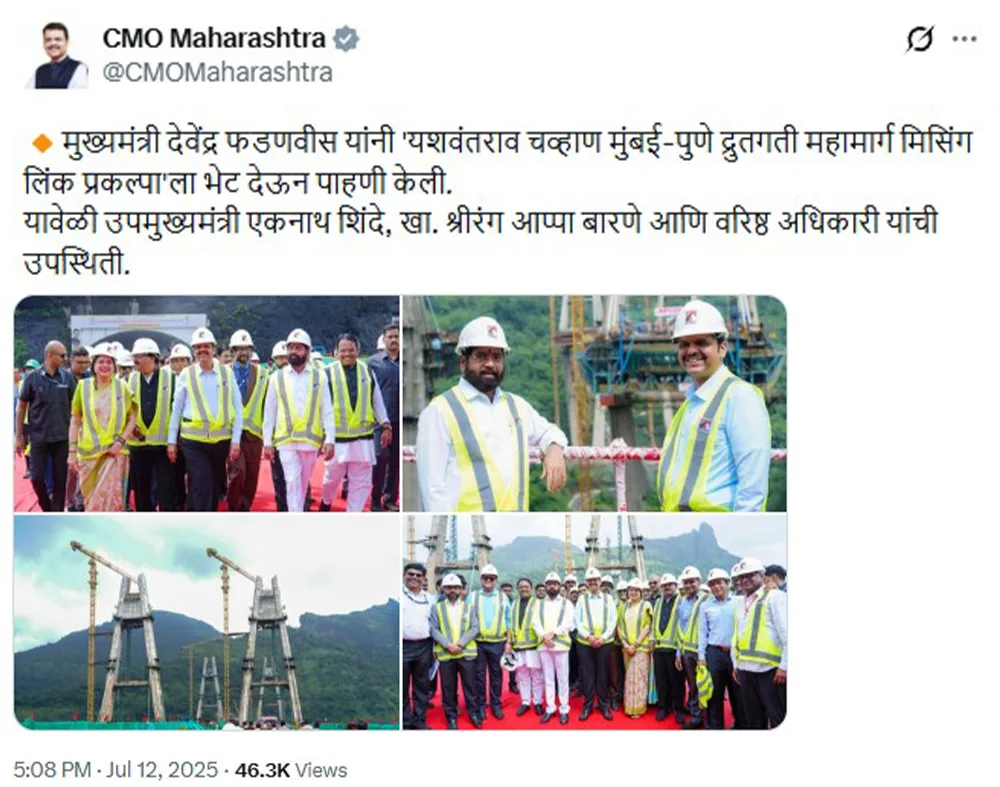
On July 12, 2025, Chief Minister Devendra Fadnavis, accompanied by Deputy Chief Minister Eknath Shinde, inspected the progress of the Missing Link project. The Missing Link project on the Yashwantrao Chavan Mumbai-Pune Expressway stands as a marvel of engineering. Notably, one of the tunnels within this project is the longest in the country. Upon completion, this project is expected to reduce travel time between Mumbai and Pune by half an hour. On this occasion, Chief Minister Devendra Fadnavis specifically lauded the engineers and workers who labored on the Missing Link project under challenging conditions.
May 1, 2026
The inauguration of the Mumbai–Pune Missing Link was carried out on Friday (1 May) by Chief Minister Devendra Fadnavis, in the presence of Deputy Chief Minister Eknath Shinde and Deputy Chief Minister Sunetra Pawar. Within a few hours of the inauguration, the Missing Link was opened for traffic. Currently, heavy vehicles are prohibited on this route. This route has been constructed at an approximate cost of ₹7,181 crore using advanced technology. The 22.33-meter-wide tunnel in this project has been recorded in the Guinness Book of World Records as the widest underground tunnel in the world. With this project, Maharashtra has achieved another major milestone.
6 July 2026
Landslide Debris Cleared Promptly; Traffic Restored
The Lonavala and Khandala Ghat region witnessed continuous heavy rainfall, with 490 mm of rainfall recorded in Lonavala within 24 hours. Due to this extreme rainfall and strong winds, nearly 100 tonnes of soil, rocks, and debris slid down from a height of approximately 150 feet near the outer section of the entrance to Tunnel No. 2 of the Mumbai–Pune Expressway Missing Link Project.
The landslide damaged the retaining wall and deposited a massive pile of debris on the road. As a precautionary measure, the administration immediately suspended traffic on the Pune–Mumbai Expressway and the connecting link road, diverting vehicles to the old Mumbai–Pune Highway.
Meanwhile, the MSRDC’s disaster management team promptly reached the site and began clearing the debris. By around 10:30 PM, more than 100 tonnes of soil and rock debris had been completely removed from the roadway. Following the clearance and cleaning operations, two lanes of the Pune–Mumbai carriageway were reopened for traffic on a restricted basis.
Related articles: