
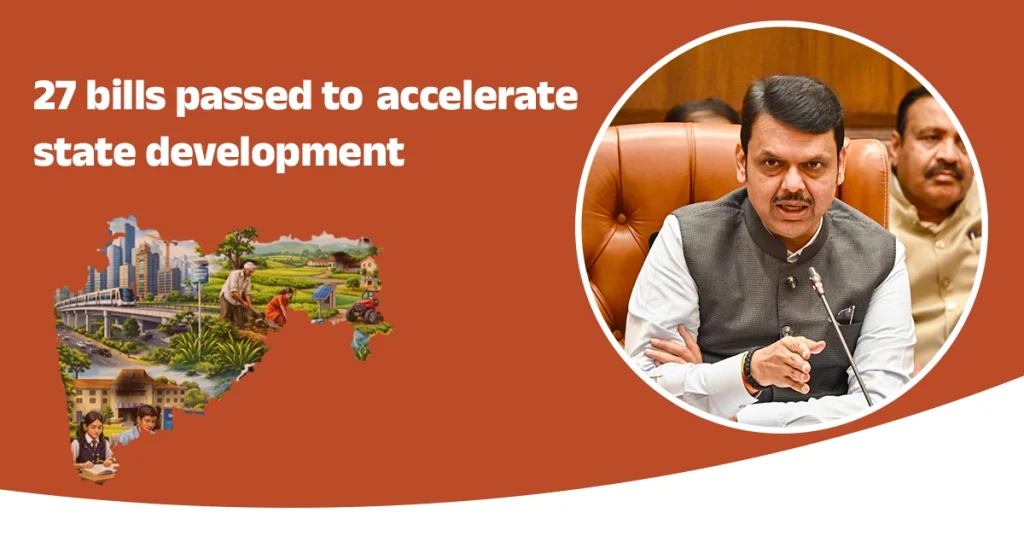
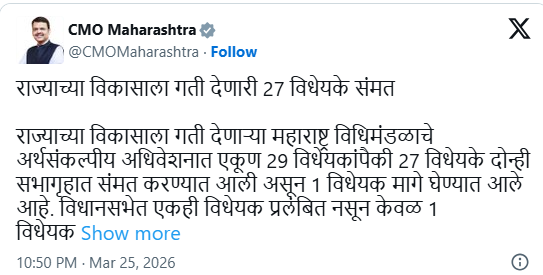
The budget session of Maharashtra for the financial year 2026-27 was successfully held under the leadership of Chief Minister Devendra Fadnavis. Out of a total of 29 bills tabled during the session, 27 key bills were passed across both houses of which several stand out for their impact on state governance. The government responded in detail to the issues raised by the members through different instruments of the legislature.
During the budget session, while answering the questions of the opposition, all the developments that are taking place in the state were discussed and were made public. The budget session being the longest and most crucial legislative session, focuses primarily on scrutinizing and approving the government’s financial plans for the upcoming fiscal year. Through the sessions, the people’s representatives inform the government about the problems of their constituencies, need for funds and development works. Therefore, this session is very important for the members. This is typically the longest session through which the state government has to present the budget proposals and then take approval of it by the legislature. The budget session is not solely restricted to budget-related bills; sometimes before implementing other important legislation, the government can take the approval from the houses during the budget session. The proposed measures of the Maharashtra Government for Cooperative Societies and Local Self-Government Bodies were approved during the budget session 2026-27. Of the 27 bills approved by both houses in the 2026 budget session, some were amended, while the rest were newly introduced.
Review of Legislative Assembly Proceedings
During the Maharashtra Budget Session 2026, the Legislative Assembly functioned for a total of 197 hours and 44 minutes. On average, work was conducted for 9 hours and 53 minutes each day. The overall attendance of members during this session stood at 86.53 percent. In this session, 22 bills were introduced in the Assembly, and all 22 of them were passed. Additionally, one bill, carried over from the previous session, was also passed. Meanwhile, in the Legislative Council, a total of 143 hours and 51 minutes were spent deliberating on 23 bills. The average daily working duration was 7 hours and 11 minutes with 83.54% average attendance. Five bills were introduced in the Legislative Council, four of which were subsequently passed. Furthermore, of the total number of bills passed by the Legislative Assembly, 19 bills were cleared by the Legislative Council while 4 bills were returned. The upcoming Monsoon Session is scheduled to commence in Mumbai on June 22.
Key Legislative Amendments and Developmental Initiatives
The bills introduced and passed during this session represent more than just changes on paper; once they receive the Governor’s assent, they get the license to become laws. These laws play a pivotal role in bringing about tangible changes in the lives of the citizens. The recently concluded Budget Session 2026 featured bills pertaining to various departments, including Urban Development, Rural Development, Education, and Law and Order. The ‘Indian Judicial Code (Maharashtra Amendment) Bill’ and the ‘Maharashtra Prisons and Correctional Services Bill’ have focused on streamlining and modernizing the justice delivery mechanism within the state. This initiative is expected to benefit both the administration and the common citizen in accessing justice. Additionally, the ‘Maharashtra Freedom of Religion Bill’ and the ‘Wildlife Protection Amendment Bill’ underscore the government’s unwavering commitment to upholding social stability and environmental conservation.
Reform in the Education and Revenue Sectors
To enhance the quality of higher education, education reform bills, pertaining to both public and private universities, have been passed. The path has now been cleared to provide the youth with modern, job-oriented education through self-financed schools and skill universities. On the other hand, bills related to the Revenue Department regarding amendments to the Land Revenue Code, along with reform bills regarding family registration and agricultural land have also been passed, which will help resolve long-pending issues faced by farmers and landowners. Reforms in stamp duty and motor vehicle taxes will boost the state exchequer and render the tax system more transparent.
Strengthening Cooperative and Local Self-Government Institutions
The bills introduced to streamline administration across the Mumbai Municipal Corporation, Zilla Parishads, and Panchayat Samitis will provide more power to these local bodies that play vital roles in delivering governance. These reform bills will make them more efficient and capable. Furthermore, reforms within the cooperative sector, which serves as the financial engine of rural Maharashtra, will make this vital sector even more dynamic. The successful passage of 27 out of the 29 bills planned by the government stands as a testament to the competence of Chief Minister Devendra Fadnavis. The fact that all these bills were passed following deliberations within the legislature, is a direct result of positive dialogue between the government and the opposition.
The 2026 Budget Session: Beyond the Budget
This 2026 Budget Session
The Maharashtra Budget Session 2026 is considered highly successful, as it saw the approval of 27 bills out of 29 introduced. According to available records, never before have such a large number of bills been passed in both houses of the legislature. It also demonstrated the Devendra Fadnavis government’s transformative vision for all round development of the state and grit to implement them on the ground, which starts with formation of legislation. The development roadmap presented by Chief Minister Devendra Fadnavis, along with the constructive response it elicited from opposition parties, is further strengthening the foundations of Maharashtra’s development. The Budget was dedicated to the late Deputy Chief Minister and former Finance Minister Ajit Pawar. Fadnavis paid tribute to Ajit Pawar’s 11 budget speeches and announced a memorial and a new civil services award in his honour.
Related articles: