
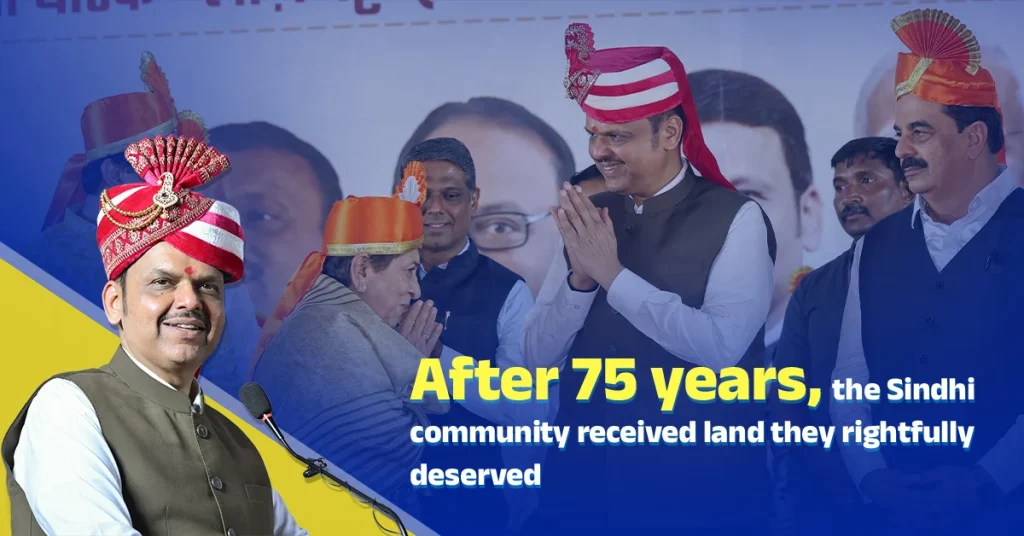
Once a prominent part of the undivided India, the Sindh province became a part of Pakistan through partition, making tens of thousands of Sindhis flee their homeland in fear of persecution to come to India, bereft of livelihood and money. But with their strong will and enterprising spirit, it didn’t take long for them to shine as a community in whichever part of the country they settled in. The Sindh community in Nagpur is known for their significant contribution to the economic and social development of Nagpur. Yet, they faced uncertainty as their refugee-era lands were held on restrictive leases, barring them from property ownership or sale. Through the last 7-8 decades, the Sindhis have transformed the areas like Jaipatka and Khamla into bustling trade and real-estate hubs, yet they couldn’t own any property or land in these areas. This engaged them in a legal battle through this long time to establish their land ownership rights. Recognising their contributions to the development of Nagpur and their long-standing struggle, the Fadnavis government resolved this issue by introducing a special amnesty scheme, granting full legal ownership rights to the residents. The Chief Minister at a recent function distributed the land ownership titles to members of the Sindhi community, meeting their long desire. Large numbers of people from the Sindhi community reside in the displaced persons’ colonies of Khamla, Mekosabagh, and Jaripatka in Nagpur. These people have now been granted ‘Class-1’ ownership rights under the Displaced Persons Rehabilitation Scheme. This decision by the Chief Minister has also paved a new path for the future development and progress of the Sindhi community.
Distribution of land plots to the Sindhi community
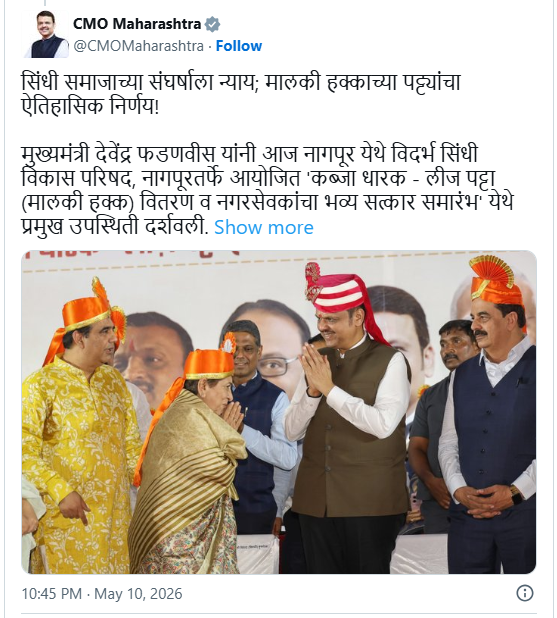
The contribution of the Sindhi community to the economy and the development of Nagpur and the rest of the country has been invaluable. Having arrived in India as refugees this community built their world from scratch. However, despite living in some settlement areas around Nagpur and contributing to their developments for decades, the Sindhi community in Nagpur had been struggling to secure rightful ownership of these refugee lands. Unlike in other states where these lands were given as “freehold” to the original occupants, in Maharashtra, these plots were classified under “restricted tenure” (Class II Occupants). Taking the Sindhi communities’ struggle into consideration, Chief Minister Devendra Fadnavis took a historic decision to convert the status of the lands where the Sindhi families had been living for many decades, from restricted lease to freehold ownership. On Sunday (May 10), during a special event organized by the Vidarbha Sindhi Vikas Parishad at the premises of Mahatma Gandhi High School in Jaripatka, Nagpur, the Chief Minister distributed the ownership titles.
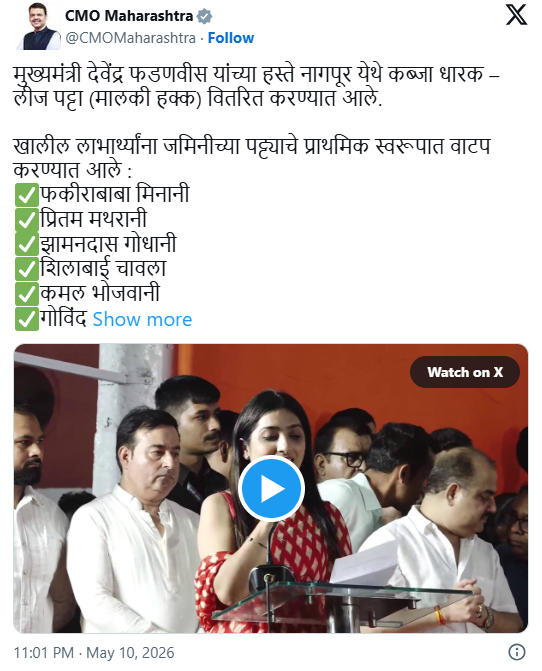
Over 350 Families Receive Legal Land Rights
Chief Minister Devendra Fadnavis has time and again championed the issue of land ownership rights ever since his very first term as an MLA. He spearheaded numerous movements aimed at securing ownership rights for residents of slums and informal settlements. Over time, the benefits of these efforts are now reaching every section of society. The Khamla, Mekosabagh, and Jaripatka areas of Nagpur have been officially designated as rehabilitation colonies. Nevertheless, the residents of these areas frequently faced various types of hurdles; specifically, these land parcels were often technically classified as encroached lands. To provide a permanent resolution to this issue, the State Government took a landmark decision to grant these lands ‘Class-1’ status, thereby conferring 100 percent ownership rights upon the residents. As a result of this decision, over 350 families have now secured legal title to their land. The Chief Minister personally distributed ownership documents to 12 of these beneficiaries in a symbolic ceremony.
The Nagpur Pattern of Lease Distribution
Ever since entering politics, Devendra Fadnavis has been the face of numerous movements for lease distribution of lands to secure living of the poor and homeless. His efforts have given rise to the ‘Nagpur Pattern of Lease Distribution.’ His initiatives secured forest leases for people from various social strata, granted ownership rights to slum dwellers, and to the refugees. This pattern pioneered by Devendra Fadnavis, has evolved into a highly successful urban governance and land reform model that converts long-term leaseholds and unauthorized slum encroachments into legal, freehold ownership documents. As a result, the marginalized families that had been living in encroached areas in and around Nagpur continuously for many decades became the legal owners of their plots, thereby ending uncertainty and restoring dignity to their lives. This model is currently being adopted across Maharashtra to provide housing security. The Sindhi community in Nagpur, which had lived for so long with the constant uncertainty and social stigma as illegal occupants, has finally found peace of mind.
Having spent their early days in refugee camps following the Partition, Sindhis in Nagpur transformed their hardships into endeavours for progress; today, the community is established as a leader in the fields of business, education, and social affairs. The citizenship drive launched under the leadership of Prime Minister Narendra Modi not only granted them citizenship but also bestowed upon this community the ownership rights to their homes, enabling them to live with dignity. Following the successful implementation of this initiative in Nagpur, the Chief Minister stated that, in the near future, the issue regarding the regularization of land holdings belonging to the Sindhi brethren in Ulhasnagar would also be resolved with special attention. Received after a wait of 75 years, these ownership rights are being hailed as a triumph—a testament to the patience of the Sindhi community and the unwavering efforts of Chief Minister Devendra Fadnavis.