
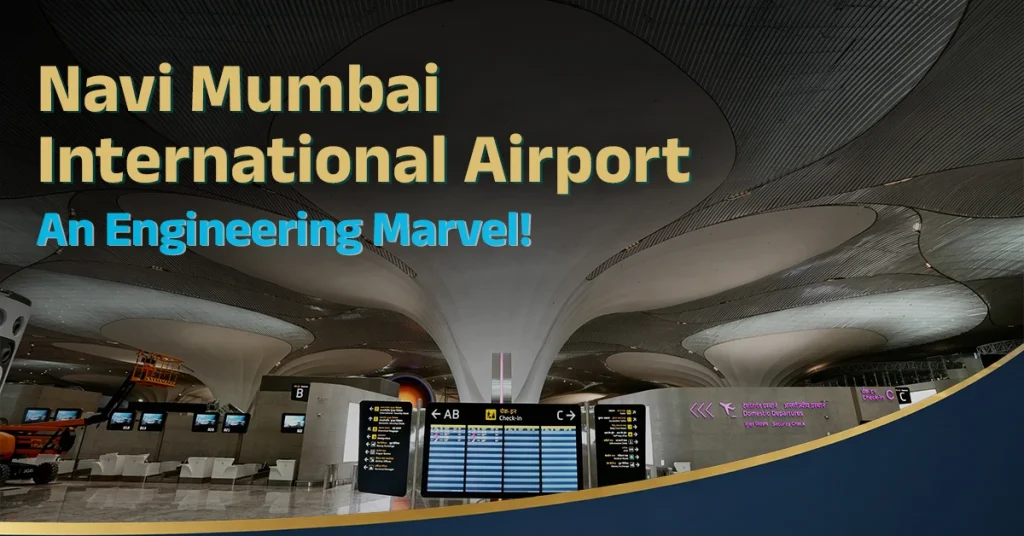
The Navi Mumbai International Airport stands as a milestone project in the history of infrastructure development in Maharashtra. Spanning nearly three decades and overcoming numerous administrative, environmental, and land acquisition hurdles, the project has finally come to fruition. Initially, this airport was conceived to provide the Mumbai Metropolitan Region with a second world-class, highly capable aviation facility that will alleviate the strain on the Chhatrapati Shivaji Maharaj International Airport. But the current capacity and future provision of this newly built airport suggest it might become the primary aviation hub for the MMR by the mid-2030s, rather than playing second fiddle. The resolute completion of this landmark project enduring so many obstacles highlights the compelling need for a second international airport for the MMR to cope with rapid industrialization and urbanization drives of the government for this region. However, this wouldn’t have been possible without the resolve of the CM Devendra Fadnavis, often referred to as the ‘Infra-man’ of Maharashtra. His relentless efforts to liaison with central government and environmental authorities in securing clearances to long pending issues and then resolving the land acquisition problems finally brought the breakthrough. He also personally monitored the actual construction of the airport. Under his leadership, the creation of Mumbai’s second international airport marks the beginning of a new era of progress for Maharashtra.
As the capacity of Chhatrapati Shivaji Maharaj International Airport in Mumbai was becoming strained, the need for an additional international airport was recognized to accommodate the growing number of passengers in a global city like Mumbai. Against this backdrop, a proposal to construct a new international airport in Navi Mumbai was first mooted in November 1997. In 2007, the then-Central Government granted in-principle approval for the project and designated CIDCO (City and Industrial Development Corporation) as the nodal agency. However, the project remained stalled for nearly a decade due to various administrative and technical hurdles.
Devendra Fadnavis’s persistent effort to see the Navi Mumbai Airport project through
When Devendra Fadnavis became the Chief Minister of Maharashtra in 2014, the fortunes of this project completely changed. Understanding that the Navi Mumbai airport project would be vital to realize his development vision for the region and the state, Devendra Fadnavis took personal interest in it and made the airport a priority agenda of his government. The project was stuck for decades with issues mainly related to clearances from the central ministries and land acquisition. After obtaining the necessary permits from the Union Environment Ministry and the Ministry of Defence through a persistent effort and by meeting stringent conditions, he set out to address the stiff resistance from the villagers regarding land acquisition. Instead of pushing the traditional method of compensation, he formulated a customized rehabilitation package for the local people. In this, the affected families were given developed land plots, three times bigger than their original homes, 18 months’ rent and considerable financial assistance to build new houses on the allotted plots. Under his supervision, the government provided land plots and compensation to more than 5,000 affected families in 10 villages.This ended years of opposition by the local people. The 90 meter high Ulve mountain was demolished by blasting. It was leveled, the marshland was filled in, and the flow of the Ulwe River was diverted to Moha Creek.
Construction of the airport on PPP basis with the help of CIDCO.
The Navi Mumbai International Airport (NMIA) is a public-private partnership (PPP) between CIDCO and a private developer, selected through a global tender. The PPP model was executed on a Design, Build, Finance, Operate, and Transfer (DBFOT) model. While the Mumbai International Airport Limited (MIAL) was selected for this project following a competitive tender process held in 2017 on a public-private partnership (PPP) basis, a special purpose vehicle called Navi Mumbai International Airport Private Limited (NMIAL) was established under the MIAL to establish the joint venture with the CIDCO to execute the project work. CIDCO had a 26% stake in this joint venture. Other agreements required for the development of this project were signed in the presence of the Ministry of Civil Aviation of the Central Government on 11 April 2018. Once all formalities were done, Prime Minister Narendra Modi laid the foundation stone of Navi Mumbai International Airport on 18 February 2018.
State-Of-The-Art Design and Extendable Capacity
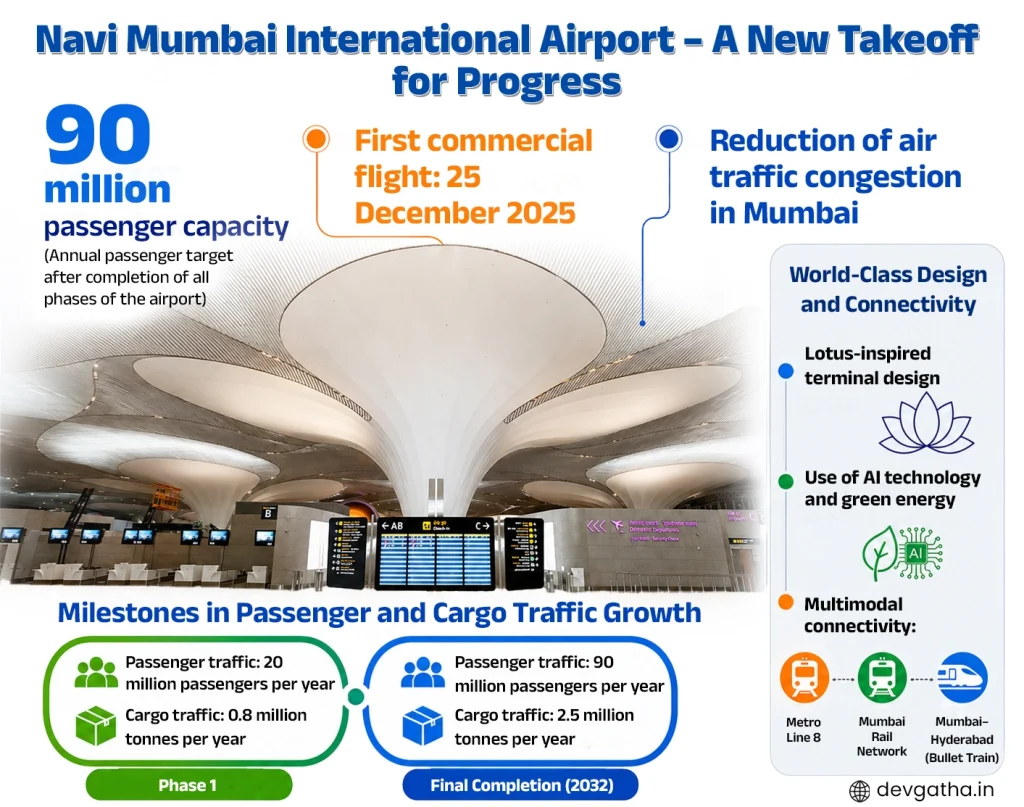
In March 2018, the world-renowned firm Zaha Hadid Architects was selected to design the airport terminal and air traffic control tower. The stunning design, which drew inspiration from India’s national flower i.e. lotus, is a perfect blend of modernity and naturality. The Adani Group took over management of the project in 2020, and construction of the actual terminal and runway commenced in 2021. Larsen & Toubro has played a pivotal role in the construction of the airport, which is scheduled to develop in phases, as and when the volume of passengers surges beyond the capacities. The initial phase saw the completion of the first 3,700-meter-long runway and the first terminal, which has a capacity of 20 million passengers per annum. A second parallel runway and a new terminal will be constructed in the next phase. Ultimately, the airport will have the capacity to handle approximately 90 million passengers and 2 million tonnes of cargo annually. Additionally, facilities such as AI based secure cargo transport, a dedicated center for pharmaceuticals, and a cold-chain cargo village are being developed.
Jannayak D.B. Patil Navi Mumbai Airport
Naming of the airport was done in 2022. The Mahagathbandhan government named the airport as the ‘Loknete D.B. Patil Navi Mumbai Airport‘ in recognition of the late leader’s contributions to the development of Navi Mumbai and his advocacy for the rights of those affected by the project. Successful landing and takeoff test runs were conducted in 2024 following the completion of the runway, while the final trial for commercial aircraft operations was concluded in 2025. Finally, on October 8, 2025, Prime Minister Narendra Modi inaugurated the first phase of the Navi Mumbai International Airport, a project constructed at a cost of ₹19,650 crore. The implementation of this long-awaited project along with the proposed 3rd Mumbai initiatives herald a significant growth and infrastructure development in Maharashtra.
Transport Connectivity and Facilities at the Airport
The extensive transport network around the Navi Mumbai international airport will make it accessible from Mumbai and other cities of the country in an easy and fast manner. While the ‘Atal Setu’ will help passengers reach South Mumbai within 20-30 minutes, high-speed metro corridors are under construction to connect the Navi Mumbai International Airport with Mumbai’s existing airport. Plans are also underway to introduce water taxi services, enabling passengers to reach the airport easily via road, rail, and water. The Navi Mumbai airport has become India’s first fully digital airport, featuring biometric entry systems and automated kiosks. Realized after years of dreaming and hard work, this airport has emerged as a new gateway for trade, tourism, and economic progress in Maharashtra.
Related articles: