
The pace of development in any country or state depends on its rural infrastructure, particularly its road network. Unless villages are properly connected to the growth centers, development cannot truly reach the grassroots level. Recognizing this connectivity challenge in rural areas, the historic Pradhan Mantri Gram Sadak Yojana (PMGSY) was launched on December 25, 2000, through the visionary leadership of the then Prime Minister Atal Bihari Vajpayee. Over the past two decades, this scheme has helped transform the landscape of rural areas across the country. When it comes to Maharashtra, the rural infrastructure and connectivity got a significant boost during the Fadnavis government between 2014 and 2019. During this time, the state launched its own ‘Mukhyamantri Gram Sadak Yojana’ alongside the central scheme, further expanding the scope of development. A large number of remote villages and hamlets in the state were connected with all weather roads.
Focus on Connecting Remote Villages and Settlements
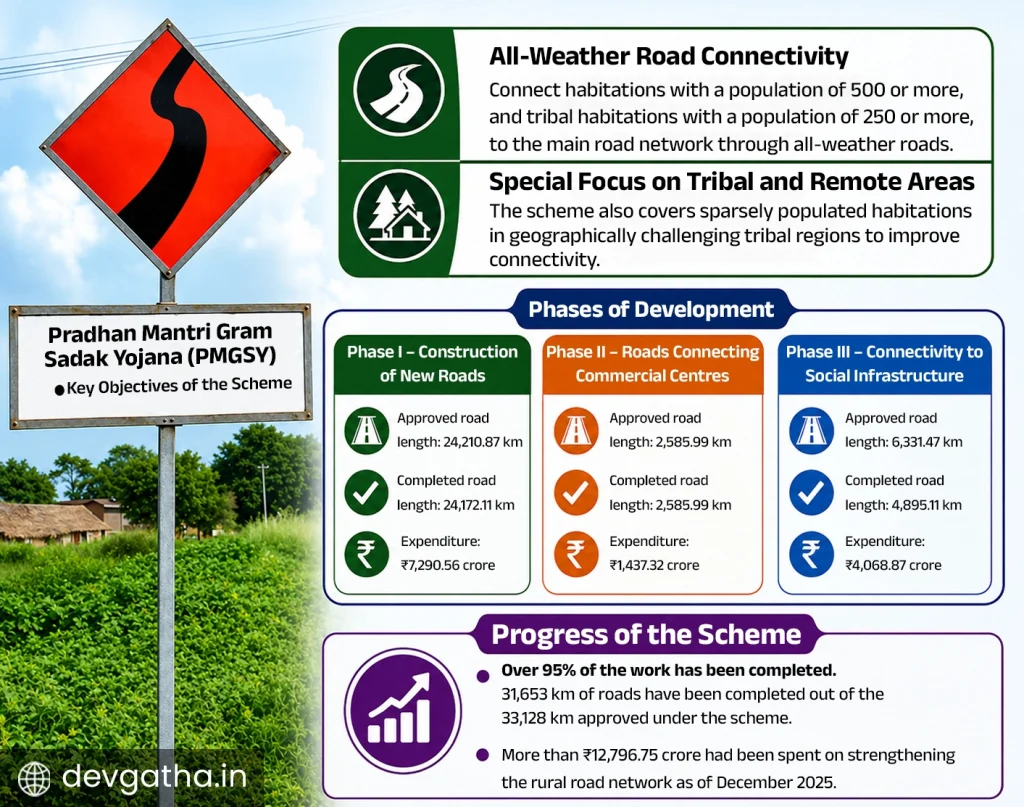
The primary objective of the Pradhan Mantri Gram Sadak Yojana (PMGSY) is to connect villages and settlements in rural areas, which remain unconnected to main roads, via all-weather roads. This establishes proper and mostly undisrupted connectivity for villagers with the urban centers for healthcare, education, and market access, even during the monsoon seasons. Under the central scheme, it has been made mandatory to connect settlements with a population exceeding 500 in plain areas, and those with a population exceeding 250 in hilly, tribal, and desert regions. Initially, the scheme was fully funded by the central government, but afterwards, the funding ratio between the central and state governments was revised to 60:40. Maharashtra has long been considered one of the country’s most advanced states and boasts a long history of rural road connectivity. During 1990, the state began self-funded rural road development programs through Zilla Parishads. However, when the central government launched the PMGSY scheme in 2000, it helped the state to implement this rural connectivity program even faster using central funds. The scheme has evolved over time; while the first phase prioritized construction of new roads, the second phase, launched in 2013, focused on improving the quality of existing roads. In the third phase, initiated in 2019, roads connecting secondary schools, primary health centers, and market committee centers are being upgraded.
Upgradation and Strengthening of Rural Roads
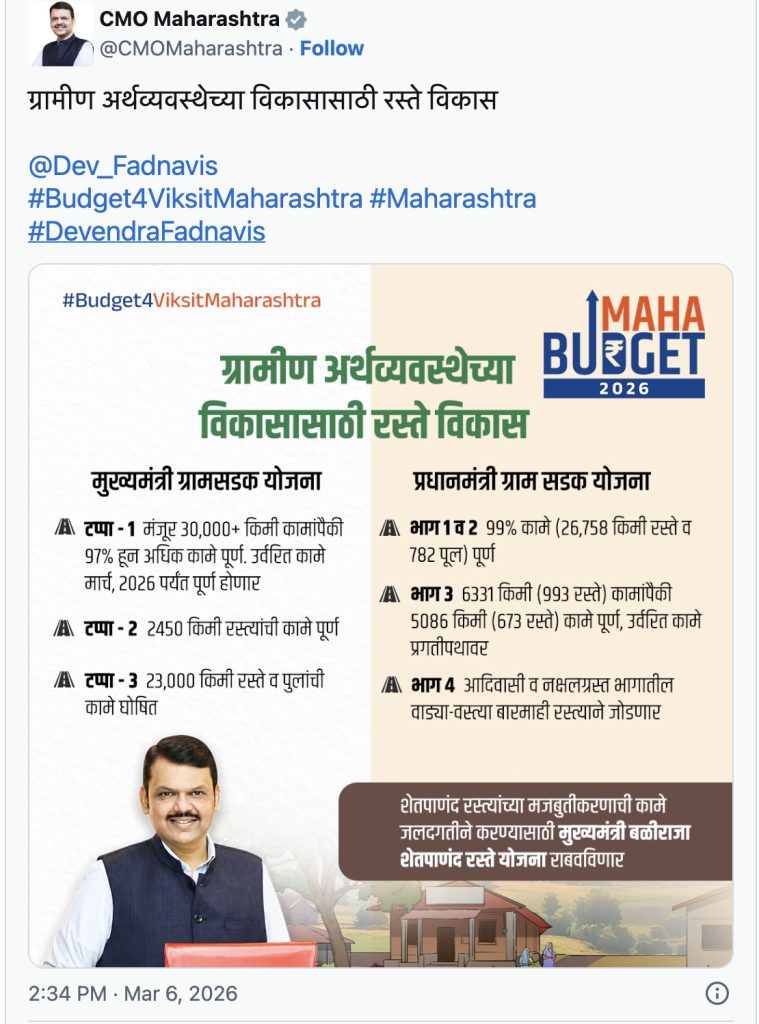
The period from 2014 to 2019 marked a milestone in the development of rural infrastructure in Maharashtra. During these five years, not only did the total length of roads increase, but unprecedented emphasis was also placed on quality and connectivity. The actual momentum of the second phase, commenced in 2013, was witnessed during the 2014–2019 period. The primary focus of this phase was on upgrading and strengthening existing rural roads rather than constructing new ones. Under this phase, Maharashtra approved projects covering 2,585 kilometers of roads and 108 bridges. The state successfully completed this phase by accelerating the work and incurring an expenditure of approximately ₹1,437.32 crore during the five-year tenure. Meanwhile, due to stipulated population-related criteria of the Central Government’s scheme, many small hamlets and villages remained outside of the scope of paved roads. To address this gap and extend road connectivity to the last mile, the Devendra Fadnavis government launched the ‘Mukhyamantri Gram Sadak Yojana’ (MMGSY) Phase-I on October 28, 2015. This scheme ensured connectivity of settlements that did not meet the central criteria of 500 population, with all-weather roads. Through this initiative, the rural road network was transformed, with administrative approval granted for road projects totaling 30,598 kilometers across the state.
Direct participation of people through ‘Meri Sadak’ app
During the 2014-19 period, rural road constructions in Maharashtra witnessed adoption of new technologies to improve speed, quality, and transparency in the project execution. The ‘Meri Sadak’ mobile app was launched to provide project updates readily. The online management monitoring and accounting system (OMMAS) was implemented to monitor the progress of the work and for greater transparencies at various stages using digital technology. During this period, experiments were conducted in Maharashtra to use waste plastics in bitumen for road construction and repairs without compromising quality. This became a highly successful experiment and was mandated by the government for the construction/repair of roads under PWD.
Boom in rural economy
Between 2014 and 2019, Maharashtra saw notable social and economic developments in many of its rural areas. A constant focus on rural infrastructure development including road connectivity is often attributed to this success along with Jalyukt Shivar Abhiyan and other major initiatives of the state government. The rural economy got a boost as farmers were able to transport their farm produce like crops, milk, fruits and vegetables to large markets in time and at a low cost. It became easier for students from remote areas, especially girls, to go to the taluka or district for higher education. In the health sector, 108 ambulance services have reached the doorsteps of villages, saving thousands of lives by providing timely medical treatment. Moreover, good roads have also contributed to tourism and industrial investment in many remote areas of the state and generated job creation for the local youth.
After the first and second phase of Pradhan Mantri Gram Sadak Yojana, now under the third phase, work is going on to widen and strengthen 6,550 km of roads connecting schools, hospitals and big markets in Maharashtra. Today, the face of rural areas of Maharashtra is changing due to the schemes of the Center and the State.
Related articles: