
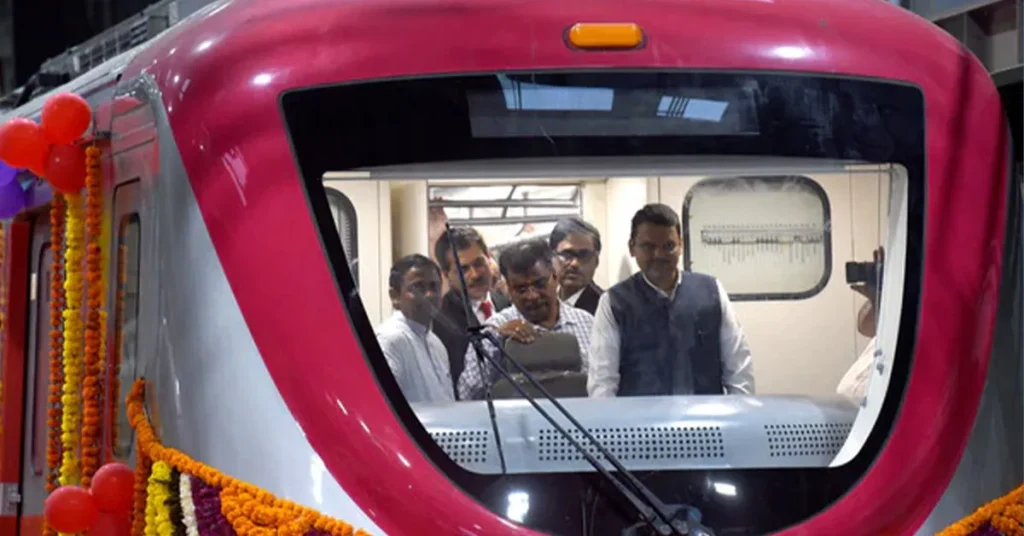
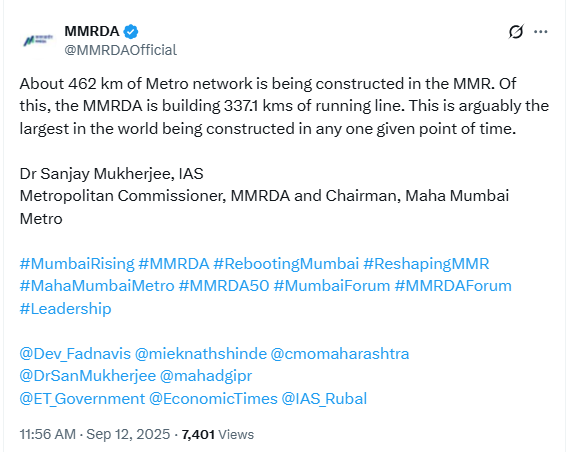
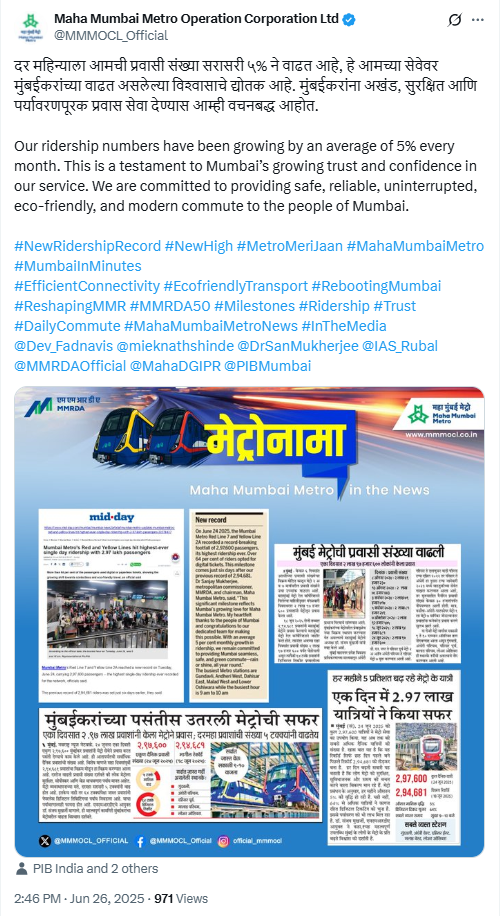
Metro Rail is an electric-powered, all-AC rapid transit system that helps reduce carbon emissions in busy cities with its environmentally friendly transporting of bulk passengers. Needless to mention how effective and popular the Mumbai Metro has become as a measure for the growing traffic congestion, pollution, and daily commuting stress in a teeming city like Mumbai. Metro rail is also known for fostering sustainable urban growth in previously inaccessible areas, which boosts a city’s overall economy and quality of life. In line with his vision for the inclusive growth of Mumbai and MMR, Chief Minister Devendra Fadnavis, the “Metro Man,” has set a target of 14 metro corridors spanning 337 km in the Mumbai Metropolitan Region. Of this, 80 km of corridors on four sections have already been commissioned, and the remaining sections of this vast metro network will be built over the next 10 years. With 3.3 lakh ridership already on peak days, a complete Mumbai Metro network will have a capacity of 100 lakh (10 million) passengers daily.
Four Mumbai Metro lines, including a fully underground one, spanning approximately 80 km have been launched in Mumbai. These include Metro 1 (Ghatkopar to Versova), Metro 2A (Dahisar to Andheri West), Metro 7 (Dahisar to Gundavali), and Metro 3 (Aarey to Cuffe Parade). Of them, Metro 3 (Aqua Line) is Mumbai’s first fully underground metro line. Mumbai’s first metro line, Metro 1, was inaugurated in June 2014. This 11.4 km line took a full 11 years to complete. In contrast, the next 10 years saw the Metro expansion of nearly 70 km on 3 new sections, with work in progress on several other lines. The combination of the Modi government at the centre and Fadnavis government at the state has made this difference. Construction on Metro 2A and Metro 7 began around 2016. Work on Metro 3 and Metro 6 (Vikhroli project) started in 2017, while work on Metro 4 (Wadala to Thane) and Metro 2B commenced in 2018 and 2019, respectively. Work on some lines began after 2020.
Work is underway on several lines
Apart from the 4 completed corridors, several Mumbai Metro lines are undergoing construction at different stages, which include Metro 2B from Andheri West to Mandale, Metro 4 from Wadala to Thane and 4A from Wadala – Thane – Kasarvadavali – Gaimukh, Metro 5 from Thane – Bhiwandi – Kalyan, Metro 6 (Vikhroli Project) from Swami Samarth Nagar to Vikhroli, Metro 7A from Gundavali to Mumbai Airport, and Metro 9 from Dahisar – Mira Road – Bhayandar. All these projects have taken longer than their scheduled deadlines. However, work is now progressing on them. The Dahisar to Kashigaon phase of Metro 9 and the Gaimukh to Vijay Garden phase of Metro 4A are expected to be completed by December 2025. While the first phase of Metro 5 is expected to commence in December 2026, the work on Metro Lines 6, 5, and 7A is expected to be completed by 2027. So, by the end of 2027, we can expect to see the Metro Lines 2B, 4, 4A, 5, 6, 7A, and 9 fully operational. Additionally, work has begun on Metro line 12 and soon, the Metro Lines 10, 14, and 14A too will have their work started.The underground section of Metro Line 11, from Anik Agar to Gateway of India, is also going to start soon. Following this, the Metro line 8, from Mumbai Airport to Navi Mumbai Airport, will be initiated by CIDCO. All these projects will be completed approximately within 8 to 10 years, to develop into a large metro network of 337 km in Mumbai.
With a focused approach by the Fadnavis government, the Mumbai Metro projects are advancing as scheduled. After completion, this 337 km Greater Mumbai Metro network will integrate with the suburban train system and BEST to offer an end-to-end fast, convenient, pollution-less, and pleasant commute across the MMR.
Related articles: