
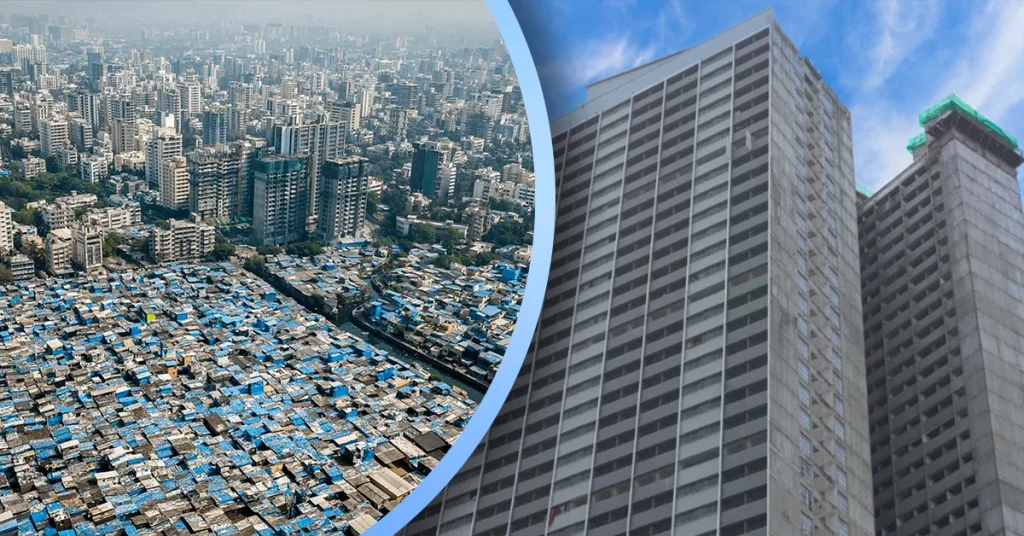
Slums are increasing in cities across Maharashtra. In Mumbai, settlements have sprung up everywhere, from hilly terrains to coastal zones, making this issue a big concern for the civic authority and administration. Besides, there are a multitude of humanitarian and health problems plaguing the dwellers due to landslides, land subsidence, and water inundation during the monsoon season every year. Recognising the suffering of the people, the Maharashtra government has elevated slum rehabilitation to a top priority task and enacted major policy frameworks for it. Under CM Devendra Fadnavis, who is known as a champion of the slum dwellers’ causes, the state government’s role in slum rehabilitation has evolved beyond merely providing housing, but also about development of the rehabilitation areas to ensure necessary civic amenities, health care, education, and transport for the eligible settlers.
With a constant focus on adoption of modern technology and transparent transactions in the slum rehabilitation policy implementation, one can access all relevant information on the government website. Information such as the status of slum projects, application procedures, approval stages, and beneficiary lists are regularly updated on the government website. While hilly terrains across the city are dotted with numerous little huts along the slopes and ridges, an abundance of them are found along the coast and near the city centers. During monsoons, these settlements face the rages of incessant rains, landslides, and floods. The enormous struggle and hardships of these slum dwellers bring forth the pressing need for their rehabilitation. Apart from that, these settlements impact the city’s aesthetics. With Mumbai striving for world class infrastructure and emerging as an international center, these slums not only create a negative perception about the city, but also pose challenges to the development drives of the government. Against this backdrop, Chief Minister Devendra Fadnavis has examined the strategic and technical aspects of slum rehabilitation and launched a comprehensive Mumbai Slum Rehabilitation Scheme.
In a meeting of the Slum Rehabilitation Authority (SRA) in June 2025, large-scale cluster and in-situ rehabilitation initiatives were undertaken, targeting major high-density and hillside-adjacent zones to rehouse eligible dwellers close to their original settlements. This measure aimed to alleviate disruptions to the social, educational, and professional lives of the slum dwellers, while enhancing their overall standard of living. Transparency in the rehabilitation process was bolstered by updating the relevant information regarding various slum rehabilitation projects on the Authority’s website, thereby enabling citizens to access data directly without resorting to the Right to Information (RTI) process.
Use of latest technology to prevent encroachment of land and proliferation of slums
Fadnavis government’s efforts for ‘slum-free Mumbai’ gets new dimensions with adoption of latest technology. The Maharashtra Remote Sensing Application Centre (MRSAC) in collaboration with the Bhaskaracharya National Institute for Space Applications and Geo-informatics (BISAG-N) in Ahmedabad, has developed an advanced monitoring system by integrating advanced satellite remote sensing, Geographic Information System (GIS) tools, and AI-driven change detection mechanisms to detect and issue alerts on illegal land encroachments and constructions. The government has decided to initially implement this system to monitor and curb encroachments on coastal mangrove forests, and later deploy it across the city. The system will be linked to the PM Gati Shakti portal. Overall, this technology will be deployed across Greater Mumbai. Meanwhile, the state government has ordered a targeted biometric-based survey for slum clusters and transit camps via the Slum Rehabilitation Authority (SRA) with a deadline of December 31, 2025, to determine rehabilitation eligibility. This initiative aims to formally record long-dormant or unregularised informal settlements and devise master plans for planned urban rehabilitation.
Cluster Scheme is to be Implemented through a PPP model
The Maharashtra government has resorted to the PPP model for slum development In Mumbai. A cluster development scheme is being implemented where several scattered or contiguous slum pockets, along with old dilapidated buildings, chawls, and vacant land, are integrated into creating complete townships equipped with wider roads, gardens, and modern municipal infrastructure. To expedite these schemes, an advisory cell comprising retired officials from the Mumbai Municipal Corporation will be established. Furthermore, the scheme will be enhanced by maximizing the utilization of FSI (Floor Area Index) in rehabilitation projects. To ensure maximum transparency in the rehabilitation process, all information updates and services to access and retrieve them have been made available online through the Slum Rehabilitation Authority’s website. Online services such as inheritance certificates, land acquisition, premium extensions, correspondence, and complaint management systems have been introduced. This will facilitate easier access to services for eligible slum dwellers, developers, and project-affected people. Additionally, the ‘Slum Rehabilitation Authority, Brihanmumbai’ mobile app has been launched, enabling citizens to access information regarding various schemes, application statuses, and government circulars with just a single click.
Consistent Engagement
Devendra Fadnavis has always championed the rights and entitlements of slum dwellers. In 2010, he fought for the ownership rights for laborers living in the slums of Parsodi and Sant Tukdoji Nagar in Nagpur, pursuing the matter both through grassroots agitation and the Legislative Assembly’s Petition Committee. The committee conducted an on-site inspection and directed the administration to grant ownership rights to the residents in accordance with the government resolution dated July 10, 2002. Many years later, his commitment to slum dwellers’ causes was found to be as strong and has helped build a state-level policy on slum rehabilitation.
Slum rehabilitation schemes have also been implemented in other urban areas such as Pune, and Thane. In Pune, slum residents living along riverbanks under the risk of floods have been rehabilitated in safer areas; the government has also provided an option for them to rent homes. Until now, a total of 218,931 houses have been constructed across the state under 228 schemes, executed either through PPP or by the various government agencies, such as the Mumbai Municipal Corporation, MHADA, MMRDA, MSRDC, CIDCO, MIDC, and the Maharashtra Housing Board. The Slum Rehabilitation Scheme initiated by Chief Minister Devendra Fadnavis is not only about providing the slum residents legitimate housing but also about ensuring an improved quality of life for them.
Related articles: