
During the recently concluded Monsoon Session 2026 of the Maharashtra Legislative Assembly, the government led by Chief Minister Devendra Fadnavis approved major decisions, introduced new bills, and amendment of laws designed to accelerate sustainable development and public welfare across various sectors of the state. Among the key areas addressed were farm loan waiver package & supplementary demand, women farmers’ empowerment, and bolstering urban infrastructure and rural governance.

Distinct Legal Identity for Women Farmers
The most historic and revolutionary decision of the Monsoon Session was the approval of the ‘Women Farmers’ Empowerment Bill, 2026.‘ Under this Act, women actively engaged in farming will be granted the formal legal status of women farmers and will be issued ‘Woman Farmer Certificates.’ Even if a woman is engaged in farming and related activities but does not own any agricultural land, this certificate will allow her to avail herself of the benefits of government schemes, agricultural subsidies, bank loans, and facilities meant for farmers. This is a landmark decision, which will not only remove gender inequality in farming but will also act towards empowering women farmers to boost the rural economies.
Relief for Eligible Farmers under the 2019 Loan Waiver Scheme
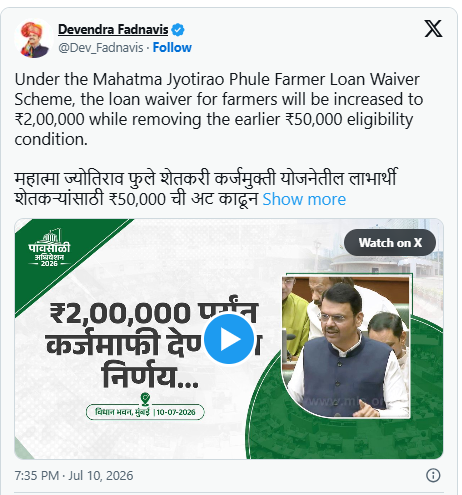
Conditions associated with the ‘Punyashlok Ahilyadevi Holkar Shetkari Karzmukti Yojana’ were causing injustice to 36 lakh farmers who were eligible under the 2019 ‘Mahatma Phule Shetkari Karzmukti Yojana’. Addressing this grievance, Chief Minister Devendra Fadnavis announced modifications to these conditions during the monsoon session. Consequently, eligible farmers under the 2019 loan waiver scheme will now be considered for a loan waiver of up to ₹2 lakh. Furthermore, for farmers who repaid loans over the past two years, the state government relaxed the repayment terms instead of enforcing deadlines for the 2026-27 financial year
Immediate Assistance for Losses Due to Natural Calamities
In addition, a policy was formulated to provide relief to farmers in the state, focusing on farmer welfare and loan waivers. A financial assistance policy was established to alleviate the debt burden on farmers and strengthen their financial standing. Special emphasis was placed on enhancing agricultural infrastructure, accelerating irrigation projects, and promptly disbursing relief funds for losses caused by natural calamities.
Curbing Objectionable Advertisements
An expert committee will be constituted in Maharashtra to further tighten the penal provisions of existing laws, aiming to curb advertisements, billboards, websites, and social media content that promote sexual offenses. This move will assist in restricting advertisements that encourage such crimes.
Improving the Functioning of Local Self-Government Bodies
Necessary amendments have been made to the Zilla Parishad and Panchayat Samiti Acts to make the administrative system in rural areas more dynamic and robust. These changes will enable local bodies to make development-related decisions more swiftly at their own level and accelerate the pace of development activities in rural areas.
Revenue Department’s decisions which brought relief to the common man
During this monsoon session, the Revenue Department, along with bringing a bill to change the Maharashtra Stamp Act, took important decisions like separate exemption for tribals, protection of all huts built before 2011 in the state, reduction in stamp duty for 99-year lease societies in Mumbai, zero royalty on sand coming from other states and drone survey to stop illegal mining in the state.
Review of Maharashtra Assembly Monsoon Session 2026
The legislative session held in Mumbai lasted for a total of 14 days. An average of 9 hours of work was done in the Legislative Assembly and an average of 7 hours of work was done in the Legislative Council. During the question-answer session in both the houses, 58 star questions were answered. Written answers were given to 500 unstarred questions. 62 special suggestions were discussed in the Legislative Assembly and 48 in the Legislative Council. 21 government bills were passed in the Legislative Assembly and 9 in the Legislative Council.
Apart from this, decisions were taken to smoothly and effectively implement education, health and other social welfare schemes in the state. Along with this, changes were made in the Maharashtra State Scheduled Castes Commission (Amendment) Ordinance, 2026 and the Maharashtra State Scheduled Tribes Commission (Amendment) Ordinance, 2026. Overall, the just concluded Maharashtra monsoon session will be distinguished by the crucial decisions taken by the Devendra Fadnavis government to steer the state towards reforms and progress in multiple areas.
Related articles: