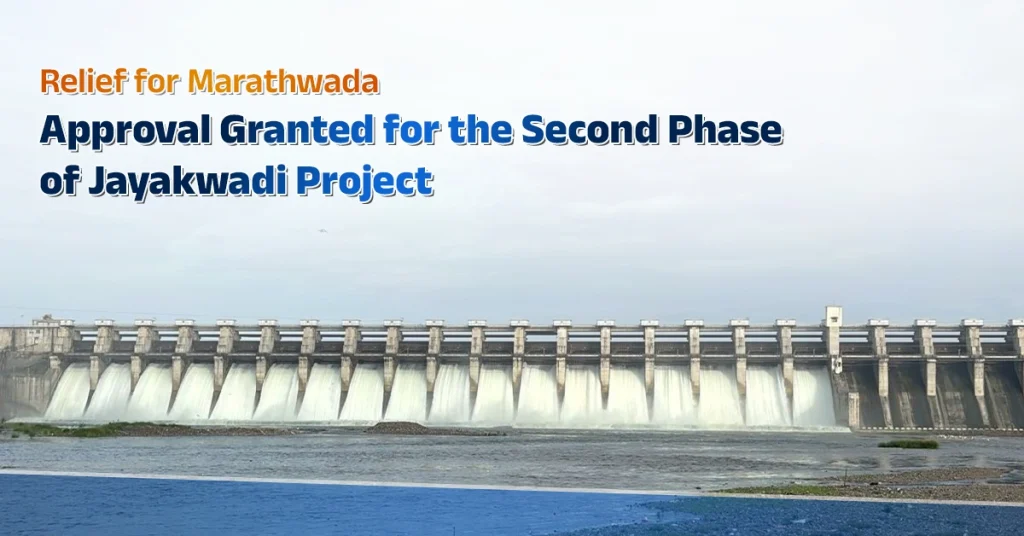
Given the severe water crisis and recurring drought situation plaguing Marathawada for more than a decade, the completion of the Jayakwadi Dam Project Phase 2 on the Godavari River near Paithan, is a vital decision for the lives and economy of the region. Planned as an integral extension of phase 1 (the original dam, built five decades ago), the Jayakwadi Dam Phase 2 will revitalize the agricultural, industrial, and urban development of Marathwada. The Water Man Devendra Fadnavis government has approved an expenditure of ₹6,477.88 crore for this project. This initiative will benefit an area of 131,652 hectares across five districts: Chhatrapati Sambhajinagar, Ahilyanagar, Beed, Parbhani, and Nanded.
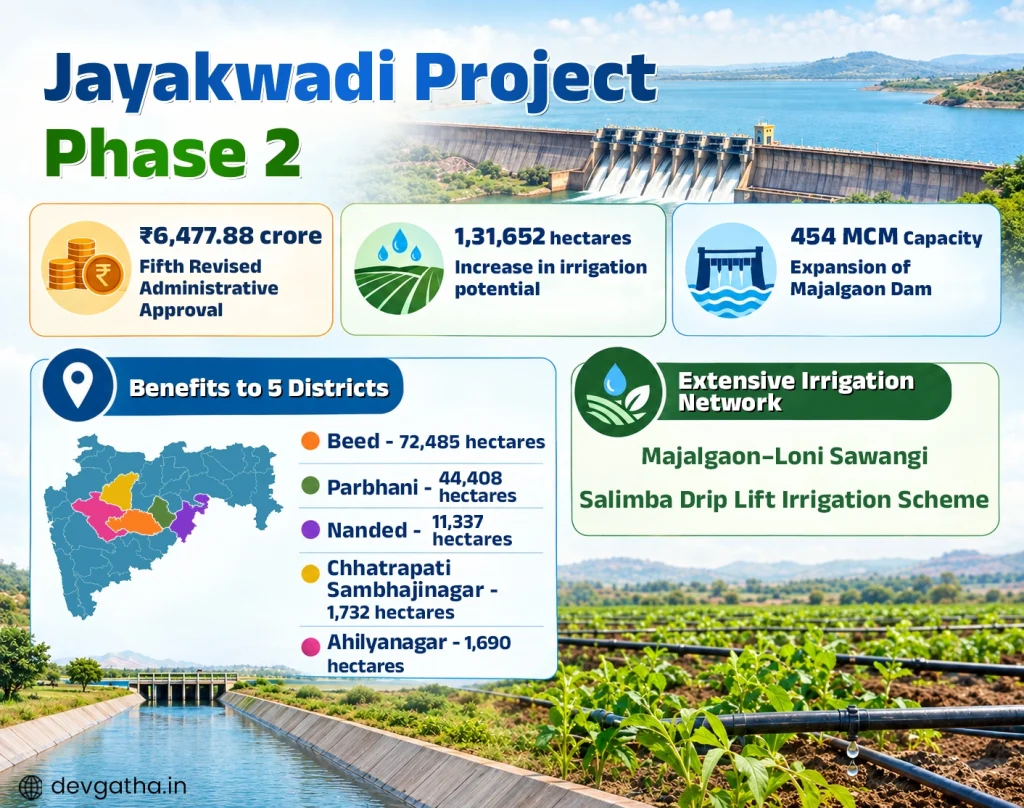
Although foundational components of the Phase 2 of the Jayakwadi Dam project were constructed decades ago under previous governments, they were left disjointed, leaving the majority of the distribution parts unbuilt. Finally, the Devendra Fadnavis led government has decided to complete the project, with the state cabinet approving the fifth revised project cost of Rs ₹6,477.88 crore in August 2026. Under the scope of this project, the Majalgaon Dam project, featuring a storage capacity of 454 D.L.H.M., will be constructed. Work will also be undertaken on the Majalgaon (Loni Sawangi) Lift Scheme, the Salimba Drip Lift Scheme, the Shiras Marg Low-Level Dam, the Roshanpuri High-Level Dam, and the 148 km Majalgaon Right Canal along with its associated reservoirs.
History of Jayakwadi Project
The history of the Jayakwadi Dam Project, one of the largest in Asia, spans nearly six decades. Initially, there was a plan to build a dam on the Godavari river in the ‘Jaikuchiwadi’ area of Beed district. But after technical study and survey, it was decided to change the location to Paithan. The original project report of the Jayakwadi Project was prepared in 1964. Thereafter, the State Government gave administrative approval to the first phase of the project on January 13, 1965. The Planning Commission of the Central Government also finalized the outline of the phase of the project on February 3, 1965. It was decided to construct Paithan Dam and Paithan Left Canal in the first phase, and the remaining work in the second phase. The foundation stone laying for the first phase of Jayakwadi project was done on October 18, 1965 by the then Prime Minister Lal Bahadur Shastri. Building a dam on the large basin of Godavari and providing irrigation facilities to the drought-hit areas of Marathwada was a big challenge of that time. Along with the dam, the construction of the 208 km long Paithan Left Canal, its branch canal, distributor, sub-distributor and small distributor were also completed. Finally, on February 24, 1976, the first phase of the Jayakwadi Project was officially inaugurated by the then Prime Minister Indira Gandhi. Over the past 60 years, the Jayakwadi Project has become the economic backbone of Central Maharashtra.
However, the concept of Jayakwadi was not limited to Paithan Dam only. The second phase of the project was planned to provide irrigation benefits to a large area of Marathwada. The then state government gave separate administrative approval to the second phase of the Jayakwadi project on May 25, 1974. After that, the approval of the Central Planning Commission was received on June 2, 1976. The main works included in this phase were the Jayakwadi Right Canal (from the Paithan dam), the Majalgaon Dam on the Sindafana River in the Godavari Valley and the Majalgaon Right Canal. Some works of these projects were completed in phases.
Irrigation benefits for 131,652 hectares of land across 5 districts
The significance of the Jayakwadi Phase-2 project lies in its substantial irrigation capacity. A total of 41,682 hectares of land will be brought under irrigation via the Paithan Right Canal, comprising 1,732 hectares in Chhatrapati Sambhajinagar district, 1,690 hectares in Ahilyanagar, and 38,260 hectares in Beed. Similarly, the Majalgaon Right Canal will cover 84,850 hectares, including 29,105 hectares in Beed, 44,408 hectares in Parbhani, and 11,337 hectares in Nanded. Additionally, 5,120 hectares of land in Beed district will be irrigated through the Salimba Drip Irrigation Scheme. Thus, the Jayakwadi Phase-2 project will benefit a total area of approximately 131,652 hectares across the five districts of Chhatrapati Sambhajinagar, Ahilyanagar, Beed, Parbhani, and Nanded.
Construction of Majalgaon Dam
The Majalgaon Dam Project in Maharashtra is a crucial component of Phase-2, essential for realizing this extensive irrigation potential. Under the revised plan, the Majalgaon Dam will be constructed with a storage capacity of 454 million cubic meters. Works associated with this dam include the Majalgaon-Loni Sawangi Lift Scheme, Salimba Drip Lift Scheme, Shiras Marg Low-Level Dam, Roshanpuri High-Level Dam, and the 148-kilometer-long Majalgaon Right Canal. Plans are in place to construct six tanks along the canal’s route: Galhati, Dhond, Ukadgaon, Murambi, Pendu, and Subhashnagar. Furthermore, raising the height of the Majalgaon-Masoli project has also been included in this phase.
Marathawad being a semi-arid and drought-prone region, the role of Jayakwadi project is immense for the lives and livelihoods of the people. Completion of Phase 2 will help in achieving its projected target, further adding vast areas under irrigation and providing sufficient water for industries. As a result, both agricultural and industrial productivity will rise, thereby recharging the rural economy. Increased water availability will also see the growth of agro-processing, food processing, dairy farming, and other complementary businesses across Marathawada to further the prosperity of the region.
Related articles: