
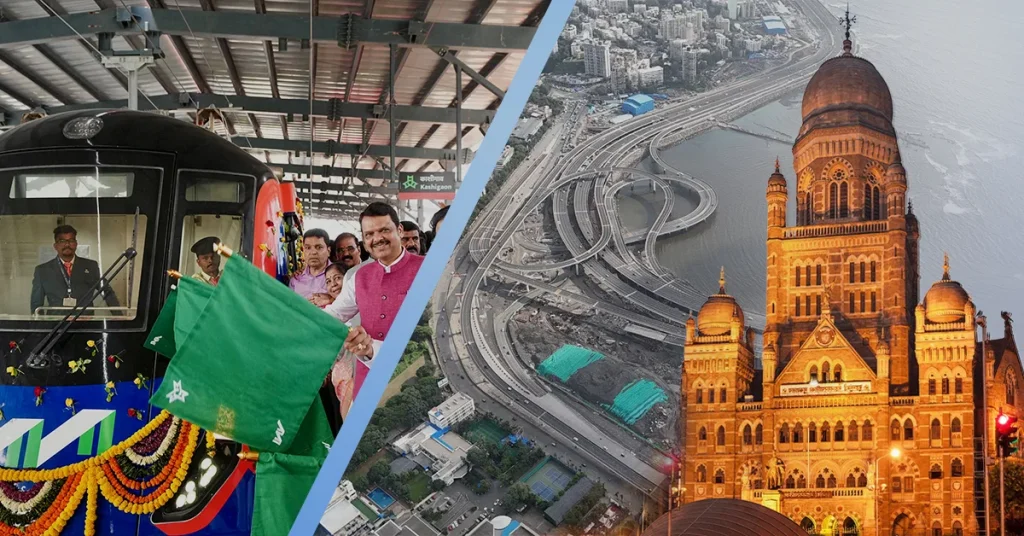
Mumbai, being a major center for finance, commerce, culture, and sport in Asia, is a bustling global city, and therefore required to be comparable to other leading cities in the world. In the last ten years, since the first Devendra Fadnavis government took charge, Mumbai has achieved a considerable facelift with crucial development projects improving the standard of the city’s infrastructure, transportation, and other aspects. Among the most significant of these projects are Mumbai Metro, Coastal road, and Atal Setu. These vital infrastructures, which were either delayed or stalled by the earlier governments, have been revived and revitalized by the Fadnavis government, boosting the city’s communication and aesthetics. While they have led to ramping up development in the MMR and brought the western suburbs, South Mumbai, and Navi Mumbai significantly closer in terms of travel time, the prospect of a third Mumbai has cropped up. The proposed third Mumbai will be another growth center like Navi Mumbai contouring Panvel, Uran, and Pen talukas in Raigad district
Aggressive push for Mumbai infrastructure development
Cities that have invested in infrastructure have prospered. Historically Mumbai has had some advantages, such as being the financial headquarters of the country, a strong MSME base, two large ports, a film industry, etc., which have helped the city flourish so far. However, the city must explore new growth opportunities to maintain its leadership position, which needs strategic infrastructure upgrades. CM Devendra Fadnavis, known for his vision and dynamism, aggressively pushed for planned infrastructural developments in the state, addressing intra-city and intercity transport, housing crises, urban planning, and ensuing climate impacts, besides renewing focus on sea ports to grab sustainable growth opportunities. Mumbai and the MMR in particular have experienced staggering infra drives, some of which are continuing or upcoming. Metro expansions, Navi Mumbai International Airport, MTHL, Coastal Road, double-decker flyovers, Dharavi redevelopment, and the road bridge over the Vasai creek are some of the major projects that will not only rewrite the city’s communication landscape with a boost in aesthetics and functionality but will also bring urbanization and industrialization beyond MMR and create new growth areas.
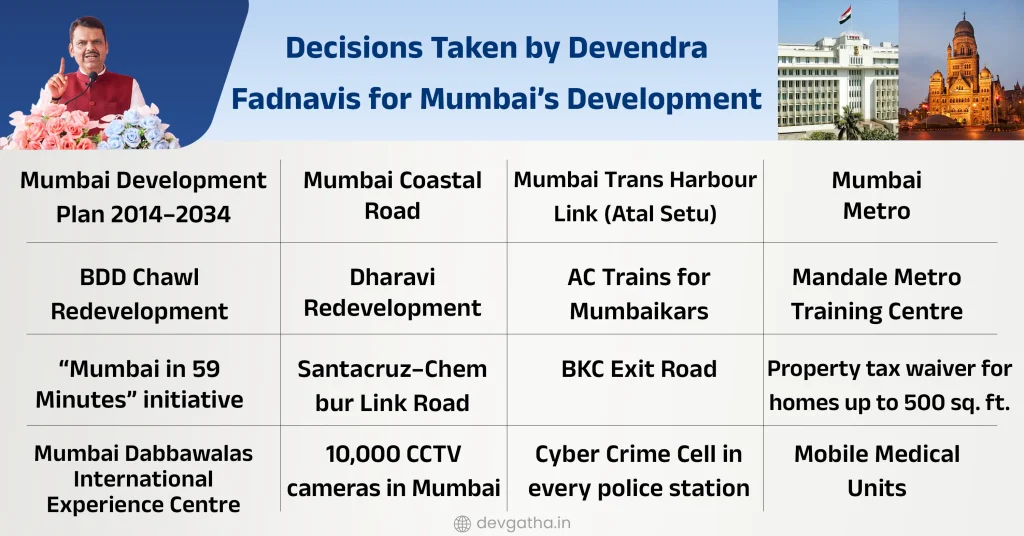
The Mumbai Development Plan 2014-34 was approved by the Devendra Fadnavis government in 2018, taking into account the need for the city’s expansion. The plan included improving amenities for the Mumbaikars, enhancing the transportation system, preserving the city’s natural habitat, and ensuring planned land use.
Mumbai in 59 Minutes
The current transport infrastructure projects in Mumbai reflect Prime Minister Narendra Modi’s ‘Mumbai in 59 Minutes’ concept. Metro, road, and public transport projects are being implemented to ensure that any part of Mumbai can be reached within 59 minutes. Three new metro lines are expected to be operational soon. The target is to commission at least 50 km of metro lines every year. The Metro Training Institute in Mandale will play a crucial role in the expansion of Metro by training skilled manpower not only for Mumbai and Maharashtra but also for metro projects across the country.
Under the Devendra Fadnavis government, Mumbai is witnessing a series of development initiatives through projects in infrastructure and other areas. Recently, the state cabinet has approved a ₹50,000 crore plan to execute some vital infrastructure projects in Mumbai and its surrounding areas. These primarily include some new Mumbai Metro corridors, expansion of Mumbai local railway network, a new railway corridor, and a new complex for the Mumbai High Court, which will be followed by the Thane Ring Metro and the Navi Mumbai International Airport Elevated Road project connecting Thane and the Navi Mumbai airport to further enhance the transportation system in and around Mumbai.
All Mumbaikars will travel in AC trains!
Chief Minister Devendra Fadnavis has approved the purchase of 268 new AC trains for Mumbai under Phase 3 and 3A of the Mumbai Urban Transport Project (MUTP). These trains will have closed doors like the Metro. Also, passengers will not have to pay extra for these new AC trains. The old trains will be phased out and replaced with the new AC trains.
Mumbai is safe under CCTV surveillance
After the 2008 terrorist attack in Mumbai, the then government announced the installation of CCTVs in public places in Mumbai. However, this announcement remained only on paper until 2014. In 2014, with Devendra Fadnavis’s government at the power, this CCTV project was approved within the first 100 days of the new government for an expenditure of Rs 800 crore. Subsequently, the government decided to install more CCTVs in Mumbai in phases. In 2018, the number of CCTVs was increased by approving an expenditure of Rs 980 crore. Along with this, the Dial 100 project was launched to step up the safety of Mumbaikars. In 2019, it was decided to further expand the CCTV network in the city with an expenditure of Rs 323.23 crore for 5625 new cameras in addition to the existing 5,000 CCTV cameras , making the total number of cameras in the city to more than 10,000.
Cyber Crime Investigation Cell in Every Police Station
Considering the rapid increase in the internet and social media users and the proportionate rise in cyber crime, a decision was made in 2017 to establish a separate Cyber Crime Investigation and Prevention Cell in every police station in the city. The Mumbai Police Force has 93 police stations across 5 regional divisions in Mumbai, and a separate Cyber Police Station at BKC. These special cyber cells in the individual police stations are linked to the cyber Police Station. The Devendra Fadnavis government has now made significant improvements to this system and provided the police with state-of-the-art equipment and laboratories.
Mobile Medical Unit Service
To ensure the health and well-being of poor and destitute citizens, the Devendra Fadnavis government launched a Mobile Medical Unit service in Mumbai in 2018. The mobile medical units are staffed with trained doctors, nurses, lab technicians, and pharmacists. Preventive and curative health services were initiated in every ward and slum for people who lacked access to primary healthcare services. National programs such as family planning, prenatal and postnatal maternal and child care, vaccination, disease control, and counseling were implemented through these mobile medical units.
Improvements in Infrastructure and Transport Models
Mumbai Metro expansion
Before Devendra Fadnavis became Chief Minister in 2014, Mumbai had only one metro line spanning 11 km. From that one line the Mumbai Metro has expanded to a large network of corridors spread across the MMR, with some are operational and others are in the making. As of today, seven Mumbai Metro lines i.e., 2A, 2B, 3, 4, 5, 6, and 7 are active. This has immensely helped commuting with improved connectivity to important parts of the city and increased commerce in those areas. The metro lines have also reduced road traffic and helped in reducing pollution.
Coastal Road
After many decades in the cold storage, the Coastal Road project was resuscitated by Devendra Fadnavis with his all out efforts, and now it is nearing completion. The necessary approvals from the central environment ministry along with other crucial permissions and fund raising for such a big project were done through his relentless endeavours. The North Channel Bridge connecting the Coastal Road and the Worli-Bandra Sea Link was inaugurated by Chief Minister Devendra Fadnavis in January 2025. The beautiful Coastal Road has not only enhanced Mumbai’s prestige but has also improved connectivity between South Mumbai and the western suburbs.
Mumbai Trans Harbour Link
The Mumbai Trans Harbour Link (MTHL), India’s longest sea bridge, was inaugurated by Prime Minister Narendra Modi on January 12, 2024. The bridge is 21.8 km long, with 16.5 km of it over the sea. It has become a crucial and much shorter alternative route connecting Mumbai with Navi Mumbai. After becoming Chief Minister in 2014, Devendra Fadnavis visited Japan in 2015 and secured funding for this project. Subsequently, after obtaining the necessary permits from the central government and the environment department, construction on the MTHL began in 2018.
Santacruz-Chembur Link Road
The Santacruz-Chembur Link Road, built to divert traffic from Mumbai’s east-west transport route, was inaugurated by Chief Minister Devendra Fadnavis on August 14, 2025. This link road features South Asia’s first cable-stayed bridge. This project has helped reduce traffic congestion in some of Mumbai’s busiest areas. The link road will ease traffic on the Vakola, BKC, and LBS routes, saving drivers 15 to 20 minutes of travel time.
Accelerating Redevelopment Projects
Devendra Fadnavis expedited the redevelopment of BDD Chawls, Patra Chawl, Dharavi slum, and other colonies in Mumbai. The rehabilitation of thousands of homes in the Worli BDD Chawl is underway. In addition, rehabilitation projects are progressing rapidly in Naigaon, Joshi Marg, Goregaon, and other areas. Chief Minister Devendra Fadnavis directed MHADA to carry out these rehabilitation projects to create affordable housing for low income citizens.
The Dharavi redevelopment is a crucial part of Mumbai’s modernization drive. Dharavi, Asia’s largest slum, is home to thousands of poor families and small industries The initiative to redevelop this area and transform it into a modern and organized locality began during Devendra Fadnavis’s tenure. In the coming years, Dharavi will transform into a well-planned locality to benefit approximately one million people with better housing and various amenities.
During Devendra Fadnavis’s term as Chief Minister, Mumbai urban development has got a continued focus with several projects of the Mumbai Metropolitan Region Development Authority meeting deadline. Numerous efforts were made to reduce traffic congestion in Mumbai and make commuting easier for Mumbaikars. Of the six identified exits to ease traffic congestion in BKC, five have been completed. The remaining one is also on track for completion by December 2025. Overall, under Devendra Fadnavis’s leadership, crucial projects in Mumbai’s infrastructure, transportation, rehabilitation, and urban planning have been successfully implemented, and through these efforts, Mumbai is on its way to becoming a more efficient, well-organized, and world-class city.