
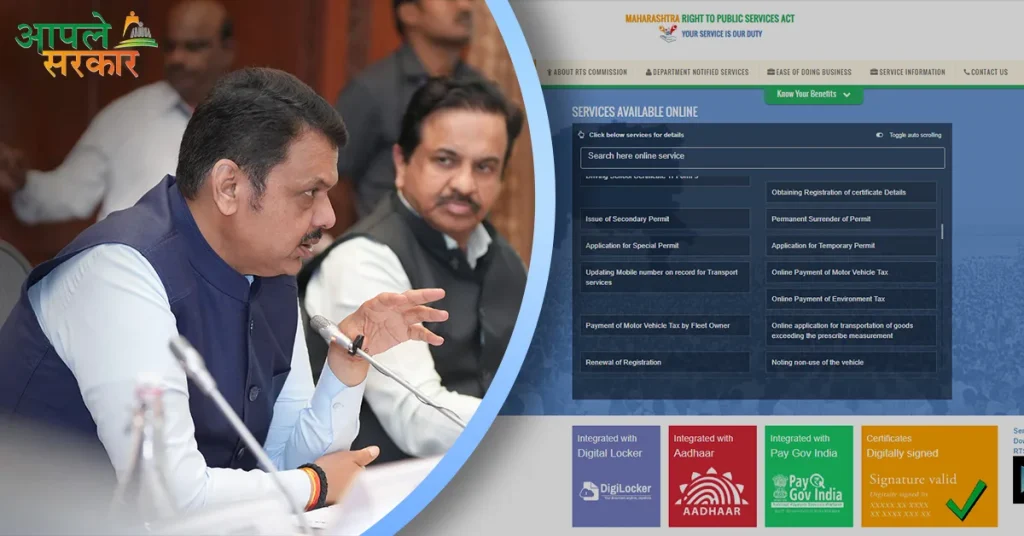
The Devendra Fadnavis government’s policy focus on prioritizing technology adoption has been a powerful driver for transformation of the governance system in Maharashtra. No one can deny that it has made a marked improvement in the access and delivery of the government services and schemes for the citizens. While a bulk of the governance services were included in the Aaple Sarkar 1.0 – the online portal launched by his government for remote and hassle-free access to government services – a decision was taken in September 2025 to make the rest of the services online as well. During a meeting on Governance Process Re-engineering, presided over by the Chief Minister and held in Mumbai on September 11, it was decided to launch the ‘Aaple Sarkar 2.0’ portal, which will be a single, unified platform where citizens can visit to avail themselves of the whole range of government services. Together with the necessary amendments to the ‘Maharashtra Right to Public Services Act, 2015’ and introduction of new citizen-centric schemes, the Aaple Sarkar 2.0 platform is poised to further the transformative changes in the state’s governance landscape.
The Aaple Sarkar portal is the primary digital platform for implementing the Maharashtra Right to Public Services Act, 2015. While the Act provides the legal framework for citizen rights, the portal acts as the practical interface where those rights are exercised. These two momentous initiatives of the Devendra Fadnavis government 1.0 are now completing a decade of existence. They aren’t simply a piece of legislation and a digital portal but are significant moves towards fulfilling the citizens’ demand for improved governance. It’s interesting to learn that the seeds of this transformative process that established the peoples’ right to public services were sown by Devendra Fadnavis during his tenure as a Member of the Legislative Assembly (MLA), and also implemented by him only once he became the Chief Minister.
In 2011, while serving as the Leader of the Opposition, Devendra Fadnavis raised a private member bill, titled the ‘Maharashtra State Service Guarantee Act, 2011,’ during the Winter Session held in Nagpur. The objective of this bill was to establish the fundamental rights of the citizens to receive the required government services in a timely, efficient, and transparent manner and get their complaints or grievances redressed. While this bill would be the bedrock for good governance and a major reform for its time, the Legislative Assembly did not have the opportunity to deliberate upon that private member bill during that session. Next year in 2012, Devendra Fadnavis made a renewed attempt, but again to no avail. Finally, in 2013, his attempt bore fruits. On this occasion, the matter was taken up for discussion within the House. During these deliberations, he eloquently articulated the significance and merits of the proposed legislation. Members from both the ruling dispensation and the opposition benches engaged in a constructive dialogue regarding this issue. As a result, Fauzia Khan—who was serving as a Minister of State at the time—gave an assurance that the matter would be given serious and earnest consideration.
However, in 2014, Devendra Fadnavis himself became the Chief Minister through a landslide victory of his party and alliance. Under his leadership, the ‘Maharashtra Right to Public Services Act, 2015’ came into being. He took the oath of office as Chief Minister on October 31, 2014, and the very next day, through a cabinet meeting, a decision was taken to convert this bill into a legislation. Consequently, the Act came into force across Maharashtra on April 28, 2015. To facilitate the more effective implementation, this law was incorporated in the ‘Aaple Sarkar’ portal, launched on October 2, 2015. This portal emerged as a platform for bridging the gap between government services and the citizens. Through this portal, citizens gained access to a wide array of services online. The portal revolutionized digital governance by ensuring transparency, timeliness in service provision, and prompt delivery. Today, ten years later, this vital platform for digital governance is being upgraded to a new version ‘Aaple Sarkar 2.0’. Chief Minister Devendra Fadnavis has reassured that, through this new version, there will be a single, unified platform, which will enable citizens to access all government services, schemes, and their associated benefits.
In the ‘Aaple Sarkar 2.0’ portal, attention has been made to make it all encompassing, more simple and convenient, towards building a truly citizen-centric governance in Maharashtra,in which the application for a service, tracking its processing, complaint lodging and tracking of grievance redressal, etc. will be entirely online. Once an application is submitted through the online process, the applicant will receive updates at every stage; furthermore, after the service has been delivered, their feedback will also be recorded on the portal. The majority of grievances will also be resolved online. The number of questions seeking non-essential information, as well as the requirement for unnecessary documents, will be reduced. Additionally, the number of approval stages will also be streamlined. The benefits of all schemes will be disbursed through the MahaDBT portal. From now on, no offline approach in application for any government services and schemes will be entertained. Plans to deliver the required information and certificates via WhatsApp will also be integrated with this portal.
The objective behind providing all services and schemes online is to ensure that people do not need to visit the government offices repeatedly, like in the earlier days, travelling from far away and wasting their time. They should avail of the services to which they are entitled in an easy, simple, and expeditious manner. This process is set to be fully implemented by October 2, 2025. Subsequently, changes to this portal will be rolled out in three distinct phases. By November 26, 2025, which is Constitution Day, the 45 most sought-after services that are utilized by 90 percent of the population, will be made available. Following this, by January 26, 2026—Republic Day, a total of 200 services and schemes will be accessible. And finally, by May 1, 2026, Maharashtra Day, all services and schemes will have been made available. This journey of transformation, which began a decade ago, has charted a new course for Maharashtra’s administration by placing the people at its very center. Throughout this journey, Devendra Fadnavis’s vision, his unwavering efforts to improve transparency and accountability within the administration have been instrumental. Under his leadership, Maharashtra’s digital governance system has become a decade-old success story. This success is not attributable solely to the portal or the technology itself; rather, it is a testament to the dedication of a visionary statesman and his steadfast resolve to bring about transformative change within the democratic system.
Related articles: