
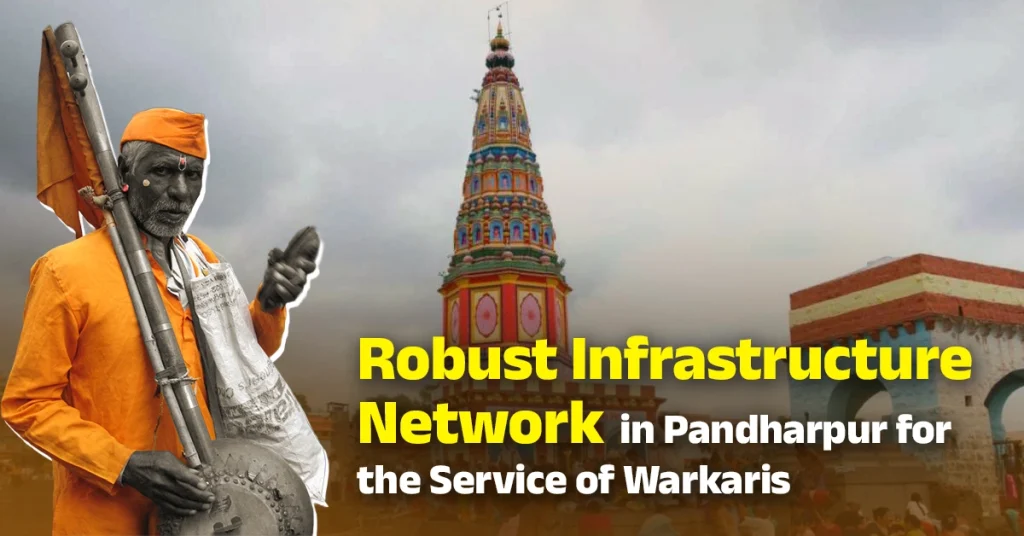
Every year, Maharashtra’s glorious Ashadhi Wari festival and the 800-year-old Warkari tradition demonstrate millions of devotees on foot-pilgrimage from as far away as 400-500 km to Pandharpur. Besides displaying unwavering devotion, social harmony, and immense faith by a massive number of people, these long, arduous journeys with large and heavy palkhis often create various health issues, including even deaths. The Government of Maharashtra has come forward to ensure a comfortable and safe journey for the Warkaris making their pilgrimage to Pandharpur, the abode of Lord Vitthal and his wife Rukmini. Initiatives have been undertaken to provide essential public welfare services, health care, and administrative support directly to the pilgrims during the annual Pandharpur Wari under the concept of ‘Gram Vikasachi Wari, Pandharichi Dari’ (Rural development along the routes to the doorstep of Pandhari). With deep faith and conviction that Warkaris’ welfare is a service to Lord Pandurang, the government led by Maharashtra’s ‘Sevak’ Devendra Fadnavis has established a robust network of infrastructure facilities along the Wari route and in Pandharpur.
Chief Minister’s Warkari Facilitation Centers
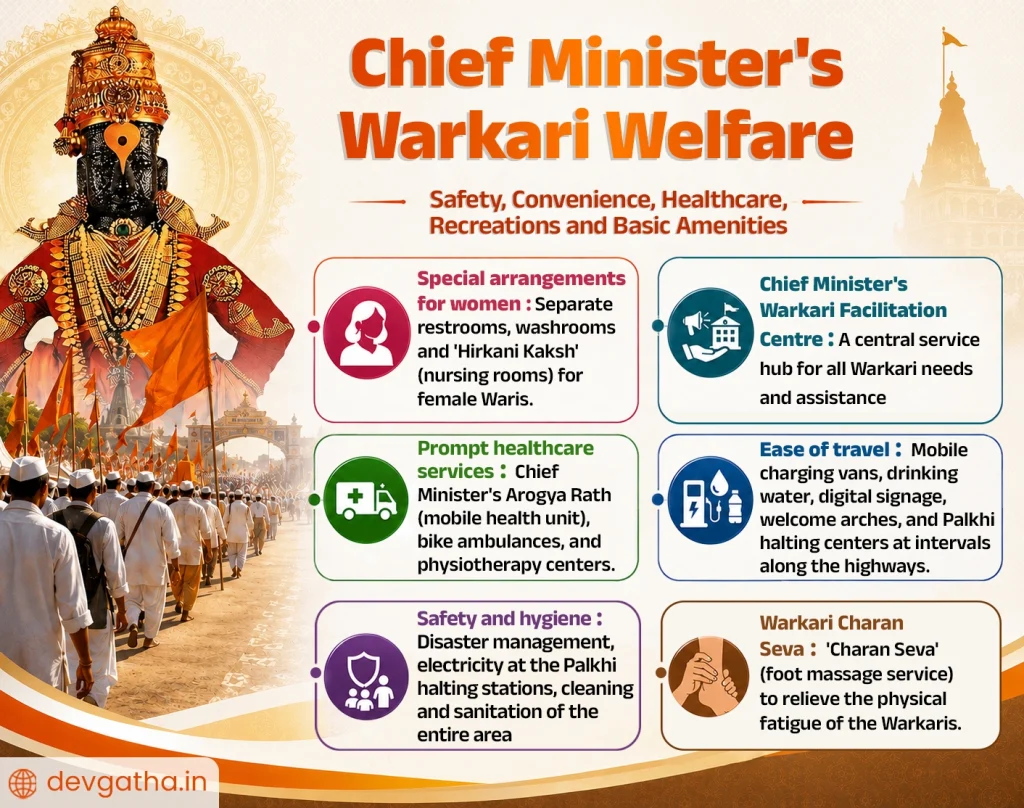
The government established ‘Chief Minister’s Warkari Facilitation Centers’ at various locations to provide resting facilities and proper accommodation for Warkaris on foot pilgrimage to Lord Vitthal in Pandharpur. To ensure their well-being during the journey, a lot of services are provided such as free medical check-ups, general health services, the Chief Minister’s ‘Health Rath’ (mobile medical unit), bike ambulances, and physiotherapy centers, etc. Additionally, essential medical kits were distributed to the Warkaris, and special ‘Charan Seva’ (foot-care services) facilities were arranged for those exhausted by the long trek.
Prioritizing Hygiene Alongside Health
Prioritizing both hygiene and health, separate toilets and bathrooms for women were constructed at various points along the pilgrimage route. Continuous cleaning up and sanitization drives were undertaken to maintain cleanliness and hygiene along the entire route and in the surrounding areas. Arrangements were made for clean drinking water through water jars and tankers. Directional signage and welcome arches were installed near Palkhi halting stations and the major entry points on the highways to guide and welcome the Warkaris.
‘Nirmal Wari’ initiative: A Journey Defined by Safety and Cleanliness
Electricity was provided at the base camps of Palkhis (Palanquin) or the Palkhi halting stations to ensure safety at night. Additionally, disaster management teams were deployed to handle any emergencies. Initiatives such as mobile charging vans, ‘Hirkani Kaksh’ (nursing rooms), ‘Abhang Sandhya’ (devotional musical gatherings), and ‘Shloka’ display boards made this devotional journey a more memorable experience for the ‘Warkaris.’ Offering a remarkable blend of social camaraderie, cleanliness, and devotion, this ‘Nirmal Wari’ also made the darshan of the deity easier to bring joy to lakhs of ‘Warkaris’.
A Grant of ₹20,000 for each ‘Dindi’
In July 2024, the Mahayuti government established the ‘Chief Minister’s Warkari Mahamandal’ to implement welfare schemes with amenities for ‘Kirtankars’ and ‘Warkaris’ in the state. Alongside this the government also approved a financial grant of ₹20,000 for each of the 1,400 participating ‘Dindis’ (pilgrim groups) accompanying the ten honored palanquins during the Ashadhi Ekadashi Wari pilgrimage to Pandharpur
Related articles: