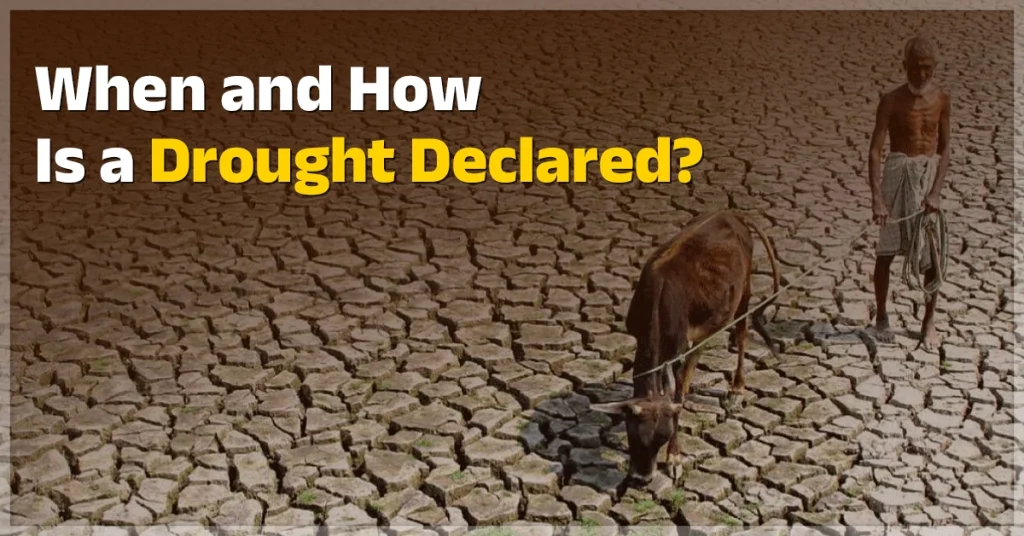
The El Nino effect has significantly affected the weather cycles over a large part of India, with Maharashtra being among the most suffering states. This year, the erratic monsoon has inflicted great disappointment on Maharashtra’s farm sector. After remaining absent throughout June, the rains made a strong comeback in July. However, August and September again went heavily deficient, causing several districts to grapple with less rainfall than expected. As drought-like conditions are apparent in many areas, the demand is getting stronger for declaration of drought in a large number of talukas. The government is being criticized for not declaring drought and relief measures for farmers in Maharashtra. But one needs to understand under what circumstances is drought declared? What criteria has the government set for this? In this article, we will discuss the drought declaration process in Maharashtra.
Steps taken by the government and Chief Minister’s visit to drought affected areas
Taking note of the prolonged dry spell from June through September that has caused agricultural and drinking water crises in the majority of the districts, the Maharashtra government has begun early damage assessment by forming a high-powered cabinet sub-committee under the chairmanship of Revenue Minister to continuously monitor and manage the state’s drought-like conditions. Chief Minister Devendra Fadnavis said in a cabinet meeting that a notification will soon be issued based on the reports of the sub-committee, listing affected areas and relief measures. The Chief Minister also began a tour of drought-hit areas in Marathwada and some districts of Western Maharashtra from Wednesday September 23, 2026.
Moving Beyond Traditional Methods: Using Scientific Standards
Maharashtra has been facing drought conditions for many years. Over time, the government has introduced several measures to address drought situations and has also made improvements to these measures. The Devendra Fadnavis government has established a more scientific, objective, and technology-driven process for declaring drought. During its first term a Government Resolution was issued in June 2018 introducing scientific drought assessment in Maharashtra, moving away from the traditional Anewari/Paisewari system based on human assessments. The current state government continues to use this GR to decide on drought relief measures for farmers in Maharashtra. Based on the Central Government’s Drought Management Manual 2016, the then government issued the criteria for declaring drought on June 28, 2018., discarding the old methods. The new system adopted a scientific and objective approach using modern technology, satellite data, and objective scientific parameters.
Provisions for Declaring Drought Based on Scientific Criteria
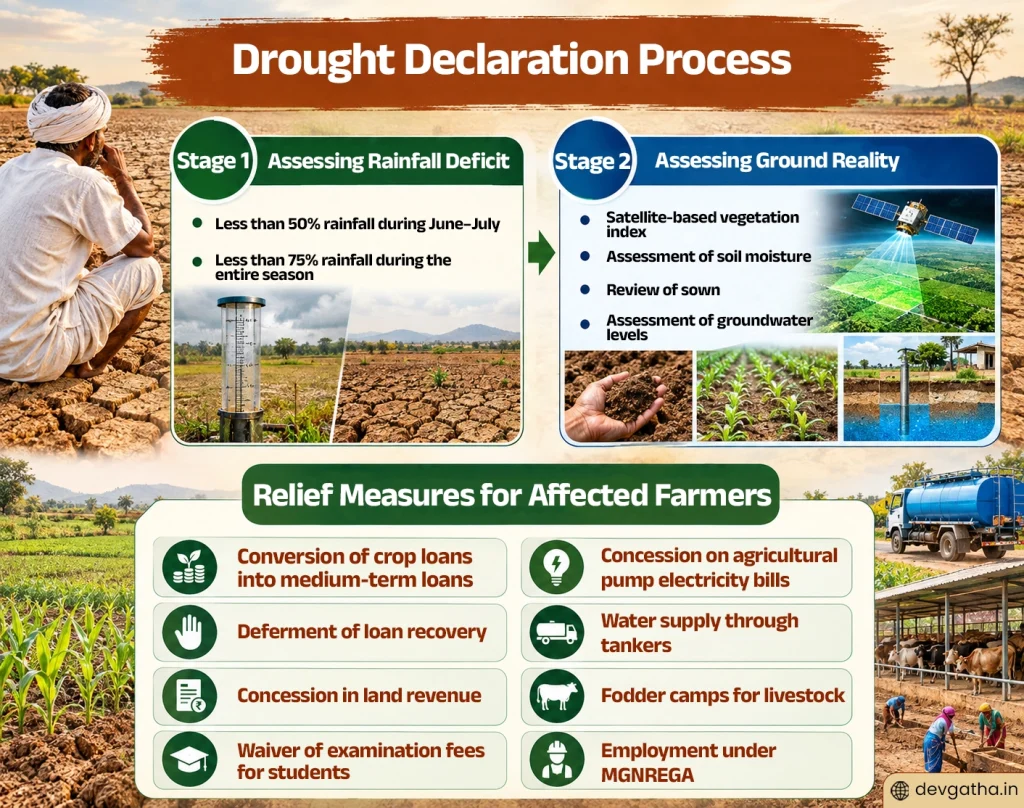
The 2018 government resolution structured the drought declaration process around scientific criteria, using a two-stage verification framework to ensure accurate disaster verification before relief funds are disbursed. The first stage focused on two key aspects – rainfall deficiency and excess rainfall for drought and flood alarms, respectively. For drought, a preliminary indication will be considered if rainfall in June and July fall below 50% of the normal level, or if total rainfall across the entire monsoon season is less than 75% of the normal average. Subsequently, in the second phase, rather than relying solely on rainfall data, four major factors will be analyzed using computerized systems to assess actual ground conditions:
- Satellite-derived vegetation index
- Soil moisture levels
- Percentage of sown area
- Groundwater levels in wells and dams
Based on these scientific criteria and the severity of the situation, a provision was made to declare a moderate or severe drought at the taluka or revenue board level.
Concrete Relief Measures for Affected Farmers
Alongside the regulations for declaring a drought, the state government formulated various drought relief measures for farmers in Maharashtra. For instance, once a drought is declared, short-term crop loans for the current season held by farmers in affected areas are converted into medium-term loans; this immediately halts loan recovery proceedings and paves the way for farmers to secure fresh loans for the upcoming season. Furthermore, farmer families receive direct financial relief through measures such as the suspension of government loan recoveries, waivers on land revenue and students’ examination fees, and concessions on electricity bills for agricultural pumps. To prevent local-level unemployment, emergency measures such as providing work under the Mahatma Gandhi National Rural Employment Guarantee Scheme are implemented. In addition, setting up fodder camps for livestock, and supplying drinking water via tankers to water-scarce villages, also feature in the list of drought measures by the government based on the aforesaidnñ regulations.
This decision by the Devendra Fadnavis government marked a significant policy shift in drought management within the state. The administration had to finish drought assessments by the end of October for the Kharif season and by the end of March for the Rabi season, with strict time limits established for this purpose. This prevented implementation delays and enabled the state government to secure timely financial assistance from the Central Disaster Response Fund. By effectively leveraging technology to minimize human intervention and fully streamlining the relief process, this decision has become a crucial step in drought mitigation and disaster management in Maharashtra.
Related articles: