
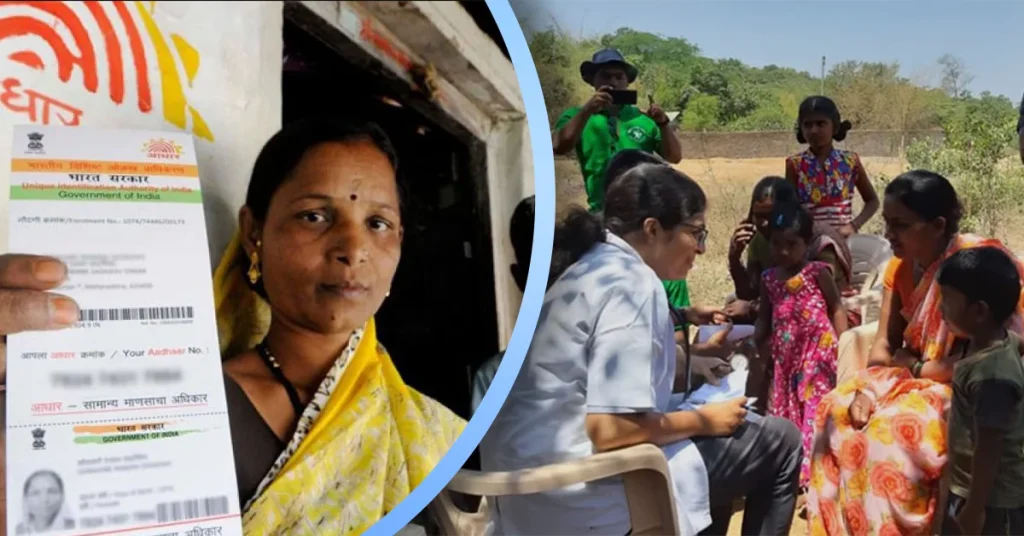
Through its various welfare schemes, the Maharashtra government is making continuous efforts to bring about transformative changes in the lives of the state’s SC/ST and VJNT – communities that have historically faced social discrimination and remained economically, and educationally backward. Under the leadership of Devendra Fadnavis, several targeted campaigns for Nomadic Tribes (NT), Vimukta Jati (VJ/Denotified Tribes), and Tribal communities have been implemented. Government endowments and welfare schemes, which are designed to suit their specific lifestyles, are being directly delivered to them. People from these categories are getting ample opportunities to improve their lives by availing the benefits of government schemes. The Devendra Fadnavis government has also decided to issue Aadhaar cards, Ration cards, Voter ID cards, and Ayushman Bharat cards to members of this community through special camps organized specifically for this purpose. These efforts are increasingly enabling the VJNT community to transition from a nomadic life to a more settled, socially connected, and supported existence.
In 1871, under the Criminal Tribes Act, the British colonial administration declared certain tribes in India as ‘criminal tribes.’ Following India’s independence and the subsequent enactment of its own Constitution, this unjust and oppressive British-era law was finally repealed in 1952. Consequently, a distinct identity was established for these social groups, designating them as ‘Vimukta Jatis’ (Denotified Castes) meaning ‘free or liberated from the colonial stigma.’ However, due to their inherent nature of constantly migrating across various regions in search of livelihood, they don’t have permanent addresses, and as a result, face numerous difficulties in obtaining official government documents and certificates, which are required to avail the benefits of government schemes. Taking these practical difficulties into consideration, the Devendra Fadnavis government has formulated a comprehensive plan, under the ‘Vimukta Jati Yojana’ (schemes for Denotified Castes) and ‘Bhatkya Jamati Yojana’ (schemes for Nomadic Tribes), to facilitate the issuance of government certificates and essential documents for proof of citizenship to the people belonging to Denotified Castes and Nomadic Tribes. This proposal was officially approved during the State Cabinet meeting held on August 26, 2025. Accordingly, the ‘Other Backward Classes and Bahujan Welfare Department’ published this government decision.
Providing the Aadhar and Voter Cards to Avail of the Government Schemes
According to the decision of the state government, a clear, easy and humane process has been laid down for this community, for providing the necessary identity cards and the benefits of government schemes. Firstly, keeping in mind the address proof of the people from this community, it has been decided to issue Aadhaar cards to them against the address where they usually live for the longest time. Those who do not have a valid identity card, have been given the option of making an Aadhaar card by submitting a self-declaration form. For this, the state government has directed to set up Aadhaar card registration camps in every district through the respective District Collector.
People from nomadic tribes do not generally have voting rights, which is one of the basic rights for the citizens in a democracy. Without having fixed addresses, they do not belong in any local body or constituency. To change this situation, the state government in collaboration with the Election Commission has decided to register these citizens in the voter list on the basis of the self-declaration form. With this decision, many people from the nomadic tribes will have their voting rights to strengthen Indian democracy.
Digital ration Cards and Co-branded Cards for Food security and Healthcare
Along with the Aadhar card and voting rights, Devendra Fadnavis government has decided to issue ‘mobile based digital ration cards’ to the VJNT class people to ensure food security of this category of citizens. The mobile ration card, which fits well with their migratory nature, will have the stamp of the Maharashtra government to enable them to take food grains from any ration shop across the state. Apart from the Ration cards, Aadhaar Cards, Voter ID Cards, the issuance of birth and death certificates to the people of the VJNT class have also been made mandatory by the Fadnavis government through an amendment of the Act of 1969. This will help the government track their population graph to determine the budgetary sanctions for schemes towards their education, health, employment in future. In terms of health, the government has planned to issue co-branded cards to the people of this community to access the benefits of Ayushman Bharat Yojana and Mahatma Phule Jan Arogya Yojana. The co-branded cards will be made through ‘AYUSH’ app, website and district level camps.
In addition, the Devendra Fadnavis government has decided to issue other documents, such as Caste Certificate, Income Certificate, Non-Creamy Layer, Domicile, Marriage Registration, Project Affected Certificate, Disability Certificate to the VJNT class people to treat them at par with other communities. Committees have been formed at the state, district and taluka level to organize camps to examine and issue certificates and implement welfare schemes for the Vimukta Jatis and Nomadic Tribes class people. Some of these welfare schemes include Shravan Bal Economic Yojana, Sanjay Gandhi Niradhar Yojana, Ladki Bahin Yojana, Pradhan Mantri Awas Yojana, Kaushal Vikas Vikas Rozgar Yojana, Scholarship Scheme, Agristock Kisan ID, and PM Kisan Yojana.
The government of Chief Minister Devendra Fadnavis is not only announcing schemes for the sake of it, rather, steps are being taken to implement them to improve the lives of the people from the Vimukta Jati and Nomadic Tribes and motivate them to join the mainstream. This decision is not limited to giving government documents, certificates, schemes. It is a step towards social justice and holistic development, taken to help them live with dignity and empower them.
Related articles: