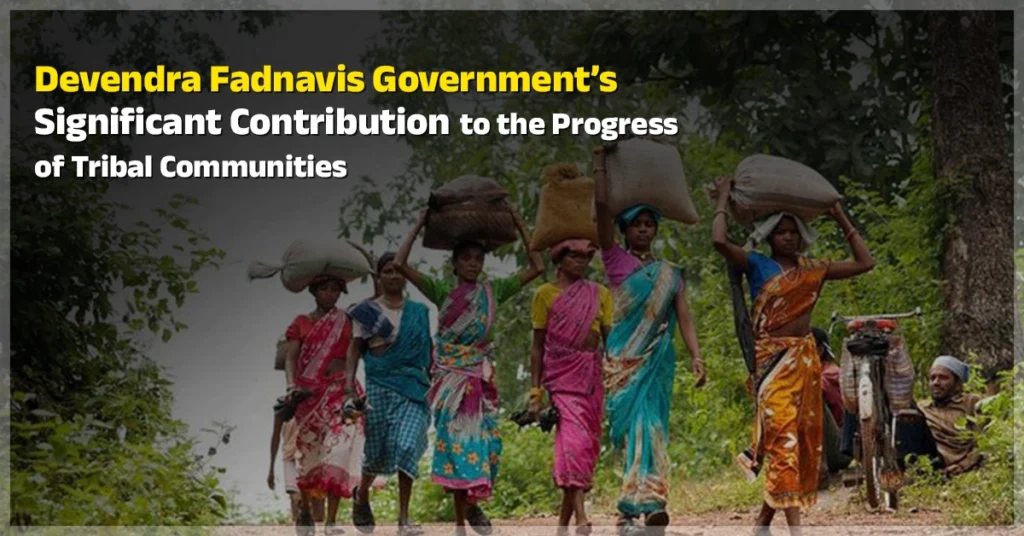
Maharashtra is home to many tribal groups; according to the 2011 census, approximately 10.51 million (105.10 lakh) tribal people reside in Maharashtra, accounting for 9.35 percent of the state’s total population. The state government’s Tribal Development Department is consistently fostering the social and economic development of the tribal communities in Maharashtra to bring positive changes to their lives. To ensure that development reaches such a large tribal population, a “Tribal Sub-Plan” has been implemented. Under Chief Minister Devendra Fadnavis, tribal welfare has always been prioritized through the budgetary allocations and implementation of schemes for the holistic development of tribal groups, including education, health, social justice, livelihoods, and living conditions.
Extending the Benefits of Government Schemes to Vulnerable Tribal Groups
The tribal-inhabited regions of the state are primarily divided into two main regions – Sahyadri and Gondwana. The districts of Dhule, Nandurbar, Jalgaon, Nashik, Palghar, and Thane are collectively known as the ‘Sahyadri Region’ (the western hilly tract), while Chandrapur, Gadchiroli, Bhandara, Gondia, Nagpur, Amravati, and Yavatmal constitute the ‘Gondwana Region’ (the eastern forest tract). A Tribal Commissionerate, based in Nashik, oversees the administrative functions for these vast areas. It operates through 4 Additional Commissionerates and 30 Project Offices. Through these offices, various government initiatives, such as the ‘Tribal Ashram School’ scheme, the PESA Act, tribal complex development projects, and various endowment schemes are being extended to some of the most remote and vulnerable tribal communities, including the Katkari, Kolam, and Madia Gond tribes.
Different Tribal Development Schemes in Maharashtra and Their Successes
Education and Accommodation: Through more than 250 government-run tribal ashram schools and hundreds of hostels in remote areas, thousands of students receive free education, lodging, food, and uniforms. For students who do not secure accommodation in a government hostel, expenses for their accommodation, food, and education related costs are deposited directly into their bank accounts under the ‘Pandit Deendayal Upadhyay Swayam Yojana’. This has significantly reduced the dropout rate caused due to financial constraints. Furthermore, tribal children are provided with opportunities to study in English-medium schools and higher education free of cost through Eklavya Residential Schools.
Agriculture and Livelihood: To provide irrigation facilities for tribal farmers, equipment such as electric pumps, diesel-powered pump sets, and drip irrigation systems are offered with subsidies ranging from 90%-100%. Under the ‘Sashaktikaran aur Swabhiman Yojana’ (Empowerment and Self-Respect Scheme), landless tribal families receive financial assistance of ₹5 to ₹8 lakh to purchase agricultural land. Additionally, self-help groups and farmers are provided with mini-tractors and farming instruments at a 90% subsidised rate; this is spreading the modern agriculture practice in tribal regions and creating new employment opportunities.
Basic Amenities and Infrastructure: To improve the living conditions of the tribal people, a village cluster approach is being followed rather than focusing on isolated, individual villages.
Together with the Sansadiya Sankul Vikas Pariyojana, also referred to as the Janjatiya Sankul Vikas Pariyojana, the state government has taken a strategy of pooling a group of 10 to 20 neighboring tribal villages into a single development block or cluster. This is resulting in a faster development in terms of roads, healthcare, education, and employment of the entire block through a streamlined resource allocation. The “Nucleus Budget” is allowing local project officers to directly utilize funds for essential tasks, ensuring there are no delays in implementation. The block-wise development and sustainable livelihood opportunities are also helping to change the migratory nature of some tribal communities to permanent, stable settlement, marking a profound life-changing shift for these populations. Under the PESA (Panchayats Extension to Scheduled Areas) Act in Maharashtra, 5% of funds are allocated directly to Gram Sabhas (village councils). Consequently, the authority to make decisions regarding village development now rests directly in the hands of the tribal villagers themselves. Meanwhile, at a recent event held as part of the Sansadiya Sankul Vikas Pariyojana, Chief Minister Devendra Fadnavis stated that an allocation of Rs 25,000 crore has been made for the development of tribal areas.
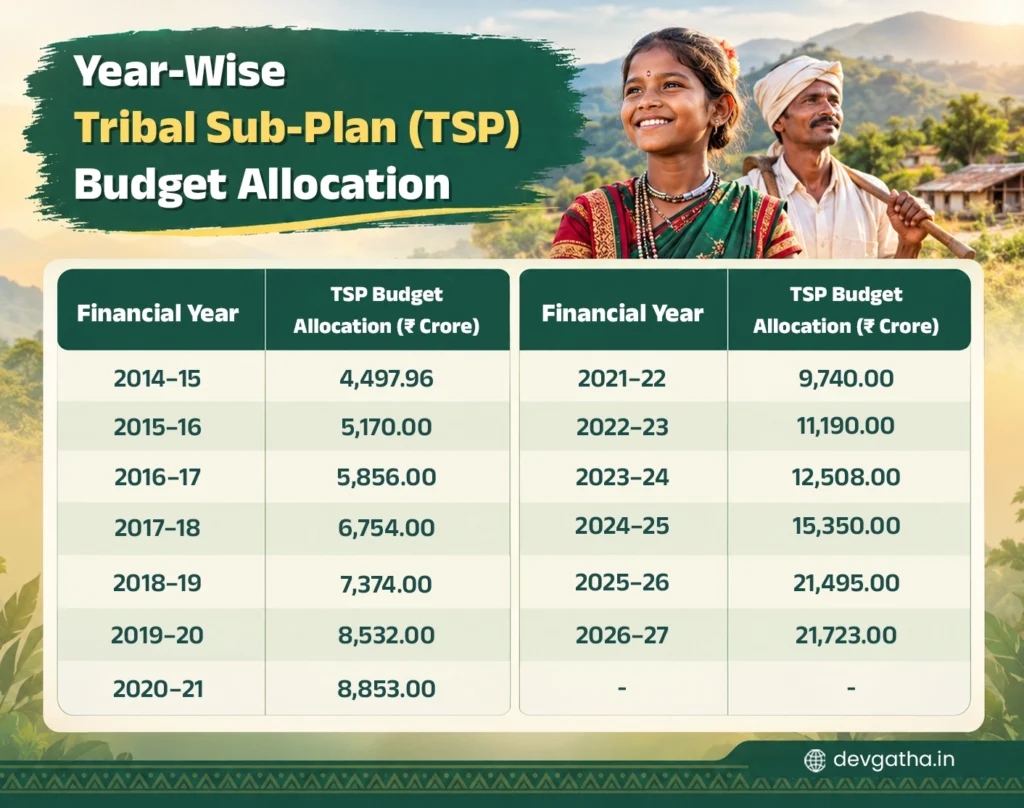
Year-Wise Tribal Sub-Plan (TSP) Budget Allocation
Significant Increase in Budgetary Funds for Tribal Communities
The state government is substantially increasing budgetary allocations every year to accelerate the completion of roads, schools, clinics, and irrigation projects in tribal areas. In 2014-15, the Planning Department allocated an annual budget of ₹4,497.96 crore for tribal development. This was increased to ₹6,754.00 crore in 2017-18, while for 2023-24 and 2024-25, the allocation reached ₹12,508 crore and ₹15,350 crore, respectively – a figure three times higher than that of 2014. Furthermore, an allocation of ₹21,723 crore has been earmarked for 2026-27. In simple terms, through various schemes and financial provisions, the state government is striving to improve the standard of living of tribal communities by extending support directly to their homes, farmlands, and settlements.
Related articles: