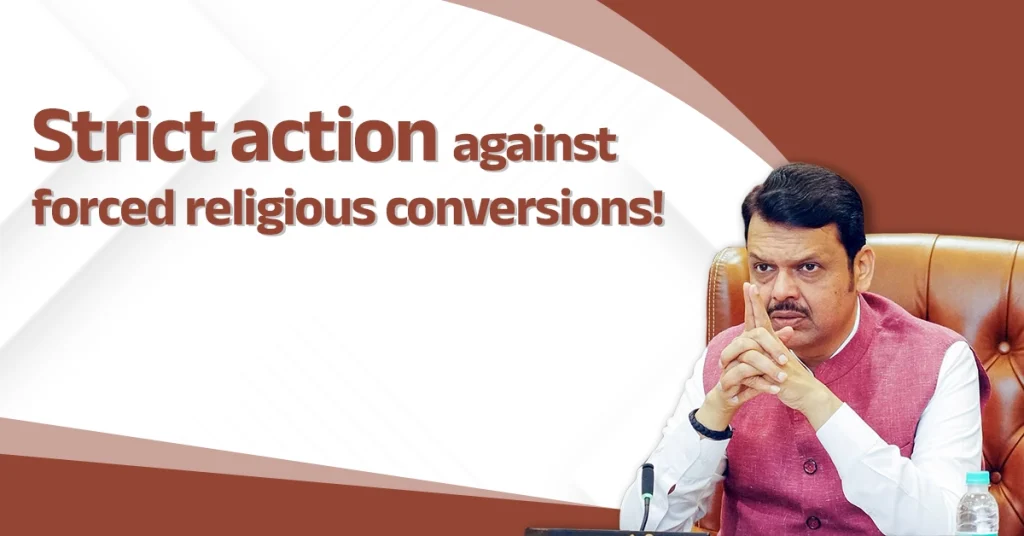
The Indian Constitution grants every citizen the right to profess and propagate the religion of their choice. However, in recent times, it has been observed that the issue of religious conversion is no longer confined merely to matters of personal faith, but has become a subject fraught with coercion, inducement, and fraud. Against this backdrop, the Maharashtra Government has introduced a law to prohibit religious conversions in the state by means of coercion, inducement, fraud, or marriage. This law will prevent exploitation of the people, especially from the economically and socially vulnerable sections of society, who are the target groups of such religious conversions, and uphold social harmony within the state. Under the leadership of Chief Minister Devendra Fadnavis, the government introduced the ‘Maharashtra Freedom of Religion Bill, 2026’ in the Legislative Assembly. This Bill serves as a robust legal bulwark against forced religious conversions. Through this legislation, the government has resolved to uphold public order and preserve the true essence of religious freedom.
Why is the ‘Maharashtra Freedom of Religion Bill’ required
Forced religious conversion has reached an alarming level and is deemed a serious issue, as observed by the Supreme Court. The apex court has warned that such practices, which involve deception, allurement, and intimidation, constitute a “clear and present danger” that could affect national security. Reports suggest organized rackets are targeting SC-ST communities in rural areas and performing religious conversions using fraudulent means. Instances of coercion, including “Love Jihad” allegations, have been reported in Maharashtra, Uttar Pradesh, and Kerala. Under this situation the government of Maharashtra introduced the Maharashtra Freedom of Religion Bill 2026, aiming to regulate religious conversions and prevent conversions through coercion, fraud, or inducement.
Ban on Forced Religious Conversion
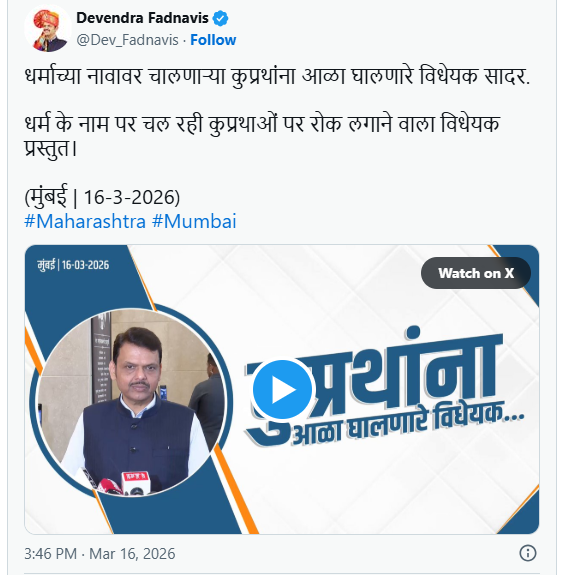
To maintain social harmony within the state and to curb incidents of forced religious conversion, the State Government introduced the historic bill—the ‘Maharashtra Freedom of Religion Act, 2026’—in the Legislative Assembly on March 16, 2026, and in the Legislative Council on March 17, 2026, during the Budget Session. The proposal for this bill was approved during the State Cabinet meeting held on March 5, 2026. Chief Minister Devendra Fadnavis elucidated in the Legislative Assembly the background of the bill, as well as its objectives and underlying rationale, thereby enabling many members to recognize the necessity of this legislation.
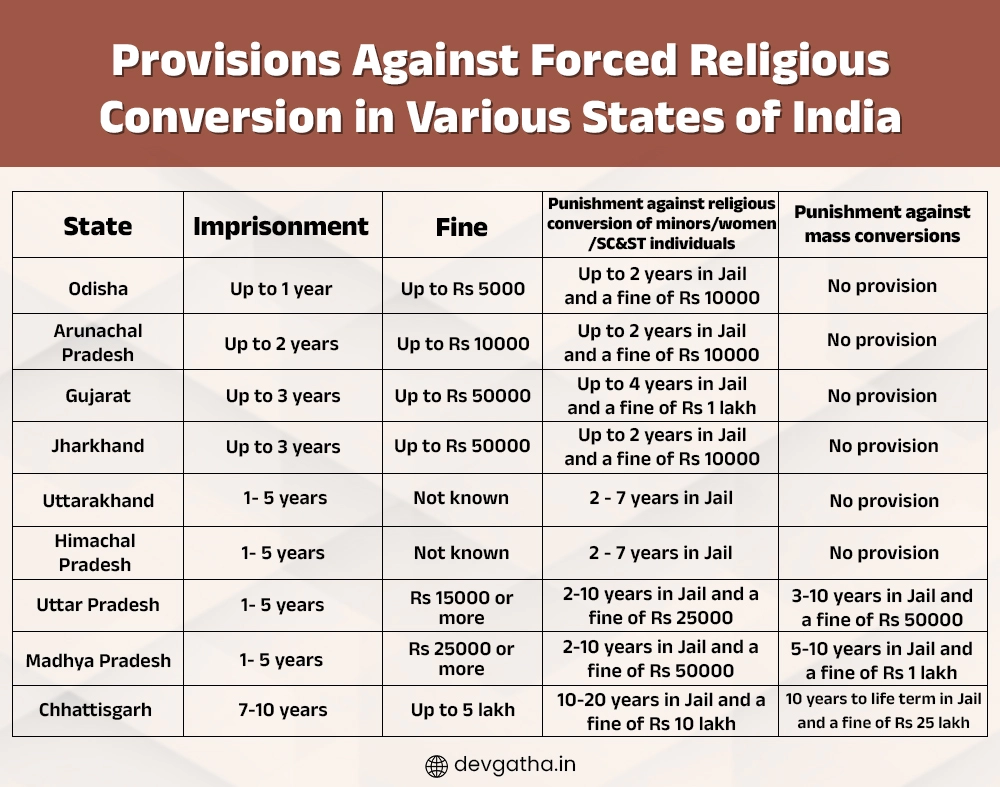
The Chief Minister also clarified that the Maharashtra Government is not the sole entity introducing such a bill; twelve other states have previously enacted similar laws, and such legislation has existed since as early as 1967. These states include Odisha (1967), Arunachal Pradesh (1978), Gujarat (2003), Jharkhand (2017), Uttarakhand (2018), Himachal Pradesh (2019), Uttar Pradesh (2020), Madhya Pradesh (2021), Haryana (2022), Karnataka (2022), Rajasthan (2025), and Chhattisgarh (2026). The Constitution of India grants every citizen the fundamental right to freedom of religion; however, this right is not absolute, but rather remains subject to public morality and public order. This constitutes the primary objective of the present bill. In recent years, numerous cases of religious conversions through various inducements, fraudulent means, or intimidation, have come to light. What is more worrying is that such cases are steadily rising, targeting individuals belonging to economically and socially vulnerable sections of society. Consequently, the State Government has resolved to impose a strict prohibition on such practices.
Rehabilitation and Legal Protection for Victims by the Government
According to the proposed legislation, impelling any individual to convert to another religion, whether through monetary inducements, offers of free education, or other allurements; by making promises of marriage; or by claiming to perform miracles, will henceforth be deemed a grave offense. Specifically, this bill will impose a legal prohibition on practices, such as the brainwashing of children or large-scale religious conversions, facilitated through educational institutions. Should a marriage be solemnized solely for the purpose of effecting an unlawful religious conversion, it shall be declared null and void by a competent court. A significant provision within this legislation stipulates that, with a view to safeguarding the future of children born from such disputed marriages, the child’s religious identity shall be deemed to be the mother’s original religion prior to the marriage. Through this bill, victims will not only receive justice but will also be entitled to financial assistance from the State Government to ensure their rehabilitation and to secure legal protection regarding the custody of their children.
10 Years Imprisonment and a ₹5 Lakh Fine for Forced Religious Conversion
To ensure the effectiveness of the Maharashtra Freedom of Religion Act, the penal provisions have been significantly tightened. The law stipulates imprisonment of up to seven years and a fine of up to ₹1 lakh for those convicted of unlawful religious conversion. If the victim is a minor, a woman, or belongs to a Scheduled Caste or Scheduled Tribe, the fine may be increased to ₹5 lakh. Furthermore, organizations or individuals, if found to have repeatedly committed such offenses will face imprisonment of up to ten years. All such offenses will be classified as cognizable and non-bailable, thereby serving as a deterrent against offenders. To ensure transparency in the process of religious conversion, it will be mandatory to submit a written notice to the District Collector 60 days in advance. A window of 30 days will be provided for raising objections. Thus, through this legislation, the Devendra Fadnavis government has established a robust legal framework to safeguard the state’s citizens faith in their original religion and curb the trend of religious conversions under any circumstances.
The Maharashtra Freedom of Religion Act, 2026, is a crucial legislation aimed at curbing the rising incidents of unlawful religious conversions within the state. Through this Act, the state government has not only imposed tougher laws against religious conversions and strict punishment for the perpetrators, it has also addressed humanitarian aspects of the victims, including their rehabilitation, lawful exit from their marriage made with the motive of religious conversion, and the rights of their children. This approach mirrors the legacy of Chhatrapati Shivaji Maharaj, who, while respecting other faiths, steadfastly defended his own religion against threats and undertook the rehabilitation of those subjected to forced conversion, restoring their right to live with dignity within their own faith. Following in those footsteps, the Devendra Fadnavis government has taken a decisive step to protect the fundamental beliefs of its citizens and to counter forces that seek to undermine social harmony.