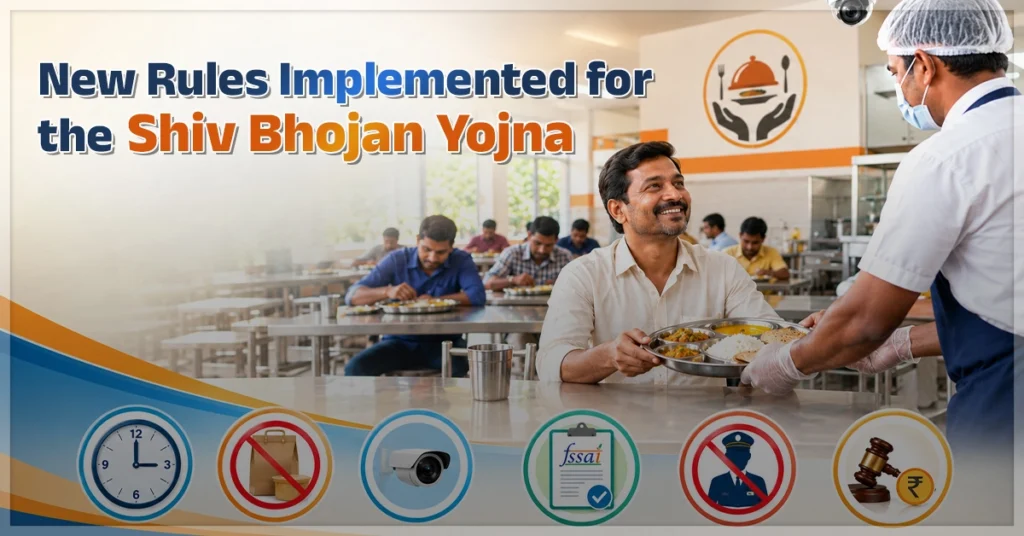
The “Shiv Bhojan” is a Maharashtra government scheme that provides affordable and quality food to all, irrespective of caste, creed, religion, and financial status. Recently, the Devendra Fadnavis-led government has decided to enhance coordination, transparency, and quality in the “Shiv Bhojan Yojana.” To this end, the government has rescinded all previous Government Resolutions (GRs) and circulars issued regarding this scheme and introduced a new set of rules, formalized through a 2026 Government Resolution. This resolution establishes the updated criteria and eligibility requirements for the ‘Shiv Bhojan Yojana.’
Old Government Resolution and Circulars Cancelled
The Devendra Fadnavis government has taken a major step to bring greater clarity and transparency to the operations of the “Shiv Bhojan Yojana,” a scheme, launched to ensure that the poor, laborers, the needy, and migrant populations in the state have access to quality food at subsidized rates. According to a Government Resolution issued by the concerned department on October 1, 2026, all prior GRs and circulars pertaining to the scheme have been cancelled, and new, comprehensive regulations have been put into effect. With this new policy, the operation of Shiv Bhojan centers, food quality, safety norms, and the subsidy payment process will become more transparent and faster.
CCTV Mandatory and Clarity on Ownership Transfer
Installation of CCTV cameras has been made mandatory at every “Shiv Bhojan” center to prevent irregularities. Furthermore, rules have been established to ensure that if any irregularities are detected, the individuals responsible will face punitive action, and the center will be shut down immediately. The new rules also provide clarity over the transfer of ownership or licenses of “Shiv Bhojan” centers—whether through inheritance or by transferring them to another person, to minimize the chances of misconception or misunderstanding in this matter. Overall, these revised regulations will better serve the scheme’s core objective, ensuring that its benefits reach those truly in need, directly and with a high standard of quality.
Some of the Shiv Bhojan Scheme New Rules and their possible impacts
CCTV Mandatory at ‘Shiv Bhojan’ Centers
Complete CCTV coverage with minimum 90 days storage of footage of all daily activities have been made compulsory at every “Shiv Bhojan” center.
No Parcels or Outside Food Allowed
Bringing food from outside into a ‘Shiv Bhojan’ center, as well as taking food out of the center or providing parcels, is strictly prohibited.
No Exemptions for Government Employees
Government employees are not eligible to avail of the subsidized meals offered under this scheme.
Strict Food Safety Regulations
It will be mandatory for centers to obtain a certificate after a timely inspection by the Food and Drug Administration (FDA), and to display the new Food Safety and Standards Authority of India (FSSAI) registration certificate/license at the center.
Priority for Disabled Persons and Women
Instructions have been issued to provide priority service to persons with disabilities, senior citizens, pregnant women, and nursing mothers, so they won’t have to wait in line,
Only one center per family
When it comes to approving new centers, it has been ruled that no “Shiv Bhojan” center will be sanctioned to a person if another family member already runs or has been approved for one.
No Inheritance or Transfer of Centers
A ‘Shiv Bhojan’ center is not a license that can be inherited or transferred. In the event of the death of the operator or the closure of the center, the license will be automatically cancelled and will not be transferred to any heir.
Online Payments
The subsidy payments from the government to the center operators will not be made via cash or cheque; instead, funds will be credited directly to a nationalized bank account through the CMP (Cash Management Product) system. The Operators must submit their vendor-payment slips corresponding to the periods from the 1st to the 15th and the 16th to the 30th of each month, within two days of the respective period.
Related articles: