
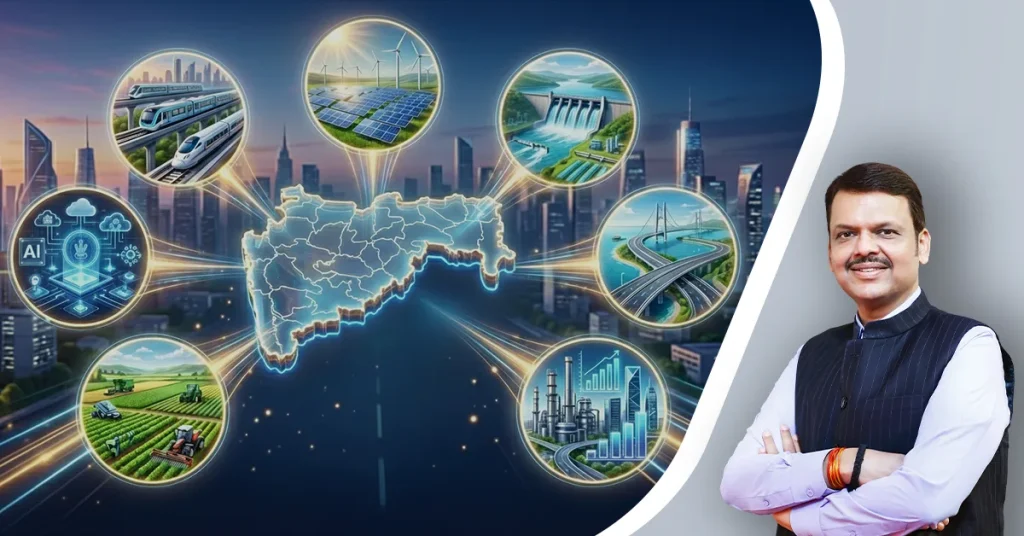
With the swearing in of Devendra Fadnavis as Chief Minister for the third time on December 5, 2024, the development graph of Maharashtra has taken a northward turn as expected. The reasons behind this may be attributed to two factors—a more streamlined administration in the government departments and adoption of technology for faster decision-making at the cabinet level and their implementation downstream. These have resulted in greater efficiency, transparency, and speed in project executions, which are apparent in the developments in key sectors like infrastructure, water management, digital governance, investment, social welfare, and internal security. We have seen reform in the government offices for enhanced governance through a 100-day program and then the 150-day program for civil servants to improve the citizens’ lives, especially in remote areas. These structural improvements in the government machinery were very critical for the state, as they help make a strong foundation for future development.
The first year of the current Devendra Fadnavis government showed the familiar characteristics like fast decisions and timely implementation, which defined his previous government (2014-19). With infrastructure being one of his all-time focus areas, the first year brought him a very special and satisfying moment as his dream project, the Nagpur-Mumbai Expressway, was fully opened end-to-end for the public on June 5, 2025. The first year also saw other significant infrastructure drives by him, such as approval for the Shakti Peetha highway with a sanction of Rs 20,000 crore towards land acquisition, the Navi Mumbai International Airport inauguration, the opening of the Mumbai Metro Aqua Line (the first underground metro line in Maharashtra), and more.
Water Conservation and Essential Reforms in Administrative Functioning
The policy of river interlinking was formalized during the first Devendra Fadnavis government with approval for four intrastate and one interstate river-linking projects as a major step towards water management to address both drought and floods in the state. We saw a continuation of the same policy, prioritizing approval of river interlinking projects; the historic water coordination agreement between Maharashtra and Madhya Pradesh through the Tapi Mega Recharge Project; and the decision to establish the Maharashtra State River Rejuvenation Authority (MSRRA) in the first year of his current government. Besides, a sanction for ₹25,972 crore was made to expedite the Gosikhurd irrigation project to help with irrigation in a vast area encompassing three districts. The first year also witnessed new policies, such as the one in shipbuilding and maritime industries (Policy 2025); the MahaAgri-AI Policy to increase the use of artificial intelligence in the agriculture sector; the Startup and Innovation Policy for new entrepreneurs; and Policy 2025 for app-based vehicles. Other notable decisions include the creation of a separate authority for the Nashik-Trimbakeshwar Kumbh Mela, taking efforts to secure UNESCO status for twelve forts and fortresses of Chhatrapati Shivaji Maharaj’s Swarajya, and the implementation of e-cabinet system for speedy government decision-making.
Improved healthcare for the poor, flood-relief for farmers, and empowerment of disabled, orphaned, and destitute
To ensure that the poor people can get timely and proper medical assistance in the hour of need, the Chief Minister’s Medical Assistance Cell (CMMA) has been started in every district. The CMMA service has also been made accessible through WhatsApp. Moreover, the ‘Maharashtra Cancer Care Scheme’ was approved for the treatment of people suffering from cancer. In addition, the government started health insurance for common citizens with coverage of Rs five lakh, ensuring the health rights of the common man. On the other hand, the government took a pack of measures during this period to provide social justice for the empowerment of disabled, orphaned, and underprivileged people. While the financial assistance for the disabled was increased, it was decided to formulate a disability welfare policy with the help of the corporate sector. Arrangements were made to create mobile teams to provide care and education to destitute and orphaned children. A package of ₹31,628 crore was announced for farmers affected by heavy rains. The fishing business was given the status of agriculture. Keys to new homes were distributed to 556 people in Worli, accelerating the long-awaited BDD Chawl redevelopment project.
Maharashtra Topped In Investment
There have been some important and reformative steps taken for the police department and for increasing the conviction rates in the state. The state has initiated police recruitment for 15,000 posts, giving a special, one-time relaxation to candidates who have exceeded the age limit. It adopted a ‘zero tolerance’ policy against drugs and launched the country’s first forensic mobile van service with a fleet of 256 forensic mobile lab ambulances. This initiative has immensely helped crime investigation in the state, increased the conviction rate, and reduced pending cases. When it comes to Maharashtra’s investment agreements during this time, it achieved a new height in terms of both domestic and foreign direct investments. Agreements worth ₹15.70 lakh crore at Davos, industrial partnerships with global companies like Candela, an ₹8,000 crore investment from Waves 2025, proposals worth ₹1.35 lakh crore in thrust areas, agreements worth ₹1 lakh crore with companies in the IT, logistics, and food processing sectors, an ₹80,962 crore investment in the green steel sector, and agreements made during India Maritime Week have given a new dimension to the state’s industrial progress. These agreements, which will create millions of jobs, will considerably boost Maharashtra’s economic strength.
These impactful decisions, taken in the first year of the current Fadnavis government, are both present-oriented and futuristic. While some are improving the lives of the citizens now, the others are meant to strengthen the economy, security, and other aspects for a better tomorrow.