
In light of the recent paper leak incidents, Chief Minister Devendra Fadnavis has taken crucial measures to ensure that the competitive exams and the recruitment in government services in Maharashtra are absolutely transparent, secure, and without any irregularities. A high-level committee has been formed by the state government to undertake a comprehensive review of the existing recruitment examination systems in the state and suggest reformative measures. The committee will visit every revenue division in the state and talk directly to the students, educational institution administrators, and experts. The review will cover every single aspect of the state-run competitive and government recruitment examination processes, including the different steps involved in setting question paper and the level of confidentiality and security during this process, management and security arrangements at the examination centres, use of technology and malware prevention strategy, coordination among the stakeholders and vendors, grievance redressal and the overall examination experience of candidates. The government is trying to find the loopholes in the procedural chain and implement the appropriate measures for the complete prevention of malpractices in the competitive exams and recruitment systems and to restore students’ confidence in the exam and recruitment process.
Strict Action Against Paper Leak Perpetrators
The government is making concerted efforts to maintain transparency and integrity in competitive examinations and strengthen students’ trust in the administration. Taking into account the paper leak and other allegations surrounding various public examinations across the country, the Central Government has enacted the stringent ‘Public Examination (Prevention of Improper Means) Act’ to prevent all kinds of wrongdoings in public examinations.
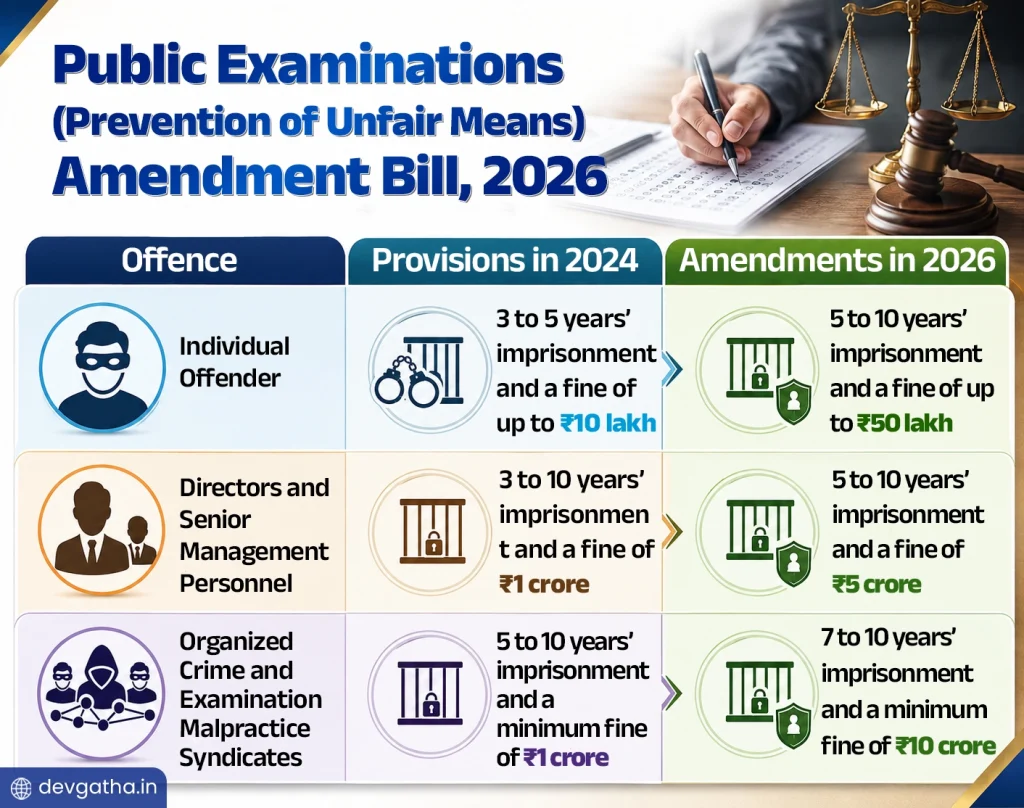
The Act provides for imprisonment of 3 to 5 years and a fine up to ₹10 lakh for leaking question papers, while serious offenses involving organized paper leaks or conspiracies carry a penalty of up to 10 years in prison and a hefty fine of up to ₹10 crore. Furthermore, this central legislation incorporates several rigorous measures, such as strict action against institutions involved in paper leaks and the establishment of fast-track courts for the speedy adjudication of cases.
Adopting Centre’s new law for a stricter State exam and recruitment system
Although a government recruitment system already exists in Maharashtra, the Centre’s new law, the Public Examination (Prevention of Improper Means) Act 2026, is more comprehensive and stringent. Accordingly, Chief Minister Devendra Fadnavis has actively pushed to adopt and implement the central law in the state, while also ordering comprehensive studies to overhaul Maharashtra’s recruitment system. The high-level committee appointed by CM Fadnavis for exam reform has also been tasked with this parallel structural change. The task force is actively conducting division-wise field visits to Pune and other zones to gather direct feedback from students and educators. Adopting Central Penalty Standards, the state government is aligning its legal framework for the prevention of malpractices in competitive exams to mirror the Central Act’s provision of imprisonment up to 10 years for organized cheating syndicates and massive financial penalties.
Thousands of secure, tech-enabled exam centers across the state
In another significant move, the Devendra Fadnavis government has launched a massive infrastructure plan to construct thousands of secure, tech-monitored, and government-supervised classrooms. These classrooms, equipped with all advanced gadgets, will be specifically dedicated to conducting the state government recruitment exams seamlessly, thereby completely eliminating the chances of outside malpractices by private vendors. Previously, the hosting of computer-based tests (CBTs) and even the manual pen-and-paper exams used to be outsourced to third-party centers. Investigations found that some of these private centers had a hand in question paper leaks, either by bypassing exam security with remote-access software, or colluding with cheating syndicates.
The administration’s core objective through this entire process is a complete overhaul – shifting the system from reacting to leaked papers to building a foolproof ecosystem that guarantees transparent, and fair exam and selection to ensure that students’ hard work is duly recognized and their confidence in the examination system is fully restored.