

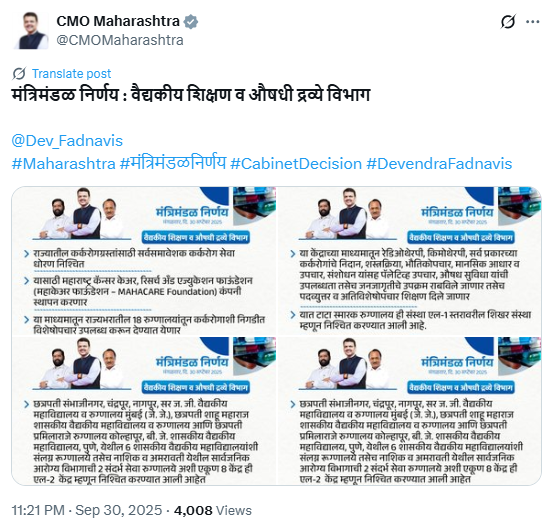
In view of the rapidly rising number of cancer patients across the state and the country, the Maharashtra government has adopted a comprehensive cancer treatment policy to establish a statewide cancer grid. This will consist of a three-tier treatment system involving 18 hospitals across the state, which will ensure superior treatment management and reduce the travel burden for patients. This policy was approved during a state cabinet meeting held recently on September 30, 2025.
The cancer treatment is often prolonged and expensive, which inflicts trauma, anxiety, and depression not only on the patient but on their family members as well. Perhaps no one can better understand this than the Chief Minister Devendra Fadnavis himself; long back during his adolescence, he would have to come frequently from Nagpur to Mumbai taking his cancer patient father to Tata Memorial Hospital. At that time, patients and their families used to face numerous hardships due to the limited facilities available for cancer care, which forced them to head for TMH in Mumbai from all across Maharashtra and other parts of the country. Later, when he became the Chief Minister, he established Central India’s largest cancer hospital, a 450 bed National Cancer Institute in Nagpur. This time his government has officially implemented a comprehensive cancer care policy to establish quality cancer treatment facilities across the state.
Maharashtra Cancer Care Scheme
Under the new cancer treatment policy, the state government will establish a comprehensive state-level oncology consortium, which will be implemented and managed by a new entity called ‘the Maharashtra Cancer Care, Research and Education Foundation (MAHACARE Foundation).’ This Mahacare Foundation will act as an independent nodal and coordination company to oversee cancer treatment statewide, with CM Devendra Fadnavis as Chairman and the two Deputy CMs as Vice Chairmen. There will be other ministers, secretaries, and commissioners in the foundation but the key functions will be handled by 18 experts from the field of cancer treatment. Apart from the 18 hospitals, effort is on to set up a large number of ‘day care centers’ specialized in cancer care, across the state
What types of cancer treatments will be offered through the Mahacare Foundation?
While the state-wide 18 cancer speciality hospitals will offer complete care, ranging from initial diagnostics to specialized treatment and recovery support, a comprehensive range of non-surgical and outpatient oncology services, such as chemotherapy, radiology, immunotherapy, hormone therapy, palliative care, psychological counseling, and more will be provided at the district level day-care centers.
Apart from these, programs on public awareness in the society and among cancer affected families and courses providing postgraduate education in this regard will also be included in the policy.
Maharashtra government’s three-tier strategy to deal with the rising number of cancer patients in the state.
The Mahacare Foundation is made up of 18 hospitals across the state, which are divided into three levels:
L1 Level – Tata Memorial Hospital
The Tata Memorial Hospital at the L1 level will function as the apex institution.
L2 Level – 8 Hospitals as midlevel hubs
L2 level includes 8 hospitals. The hospitals attached to the 6 government medical colleges in the cities of Chhatrapati Sambhajinagar, Chandrapur, Nagpur, Mumbai, Kolhapur, and Pune are included in the crucial group. The referral hospitals of the Public Health Department at Nashik and Amravati have also been added in this group thus making the total number to eight.
L3 Level – 9 designated district and peripheral hospitals
There will be 9 hospitals in L3 level, which include hospitals in Ambajogai, Nanded, Yavatmal, Satara, Baramati, Jalgaon, Ratnagiri, Shirdi Sansthan Hospital, and Cama Hospital in Mumbai.
To have good coordination between all 18 hospitals, a command and control center will be created at the state level.
Mahacare Foundation will get share capital of Rs 100 crore
The Mahacare Foundation will receive an initial corpus of Rs 100 crore, designated as share capital.
Along with this, 20 percent of fees collected under the Mahatma Phule Jan Arogya Yojana will be reallocated to this foundation. The foundation will adopt a corporate-style functioning; While an expert executive board will oversee the governance, a hierarchy under a specialist CEO will look after the coordinated operations among all 18 hospitals. This will include running a command and control centre that will coordinate referrals, teleconsultation and logistics across tiers. Also, NGOs will be involved to implement palliative care services. Training on cheap and useful health practices will be carried out for cancer prevention at the local level. Besides, special activities will be carried out to create awareness about the proper lifestyle and treatment, and also about the new findings from research. The Foundation will work to further strengthen the network of information exchange between the health care centers of the state and the country.
Approximately ₹1,529 crore has been allocated for the L2 level and ₹147 crore for the L3 level. At the L2 level, recruitment in government medical colleges under this program will be conducted through the State Government’s Department of Medical Education and Public Health; the requirement for prior approval from the high-level committee has been waived for this purpose.
Establishment of L3 centers will be executed under PPP modalities The procurement, manpower and management for L3 centres will be executed under PPP modalities, with one exception for Shirdi Institute where construction and equipment costs will be borne by the Institute.
The incidence of cancer is already alarming and may even rise in the future. According to a report presented by the Indian Council of Medical Research (ICMR) and the National Centre for Disease Informatics and Research (NCDIR), there has been an 11% increase in the number of cancer patients in the state compared to 2020. In India, there are approximately 100 cancer patients per 100,000 population. Recognizing the gravity of this issue, the Central Government announced in the 2025-26 budget that day-care centers for cancer treatment would be established in all district hospitals across the country within the next three years. It is against this backdrop that the Maharashtra government has formulated the Mahacare policy. This marks a significant step towards controlling the rising incidence of cancer in the state by establishing a consortium of designated cancer treatment centers across Maharashtra, providing screening and modern treatment facilities at the district level itself, thus saving the patients in rural areas from travel burdens in most cases. This decision by the Maharashtra government will bring about a positive change in the healthcare sector and, more importantly, in the lives of cancer patients in need.
Related articles: