
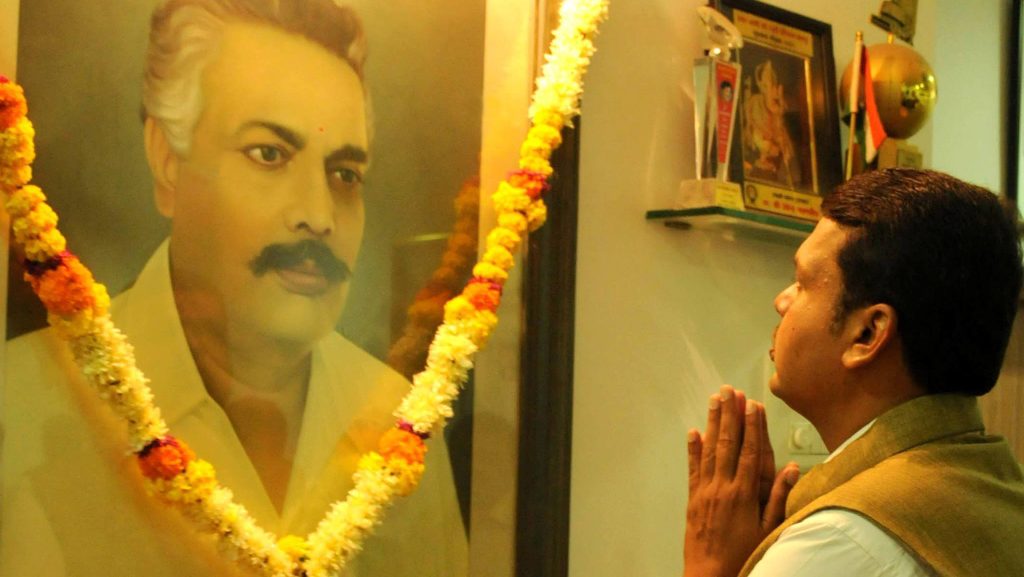
Devendra Fadnavis’s upbringing was deeply shaped by his family—especially his parents. Their values, principles, and influence are clearly reflected in his thoughts and leadership style. Devendraji’s father, Gangadharrao Fadnavis, served as a member of the Nagpur Municipal Corporation, Deputy Mayor, and later as a Member of the Maharashtra Legislative Council. He was a devoted volunteer of the Rashtriya Swayamsevak Sangh and worked sincerely in the fields of social service and public welfare.
Through his father’s life and work, Devendraji imbibed the values of transparency, public service, and politics rooted in ethics. The lessons of social responsibility and political life were learned at home itself, directly from his father. While listening to Devendraji’s speeches or his discussions on various issues, one can clearly sense the depth of his reading and scholarly approach. His love for reading was most likely inspired by his father, as Gangadharrao himself placed immense importance on reading. This habit helped him maintain a strong grasp over politics, social issues, and the economic dimensions of every subject. Today, we will learn more about Devendra Fadnavis’ father, Gangadharrao Fadnavis, and his political journey. Along with this, we will also take a look at his first speech in the legislature.
Biography of Gangadharrao Kashirao Fadnavis
Gangadharrao Fadnavis was born on 14 December 1935 in Mul, Chandrapur district. He completed his postgraduate studies (M.A.) in Logic & Philosophy. A committed worker of the Rashtriya Swayamsevak Sangh, he served twice as a Corporator in the Nagpur Municipal Corporation. He held the position of Deputy Mayor of Nagpur from 14 February 1975 to 7 March 1976. Speaking of his entry into state politics, he was first elected to the Maharashtra Legislative Council (MLC) from the Graduate Constituency on a Jansangh ticket. Subsequently, he was elected to the Legislative Council representing the Bharatiya Janata Party. His first term as an MLC was from 20 July 1978 to 17 July 1984, and his second term lasted from 23 July 1984 to 11 January 1988. In total, he served in the Legislative Council for ten years. In 1980, he served as the National Democratic Alliance’s Chief Whip in the Legislature. In his organisational political career, Gangadharrao Fadnavis worked across various executive bodies of the Jana Sangh and later the Bharatiya Janata Party. From 1962 to 1968, he served as Bhartiya Jana Sangh Mantri of West Nagpur. From 1968 to 1977, he was ‘Sah-Mantri’ of Nagpur Nagar Jana Sangh, followed by his tenure as ‘Maha-Mantri’ of Nagpur City Janata Party from 1977 to 1979. In 1980, he served as a member of the Bharatiya Janata Party’s executive committee of Nagar.
Professionally, Gangadharrao Fadnavis was engaged in agriculture and also owned a mosaic tiles factory. He additionally ran a juice centre (Rasvanti Gruh) in Nagpur. He was actively associated with several social organisations—serving as President of the Nagpur Milk Producers and Vendors Association, Advisor to the Janata Mill Workers Union, and as a member (and for some time Vice President) of the Nutan Bharat Club in Nagpur. He was also a member of the management board of Indira Gandhi Medical College.
While working with various institutions and organisations, Gangadharrao actively participated in several public movements, including labour movements, slum improvement campaigns, the Kutch Agreement agitation, ST fare hikes, and the Shimla Agreement movement. Due to his involvement, he was imprisoned during multiple agitations. During the Emergency, he spent a maximum of 19 months in prison.
A Journey of Service: Dedicated to Public Welfare
Gangadharrao Fadnavis is often described as the political mentor of Nitin Gadkari. Gangadharrao Fadnavis headed Gadkari’s first election campaign. Though originally from Mul in Chandrapur district, Gangadharrao began working in Nagpur as the party’s General Secretary. There, he played a key role in expanding and strengthening the organisation and gradually became deeply rooted in Nagpur itself. He ran a small business in Nagpur and also operated a Rasvanti Gruh (juice centre) at Laxmi Chowk in Dharampeth. Over time, this modest establishment evolved into a hub for political discussions. During the Emergency, Gangadharrao was imprisoned for 19 months. Even then, he remained actively involved in various programmes and movements of the Janata Party and the Rashtriya Swayamsevak Sangh. After the Emergency was lifted, he was released, and the party entrusted him with a new responsibility by fielding him as an MLC from the Vidarbha constituency. His tenure as a legislator gave a new dimension to his public work. During his ten years in the Legislative Council, he consistently raised issues related to education, teachers, labour, social organisations, and economic policy. Beyond politics, his commitment to social service was extensive. Room No. 401 at the Majestic MLA Hostel in Mumbai became a dependable shelter for citizens from Nagpur visiting the city. Along with his associates, Gangadharrao Fadnavis also founded Sadhana Bank. There was no commercial motive behind its establishment; the bank was created with the sole intention of generating financial resources for public service. For the past 35 to 40 years, the bank has been functioning steadily and responsibly.
The Battle with Cancer!
When Devendra Fadnavis was just 17 years old, in 1988, Gangadharrao Fadnavis passed away. He had been diagnosed with cancer and was taken from Nagpur to Tata Memorial Hospital in Mumbai for treatment. Unfortunately, despite medical efforts, he could not recover. During this period, the Fadnavis family faced immense hardship. At that time, Vidarbha lacked adequate cancer treatment facilities, forcing patients to travel long distances and endure severe difficulties. Determined to change this reality, Devendra Fadnavis later spearheaded the establishment of a state-of-the-art 450-bed National Cancer Institute in Nagpur. Today, it stands as a major lifeline for cancer patients across Central India.
Gangadharrao Fadnavis’s First Speech in the Legislature
Gangadharrao Kashirao Fadnavis was elected to the Maharashtra Legislative Council from the Vidarbha Graduate Constituency. On the very first day of the session, 20 July 1978, he participated in the discussion on the working report of the Maharashtra State Electricity Board. His speech on that occasion is reproduced below:
Shri G. K. Fadnavis (Vidarbha Graduate): “Honourable Chairman, since I have been given very little time to speak on this report, I will not go deeply into its details. However, I would like to give one example to show how much progress the Electricity Board has actually made and how that progress is experienced by the common citizen.
When the Electricity Board was first established in Nagpur, an ordinary person could get an electricity connection by paying just ₹50. Those were the earlier days. Today, however, a common man has to pay ₹300 to the Board to obtain a connection—without this payment, no connection is provided. Is the intention behind this to prevent poor people living in huts from taking electricity connections? If you visit such settlements, you will see their real condition. Even if a fuse blows in a poor man’s hut, the Board now charges ₹3 to replace it. Earlier, such minor repairs were done free of cost. The Board seems to have forgotten even this basic responsibility.
What surprises me is that those who earlier managed this Board are now sitting in the opposition. I would like to request the new Honourable Minister to at least reflect on these issues and ensure that electricity is supplied to the common man at the lowest possible cost.
Honourable Chairman, regarding temporary connections, respected member Smt. Pramila Tople has already highlighted some examples. If a member of this House wishes to hold a meeting in a village, a minimum deposit of ₹500 is required for a temporary electricity connection. As a result, even a local worker who wishes to present ideas before the people finds it nearly impossible to do so. I therefore humbly request the Minister to introduce some flexibility in the Board’s rules. Small and large electrical works should be made affordable for poor farmers.
Honourable Chairman, I have several cases of corruption with me, but due to lack of time, I am limiting myself to voicing the grievances of ordinary citizens. Temporary employees recruited by the Electricity Board are paid wages between ₹4 and ₹6. Government orders state that if an employee completes 120 days of service, they should be made permanent. However, to avoid this, the Board removes such workers on the 119th day without prior notice, forces them to stay home for 15 days, and thereby breaks their continuity of service. These employees should be taken on permanently and paid assured salaries. The same policy was followed in the case of bonded labour, though that practice has now been discontinued.
My humble request to those running the government is to intervene in these matters and resolve the grievances of the common people. With this, I conclude my speech.”
Along with such issues, Gangadharrao Fadnavis also forcefully raised his voice in the Legislature on matters including the devastation caused by floods in Akola city, police lathi-charge during the Nagpur bandh, supplementary expenditure demands, the state budget, compensation for independent professionals detained under MISA during the Emergency, and the need to allocate adequate funds for industries, employment, and development schemes for Vidarbha.