
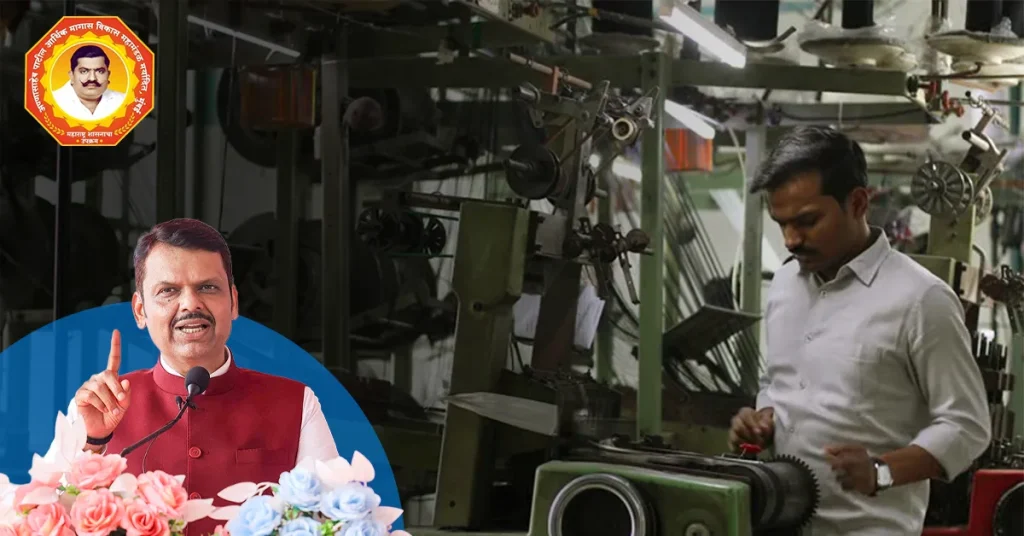
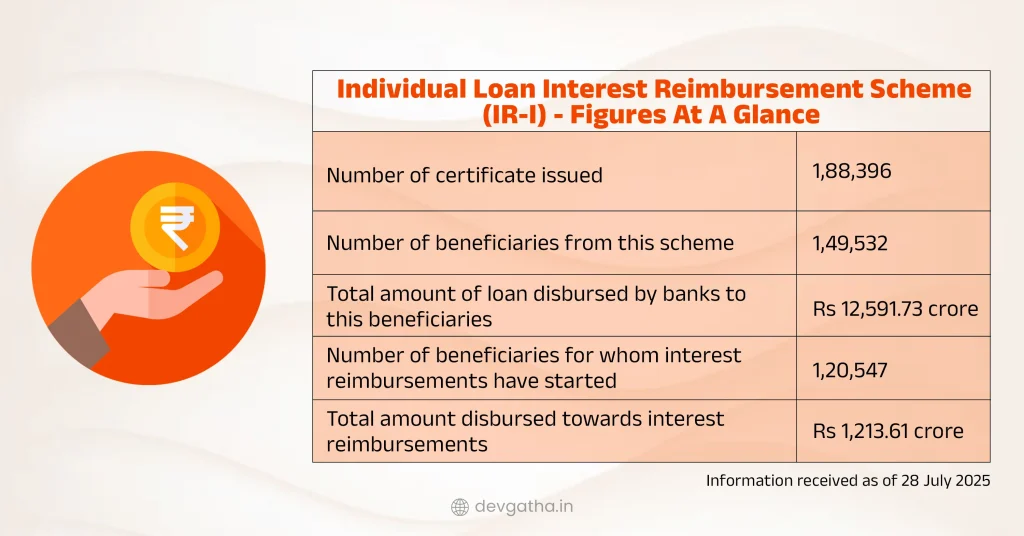
To provide self-employment opportunities to the educated but unemployed youth from the economically backward communities in the state, the Devendra Fadnavis government has, to date, disbursed a total of ₹1,247.79 crore to beneficiaries, either directly to the individuals or through groups, through the Annasaheb Patil Economic Development Corporation. Other than this, banks have reimbursed a total of ₹12,591.73 crore to 149,532 beneficiaries under the Individual Loan Interest Reimbursement Scheme. Through this initiative, 120,547 beneficiaries have already received interest reimbursed; so far, a sum of ₹1,213.61 crore in interest reimbursement has been disbursed to them. Under the Fadnavis government, the Annasaheb Patil Economic Development Corporation has become a major institution to foster self-employment and entrepreneurship among the young people from the Maratha community and other economically weaker sections of the society through several government initiatives. The government has endeavored to increase financial subsidies and enhance transparency by implementing strategic reforms and leveraging new technologies in these self employment loan schemes. This has empowered the economically backward, educated Maratha youth to stand on their own feet.
The Annasaheb Patil Economically Backward Development Corporation Limited, a Maharashtra government’s initiative established on August 29, 1998, with the sole purpose of providing financial assistance, self-employment training, and guidance to the economically weaker sections in Maharashtra, with a significant focus on youth from the Maratha community. Although the corporation’s goal was ambitious, its benefits failed to reach the target category mostly and the scope remained largely limited, due to poor planning and administration. However, after the Devendra Fadnavis government came to power in 2014, this institution attained its due importance and started making meaningful contributions to the Maratha community. This was because Devendra Fadnavis has always believed in self-reliance of the youth in the weaker sections of the society for their economical upliftment, and he envisioned the Annasaheb Patil institution as an instrument for guiding the youth of the Maratha community toward self-reliance and prosperity. Subsequently, several reforms were implemented in the Annasaheb Patil corporation in its functioning and schemes. To ensure a higher engagement of Maratha youth in the Maharashtra government’s initiatives through the Annasaheb Patil corporation, his government decided, first thing, to raise the annual income ceiling for eligibility under the corporation’s schemes. The annual income limit established in 2003 was notably low; as a result, a significant number of young Maratha people were unable to avail themselves of most of the schemes from the organization. With this issue in mind, Devendra Fadnavis raised the annual income limit to ₹6 lakh in March 2017. Later on, the government further increased this limit to ₹8 lakh. The outcome of this measure was that an ever-increasing number of young people from a wider range of families began to reap the benefits of these schemes.
The Organization’s Share Capital Increased from ₹50 Crore to ₹750 Crore
Devendra Fadnavis significantly increased the Corporation’s share capital, alongside adjusting the annual income limits. Previously, the Organization’s share capital stood at a mere ₹50 crore. The Devendra Fadnavis government decided to augment this figure, raising it to ₹400 crore during a State Cabinet meeting. This was done in two parts – increasing from Rs 50 crore to Rs 200 crore during the 2016-17 Winter Session and later from Rs 200 crore to Rs 400 crore during the 2017-18 Budget Session, bringing the total to ₹400 crore. Subsequently, in the 2025-26 budget, a decision was taken to further raise this share capital to ₹750 crore. With the expansion of the Annasaheb Patil Corporation’s share capital, the benefits of its schemes began reaching a wider segment of the youth population. Meanwhile, it was observed that certain existing schemes were not getting implemented effectively. Specifically, two schemes had performed very poorly over the preceding few years: the Seed Capital Loan Scheme and the Group Project Loan Scheme. While no loans had been disbursed to any group under the Group Project Loan Scheme since 2010, the Seed Capital Scheme saw majority of the loan takers had failed to repay the loans, which compelled the government to announce loan waivers periodically. Against this backdrop, during a meeting of the Cabinet Sub-committee held on October 24, 2017, a decision was taken to discontinue these two legacy ‘Annasaheb Patil Loan Schemes,’ and instead, introduce three new flagship schemes as outlined below.
Individual Loan Interest Reimbursement Scheme (IR-I)
The Annasaheb Patil Economically Backward Development Corporation’s interest reimbursement scheme is a Maharashtra government initiative providing interest-free loans to entrepreneurs from economically weaker sections. It supports self-employment by subsidizing interest for regular repayments. Under this scheme, the Corporation reimburses the interest on loans granted to unemployed youth from the Maratha community for self-employment purposes. Under this scheme, loans of up to a maximum of Rs 10 lakh can be sanctioned. However, the interest amount accrued on these loans, up to a maximum of Rs 3 lakh, is reimbursed directly by the Corporation into the beneficiary’s bank account. Notably, the first installment under this scheme is disbursed in the form of a government grant—a distinctive feature of the program.
In 2024, through the Annasaheb Patil Economic Development Corporation, bank loans totaling Rs 5,659 crore were sanctioned to 74,873 beneficiaries. Additionally, interest reimbursements amounting to Rs 608.12 crore were distributed to the beneficiaries under the Personal and Group Loan Interest Reimbursement Schemes. In 2025, a total of 149,532 beneficiaries availed the benefits of the Individual Loan Interest Reimbursement Scheme. Loans amounting to Rs 12,591.73 crore were disbursed to them, along with Rs 1,213.61 crore towards interest reimbursement.
Group Loan Interest Reimbursement Scheme (IR-II)
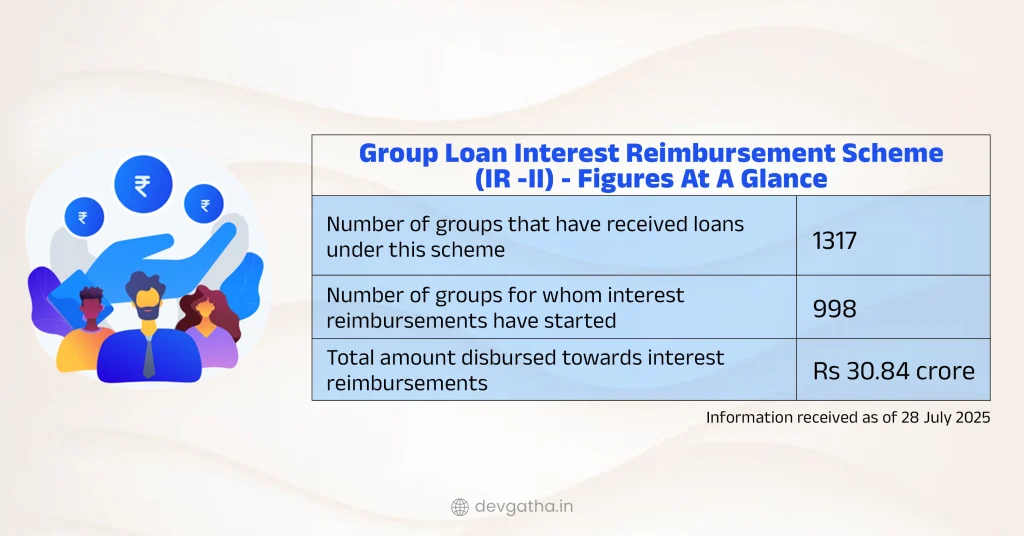
Under the Group Loan Interest Refund Scheme, groups comprising two or more members receive an interest refund on loans availed from a bank. Under this scheme, the loan limit has been set, ranging from ₹25 lakh to ₹50 lakh, depending on the size of the group. A key feature of this scheme is that it allows various types of groups, such as Farmer Producer Organizations (FPOs), Women’s Self-Help Groups, Cooperative Societies, and groups of persons with disabilities. Furthermore, the age limit criteria have been relaxed for these specific categories. The total number of groups that have received bank-approved loans under this scheme stands at 1,317. Of these, interest reimbursements have already commenced for 998 groups. To date, a total of ₹30.84 crore has been disbursed in the form of interest reimbursements under this scheme.
Group Project Loan Scheme (GL-I)
This scheme has been launched specifically for Maratha entrepreneurs who are executing projects in groups. Under this scheme, an interest-free loan of up to ₹10 lakh may be provided for projects. The loan is repayable over a period of 7 years. This loan is disbursed directly to the supplier or contractor through the bank. The funds obtained through this loan are primarily utilized for machinery, buildings, furniture, and industrial capital. To avail the benefits of this scheme, one guarantor and two co-guarantors are required. Currently, applications from 35 groups have been approved under this scheme, and a total amount of ₹3.35 crore has been sanctioned for them.
These three new schemes, initiated by the Devendra Fadnavis government through the Annasaheb Patil Economic Development Corporation have brought great opportunities to the youth of the Maratha community to establish themselves as entrepreneurs and foster economical empowerment for others in the communities. So far, numerous individuals have benefited through these schemes that are rooted in the principles of microfinancing and guidance to drive the economically weaker sections of the society towards prosperity.
Thus, under the leadership of Devendra Fadnavis, the Annasaheb Patil Economic Development Corporation acquired a new identity and direction. By discontinuing previous failed schemes and implementing new ones, the government extended effective support to the needy youth of the Maratha community. Consequently, many educated youths within the Maratha community have successfully launched their own businesses and are becoming self-reliant.
Related articles: