
Devendra Fadnavis is one of the most influential and visionary leaders in Maharashtra’s political landscape. During his tenure as CM from 2014 to 2019, and later as Deputy CM and Minister of Water Resources from 2022 to 2024, he took several landmark decisions for the state’s development. His contribution in the field of water resources has been crucial for Maharashtra’s agricultural, industrial, and social progress.
To provide relief to drought-affected regions and improve water management across the state, he implemented a series of strategic initiatives. Through the Jalyukt Shivar Abhiyan, significant goals were achieved—reviving groundwater reserves, raising the water table, and most importantly, ensuring sustainable water availability for agriculture. In addition, long-pending irrigation projects across various districts were revived with revised administrative approvals. New canals were constructed to bring water to villages, while repairs and maintenance of existing ones strengthened the efficiency of irrigation systems. These measures collectively enhanced the quality and utility of the state’s water resources. Whether it was the Marathwada Water Grid Project, which aimed to resolve the region’s long-standing drought issue, or the measures undertaken in Satara, Sangli, and Kolhapur districts to mitigate the recurring flood damage caused by the Krishna River, Devendra Fadnavis worked tirelessly to find long-term solutions. It is for these visionary efforts in water conservation and management that he is rightly known as Water Man Devendra Fadnavis. This article presents an overview of his initiatives and achievements as both CM and Minister of Water Resources.
Recognizing the importance of water conservation, Devendra Fadnavis launched the ‘Jalyukt Shivar Abhiyan’ during his earlier tenure. The campaign witnessed overwhelming public participation and soon transformed into a mass movement. Under this initiative, water conservation works were carried out in 22,000 villages across the state, significantly improving groundwater levels in drought-prone regions. Alongside this campaign, the state also implemented ‘Galmukt Dharan, Galayukt Shivar’ (Silt-free Dams, Fertile Fields). In the 2018–19 report of the Central Government, which revealed that groundwater levels had declined in almost every state across India — except Maharashtra. Several independent reports confirmed that the Jalyukt Shivar Abhiyan was the key reason behind this remarkable exception. In 2020, the Maha Vikas Aghadi government ordered an inquiry into the scheme, which led to its suspension. However, in June 2022, when the Mahayuti government came to power, the initiative was revived as ‘Jalyukt Shivar Abhiyan 2.0’. Under this renewed program, works were undertaken across 409 water reservoirs, directly benefiting 6,072 farmers and creating 667 crore litres of water storage capacity. Meanwhile, the state government also launched a massive effort to rejuvenate water reservoirs across 24,000 villages, providing tangible benefits to thousands of farmers.
Devendra Fadnavis’s determined efforts brought water to the drought-hit region of Mandesh
The Jihe-Kathapur Lift Irrigation Project in Satara, launched in 1997, remained incomplete for decades. Through Devendra Fadnavis’s determined efforts, this project was finally completed, bringing water to the drought-hit Man Desh region. It stands as a powerful example of how strong political will can drive real change. The Man-Khatav region receives very little rainfall due to its geographical conditions, forcing residents to battle drought year after year. But through sheer commitment and perseverance, Water Man Devendra Fadnavis succeeded in completing a project that had been stalled for 25 years, turning hope into reality for the people of the region. Similarly, the Nilwande Dam project in Ahilyadevi Nagar (Ahmednagar), pending for over 53 years, was completed under his leadership. This project resolved the drinking water problems of nearly 125 villages in Nashik and Ahilyadevi Nagar districts.
As Deputy Chief Minister and Water Resources Minister, Fadnavis has continued to approve and advance major irrigation projects, strengthening Maharashtra’s water infrastructure and ensuring lasting relief for farmers.
Approval for 10 Major Water Projects in Marathwada
In a significant step toward strengthening Maharashtra’s water resource development, the state cabinet approved a revised expenditure of ₹13,677 crore, covering 10 major irrigation projects in the Marathwada region. These projects will ensure a steady water supply for agriculture, providing substantial relief and support to farmers.
The cabinet also made an important decision regarding chain bund projects — instead of seeking separate administrative approvals for each dam, a single consolidated approval will now be granted for the entire project chain. This move will speed up the approval process and help accelerate project implementation across the state.
With these initiatives, the irrigation network in Marathwada will expand, water storage will increase, and long-standing water scarcity issues will be addressed. These irrigation projects will enable farmers to cultivate more profitable crops, leading to higher productivity, a stronger local economy, and improved employment opportunities in the region.
Approved Projects
- Ambad Flow Diversion Scheme (Tal. Dindori, Dist. Nashik)
- Nimna Dudhana Project (Tal. Phulambri, Dist. Nanded)
- Wakod Project (Tal. Upper Painganga Project, Pusad, Dist. Yavatmal)
- Pota High-Level Barrage (Tal. Aundha Nagnath, Dist. Hingoli)
- Jodparli High-Level Barrage (Tal. Vasmat, Dist. Hingoli)
- Pimpalgaon Kute High-Level Barrage (Tal. Vasmat, Dist. Hingoli)
- Mamdapur High-Level Barrage (Tal. Purna, Dist. Parbhani)
- Unkeshwar High-Level Barrage (Tal. Vasmat, Dist. Hingoli)
- Mamdapur High-Level Barrage (Tal. Purna, Dist. Parbhani)
- Unkeshwar High-Level Barrage (Tal. Kinwat, Dist. Nanded)
Cabinet Decision: 16 September, 2023
Sambarkund Dam and Vandre Dam Water Supply Scheme
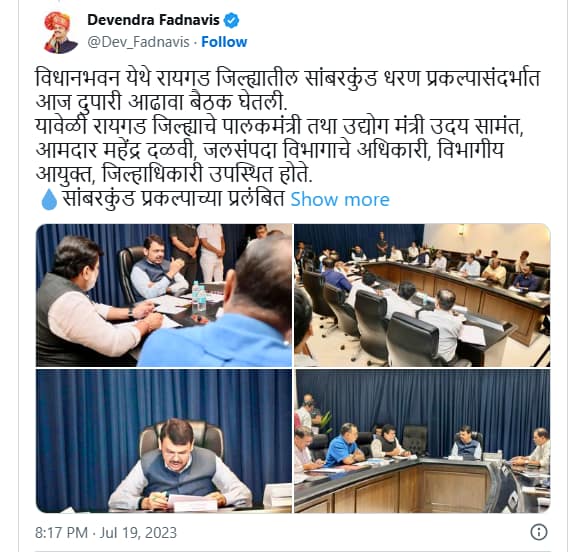
The Sambarkund Dam project is crucial for ensuring the water supply of Alibag city in Raigad district. Due to delays in its implementation, the drinking water situation in the city had become increasingly serious. In this context, the then Deputy Chief Minister and Water Resources Minister Devendra Fadnavis held a review meeting in the Legislature to expedite the project. He discussed all issues with officials and issued instructions to resolve them quickly.
The main obstacle was land acquisition, and the Revenue Department was directed to take immediate steps to clear these hurdles. Instructions were also given to ensure fair compensation to the project-affected families.
The Vandre Irrigation Project is proposed on a stream near Vandre village in Murud taluka of Raigad district. This project will play an important role in water management and irrigation in the region. It has a catchment area of 7.818 sq. km and is expected to store 10.549 MCum of water. Once completed, the project will bring 667 hectares under irrigation.
A total of 16 villages will benefit from this project: Mazgaon, Nandgaon, Dhand, Pangli, Adi, Khardokule, Kharikwada, Aravghar, Walvati, Chikhlad, Ambiste, Usroli, Kashid, Velaste, Vihur, and Manor.
With the cooperation of the local administration, the Revenue Department, and project-affected families, the project is expected to be completed successfully soon.
Along with major water supply and irrigation projects, Devendra Fadnavis also ensured that citizens receive transparent and easy access to information about the schemes and projects implemented by the Water Resources Department. For this purpose, the websites of the five irrigation development corporations—Konkan Irrigation Development Corporation, Maharashtra Krishna Valley Development Corporation, Tapi Irrigation Development Corporation, Godavari Marathwada Irrigation Development Corporation, and Vidarbha Irrigation Development Corporation—were updated and made publicly accessible.
Additionally, Water Resources Minister Devendra Fadnavis approved ₹890.64 crore for the Brahmagavhan Lift Irrigation Scheme in Chhatrapati Sambhajinagar district; ₹2,288.31 crore for the Waghur Project in Jalgaon district; and ₹1,491.95 crore for the Bhatsa Project in Shahapur taluka of Thane district.
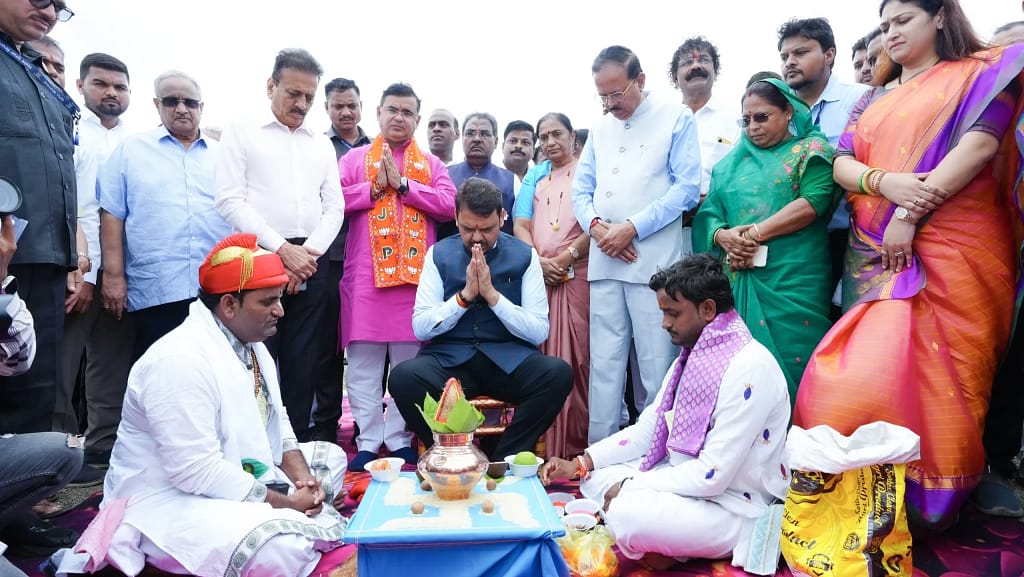
A few months ago, he also reviewed and performed the bhoomipujan for the work of supplying water through a closed pipeline to the 26,907-hectare command area of the Sulwade–Jamphal–Kanoli Lift Irrigation Scheme in Dhule district.
Through these initiatives, Devendra Fadnavis has given new direction to Maharashtra’s progress in the water resources sector. Under his leadership, these schemes have not only improved water management but also ensured drinking water for drought-prone regions. As a result, farmers now have reliable water for agriculture, and industries have access to water necessary for their operations.
Related articles:
- Magel Tyala Shettale Scheme – Facilitating Farmers with Micro Irrigation
- Maharashtra River Linking Project: Sharing river waters for drought relief
- Water Man Devendra Fadnavis’ drive to step up sustainable irrigation in the state. 381 irrigation project schemes have been approved to bring 30 lakh hectares of area under irrigation