
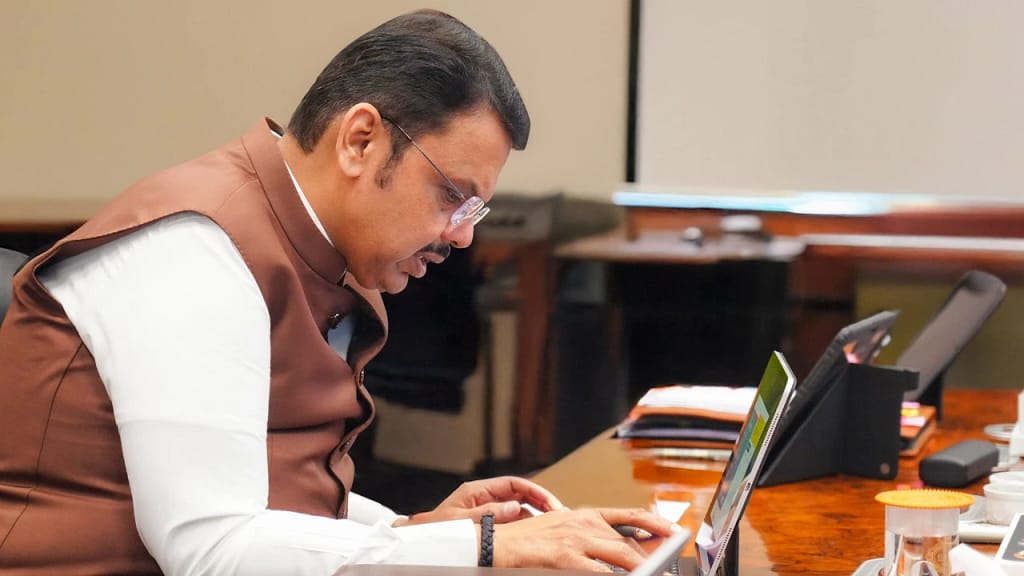
Upon taking oath as Chief Minister for the 3rd time, Devendra Fadnavis initiated a 100-day program under which all state government departments and offices were required to improve their cleanliness and hygiene levels, look neat & tidy, and adopt a people-centric work culture. The objective of this drive was to create a positive image of the government offices through ensuring an improved overall experience for the visitors. Now, continuing with his inward reforms in the government procedures, CM Fadnavis has adopted a milestone initiative called e-Cabinet, which is about conducting virtual cabinet meetings. This reflects Devendra Fadnavis’s commitment to boosting the efficiency of his government through faster decision-making and enhanced effective cabinet throughput.
Benefits of e-Cabinet meeting
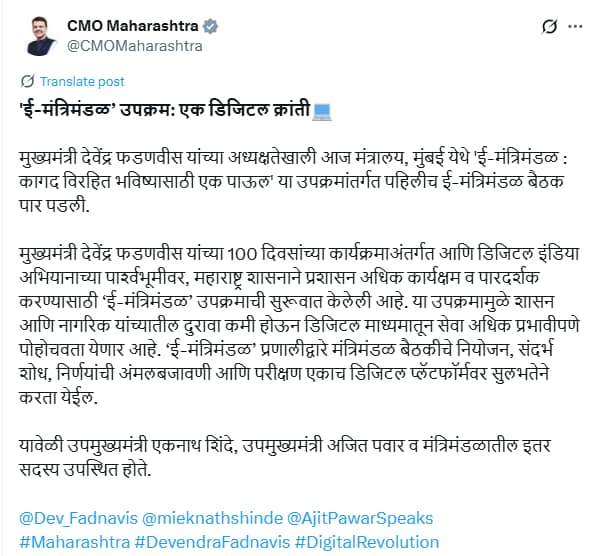
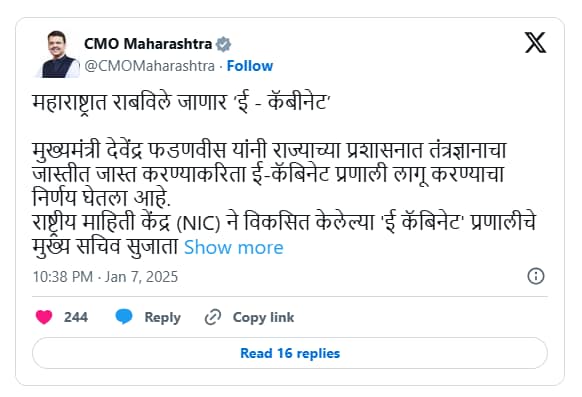
Similar to the central government, the Devendra Fadnavis-led state government began using the e-Cabinet system from June 24, 2025. In a sense, e-Cabinet is a natural progression to e-governance (Aaple Sarkar) introduced by his earlier government, which became a towering success, providing quick and transparent governance to citizens across the state. Other recent initiatives on technology adoption in the state government include the digitalization of certain functions of the Maharashtra Legislative Assembly and providing tablets to members of both houses to help with information searching for questioning and also for receiving written responses. Now, with the implementation of the e-cabinet system, the government will be able to conduct faster, more effective, and paperless cabinet meetings. The e-cabinet will allow all cabinet ministers to have easy access to the proposals, agenda, and related documents for the cabinet meetings just by clicking on their iPads. Apart from its other benefits, the e-cabinet system will also ensure the confidentiality of cabinet matters. In addition, the e-Cabinet will be linked with e-governance to provide access to all information regarding cabinet meetings, planning, context, implementation of decisions, and its functioning.
What is e-Cabinet?
A cabinet is a core group formed by the senior ministers and is the highest decision-making body of the government that formulates and implements policies critical for running a state through cabinet meetings. Conventional cabinet meetings typically involve the high cost and lengthy process of preparing documentation, poor document control, delays in information sharing, and a slow rate in processing cabinet decisions. E-cabinet is a combination of digital technology techniques for running virtual cabinet meetings and related institutional arrangements. This empowers cabinet members with real-time information and knowledge needed for speedy decisions. This ensures that all stages in the government decision-making workflow, such as preparations, submission, and approval of proposals, are synchronized with the cabinet schedule and meetings, and in an absolutely paperless way. Other important aspects of the e-cabinet system include the improved communication and collaboration between government ministries, departments, and agencies on cabinet decisions; greater transparency and accountability; improved confidentiality; and cost savings. Together with e-governance, the e-cabinet brings speed and efficiency to a government’s functioning and delivery of benefits to the citizens.
An e-cabinet is conducted through a portal that the chief minister and other cabinet ministers can easily access using their tablets or other devices and read notices, topics, and dates & times before joining a meeting simply by pressing buttons. Later, they may also review the context, action points, and the implementation of decisions taken in a meeting. The Information and Technology Department of the government has hired dedicated engineers to manage the e-Cabinet system and assist ministers as needed. The iPads provided to the ministers will enable them to join e-Cabinet, perform other functions through the e-office system, conduct video conferencing meetings, review schemes on dashboards, check service status on Aaple Sarkar, and more. As it houses numerous government-related apps, these iPads will be very useful for ministers to work digitally.
Fadnavis Government’s Digital Maharashtra initiatives
Devendra Fadnavis’s vision for the development of the state is complemented by his Digital Maharashtra initiatives to arm the state with a robust digital infrastructure. The e-cabinet meeting is an important step to that end, which will significantly improve the decision-making process at the top and influence the lower levels of the workflow, meeting citizens’ expectations and speedy development in the state.
After assuming office as CM for the third time, Devendra Fadnavis stated that enhancing the ease of living for the public, improving efficiency in government offices, and ensuring better governance will be among the initial focus areas of his government. To this end, he, flanked by both Dy. CMs, addressed key officials, including divisional commissioners, district collectors, municipal commissioners, police commissioners, and superintendents of police, launching a seven-point program for all state government departments in the state for the next 100 days.
Seven-point directives from CM Fadnavis
1. Every department must have an up-to-date and secure website, ensuring that Right to Information (RTI) requests are answered promptly, with correct information. He also stressed protecting websites from cyber threats.
2. Government offices should be kept clutter-free and clean. Unnecessary files and unused vehicles should be removed from the office.
3. People should have access to drinking water in the office. Clean washrooms should also be ensured.
4. The number of pending tasks in the government offices should be reduced to zero, and if people want to meet government officials, they should be informed in advance when the officials will be available.
5. To avoid crowds in the ministries, local-level issues should be resolved at the taluka and district levels. Activities like Democracy Day should be implemented for this purpose.
6. To promote ease of doing business, entrepreneurs should not face any difficulties in setting up or running their businesses in the state. Divisional commissioners and district collectors should interact with the representatives of entrepreneurs.
7. Officials should regularly visit villages, schools, and health centres, as well as important projects, programs, and schemes in the district. A schedule for these visits should be established.
Following the successful implementation of the 100-day program, Chief Minister Devendra Fadnavis has established a 150-day program aimed at setting long-term goals for the years 2029, 2035, and 2047. The long-term goals include improving e-governance processes, more digitalization of government services to boost efficiency, ensuring better governance for the common man, and creating a developed Maharashtra.
Decisions in the first e-Cabinet meeting
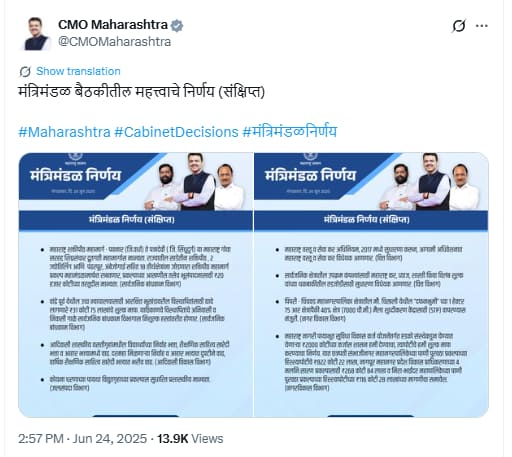
The first e-Cabinet meeting (Maharashtra’s first eCABINET) was held on June 24, 2025, under the chairmanship of Chief Minister Devendra Fadnavis. In this first e-Cabinet meeting, the Urban Development Department, Public Works Department, Finance Department, Water Resources Department, and Tribal Development Department took the following decisions.
- A provision of ₹20,000 crore was approved towards land acquisition for the Maharashtra Shaktipeeth Highway from Pavanar (Wardha) to Patra Devi (Sindhudurg).
- The pending fee of ₹31.75 crore due from the people removed from the plot reserved for the High Court in Bandra East was waived off. It was also decided to transfer the land to the Public Works Department free of charge.
- Raise the subsistence allowance, study material purchase allowance, and food allowance for students in tribal government hostels.
- Grant revised administrative approval to the powerhouse project below the Koyna Dam.
- The state government will introduce the Maharashtra Goods and Services Tax Bill in the upcoming session, amending the GST Act 2017.
- The government will introduce an amendment bill for the settlement of outstanding Maharashtra taxes, interest, penalties, or late fees for public sector companies.
- Approval granted for the use of 7,000 square meters of land from the 1-hectare (75 R) cemetery area in Chikhli, in the Pimpri-Chinchwad Municipal Corporation area, for a sewage treatment plant.
- Providing a government guarantee with a waiver of the guarantee fee for a loan of ₹2,000 crore to be taken from HUDCO under the Maharashtra Urban Infrastructure Development Loan Scheme.
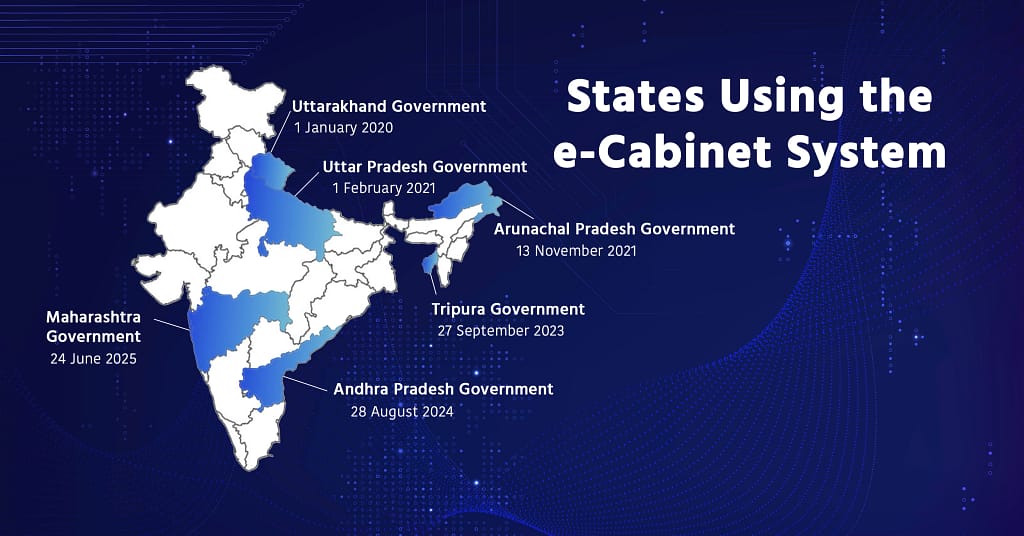
States Using the e-Cabinet System
Currently, the central government, along with the states of Uttarakhand, Uttar Pradesh, Arunachal Pradesh, Tripura, and Andhra Pradesh, is using the e-Cabinet system. Maharashtra has now joined the list. In the coming days, the states of Madhya Pradesh, Karnataka, and Sikkim will also soon begin using the e-Cabinet system. The e-Cabinet system will make government administration transparent and dynamic. Under the leadership of the Fadnavis government, Maharashtra is truly realizing the concept of ‘Digital India.’
Related articles: