
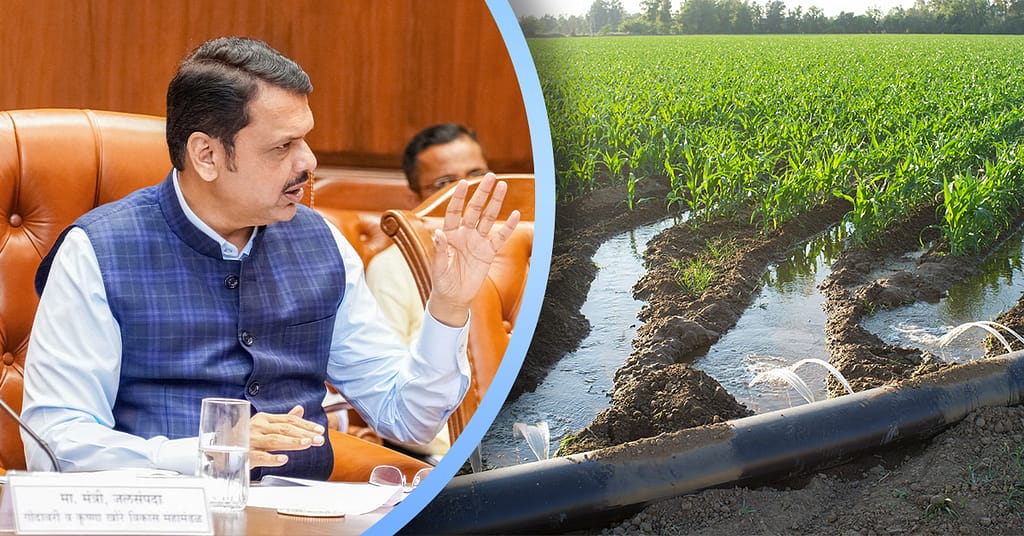
Another crucial irrigation project in Maharashtra has started sailing after being stuck for decades, with a strong tailwind from CM Fadnavis. The Gunjawani irrigation project, the first piped irrigation project in Maharashtra, is undergoing speedy implementation with all obstructions cleared. Chief Minister Devendra Fadnavis, known as the Water Man of Maharashtra, not only expedited administrative decisions and did the needful to obtain the necessary approvals from the state and central ministries but also ensured the central funding for the project by linking it to the central policy of promoting piped irrigation systems under the Central Water Commission.
The Gunjwani water irrigation scheme is the first of its kind in the state in the sense that it will use underground pipelines for delivering water from the dam for irrigation, instead of the current open canal system. Both the right canal (20.37 km long) and the left canal (83.7 km long) will be used for providing farmers with high-pressured water through an underground pipe network round the year. Each eligible farmer will be able to irrigate six acres of land (approximately 2.4 ha) without the need for electricity or pumps. This type of underground pipeline irrigation system will eliminate the chances of water theft and at the same time lower evaporation and seepage. This will result in significant water savings and increased project efficiency.
Under the Central Government’s Piped Irrigation Network (PIN) policy, the Gunjavani Water Supply Project will irrigate 21,392 hectares in the Bhor, Velha, and Purandar talukas of Pune district. With a capacity of 4.17 billion cubic feet, this project will provide farmers with direct water from the pipeline. The government has decided to expedite this stalled project and provide farmers with cheap and sufficient irrigation water through this eco-friendly and technically sound piped irrigation project.
The Gunjawani Project in the Pune district is falling under the jurisdiction of the Maharashtra Krishna Basin Development Corporation. It was first approved in 1993, on October 16, by the then government for a cost of ₹86.77 crore. However, the construction halted in 1999 due to rehabilitation problems. But the cost kept increasing; the revised cost became ₹316.60 crore in 2002 and ₹1313.73 crore in 2018. The then Devendra Fadnavis government approved the second revised cost in December 2018 as part of a broader push to complete long-delayed irrigation projects and address water shortages in drought-prone regions of Maharashtra. However, the project execution was delayed again for nearly three years due to two petitions filed against it in the Bombay High Court. In November 2020, the ruling of the court came in favour of the project, clearing the path to begin the actual work. Meanwhile, due to delays because of COVID-19 and court adjournments in 2019, the total project cost increased to ₹1,892 crore. Therefore, Chief Minister Devendra Fadnavis ordered the State Technical Advisory Council to submit a revised proposal for approval of the revised cost.
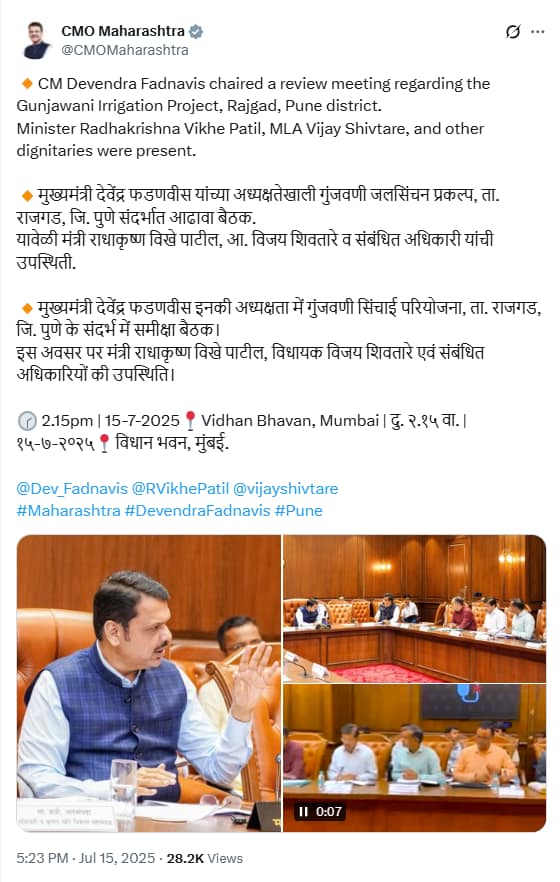
The Gunjawani dam is an earthfill and gravity dam with a capacity of 3.69 billion cubic feet, constructed on the Kanandi River at Mauja Dhanep (Tal. Velha, District Pune), which will supply water through the right and left canals as well as the Narayanpur Lift Irrigation Scheme. During his first term as Chief Minister, then from 2022 onwards as Deputy Chief Minister and Water Resources Minister, and now in his second term as Chief Minister, Devendra Fadnavis consistently reviewed the progress of the Gunjawani piped irrigation project, approved the revised administrative costs to resume operation, and gave a strong push for its timely completion and the use of modern, closed-pipe distribution systems. At a review meeting on July 15, 2025, he set the completion date for main water channels of the Gunjawani project to July 2026 and the completion of sub-distributor drains to March 2027. It has also been stated that a proposal for the third revised administrative approval of this project should be sent to the State Technical Advisory Committee. And, apart from the central funds, the state government will also allocate some funds in order to accelerate the project completion. Also, as the project area falls within the Western Ghats Environmental Zone, CM took the initiative to obtain the No Objection Certificate (NOC) from the Central Environment Committee.
Overall, the Gunjwani project is currently in progress under the close monitoring of CM Fadnavis. Maintaining all environmental guidelines and utilizing modern technology, it is set to be an exemplary and important project for Maharashtra, providing water for irrigation to 16 villages in the Pune district.
Related articles: