
The Gadchiroli district, established on August 26, 1982, has a history of Maoist extremism, deprivation, and lack of development. Considered a Naxal belt, Gadchiroli would often make headlines with spine-chilling violence by the Maoists, who were running a parallel government in the district. The situation there was so bad that the state practically had no administrative control over the district, and as a result, there was nothing but apathy from the successive governments, which left mineral-rich Gadchiroli as an underdeveloped, prohibited region.
The first ray of hope appeared in 2014 with the changes in political dispensations at the centre and in the state. Under the Narendra Modi government at the centre and the Devendra Fadnavis government in the state, a joint drive was launched to free Maharashtra of the Maoist extremism and bring the affected regions into the mainstream of society through comprehensive development.
Unlike his predecessors, CM Devendra Fadnavis wouldn’t want to leave Gadchiroli to its status quo as a Naxal-ruled area but wanted to liberate the district from the Naxal terror and put it on the development track. However, he did not intend to eradicate the district’s reputation as a “Naxal hotbed” solely through force, but rather by fostering development, security, and trust among the local population. He firmly believed that guns alone could not eradicate Naxalism, but rather, development, education, and job creation for the youth could. With this conviction, he adopted a two-pronged strategy—combining robust security operations to combat the armed, hardcore Maoist operatives through deployment of the police force’s state-of-the-art C-60 Commando Force and at the same time initiating a foundation for development in the region. His relentless efforts through the years led to confidence building among the businesses for setting up industries and institutions in Gadchiroli, creating jobs and prosperity for the people and the region as a whole. This induced a gradual change in the mindset of the youth, shedding the Naxalite ideology for a social, peaceful, and pro-development stance.
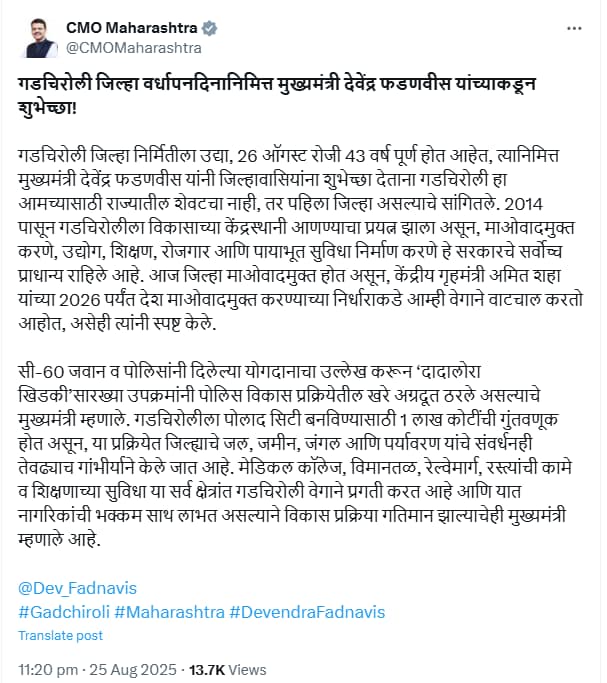
Today, when the state is celebrating the 43rd anniversary of Gadchiroli Foundation Day, one may recall that most of this period was like a passage through a long dark tunnel that first saw the light at the far end 11 years ago when Devendra Fadnavis took the reins in 2014.
A peek into Gadchiroli’s history
Gadchiroli district was carved out of Chandrapur district on August 26, 1982 (Gadchiroli Foundation Day) to become the 31st district of Maharashtra. The two talukas of Gadchiroli and Sironcha were previously parts of Chandrapur district. Located in the northeast of Maharashtra and bordering the states of Telangana and Chhattisgarh, Gadchiroli quickly became an easy pasture for the Naxalites, as the maximum area (76%) in this largely tribal-populated district was covered with dense forest and marred with deprivation, poverty, poor communication, and backwardness. The people here primarily speak Gondi, Madia, Marathi, Hindi, Telugu, Bengali, and Chhattisgarhi. Gadchiroli district has a total of 12 talukas. The district has 12 Panchayat Samitis, 9 Nagar Panchayats, and municipalities in the cities of Gadchiroli, Desaiganj (Wadsa), and Armori.
Allaying fears among the tribal community…
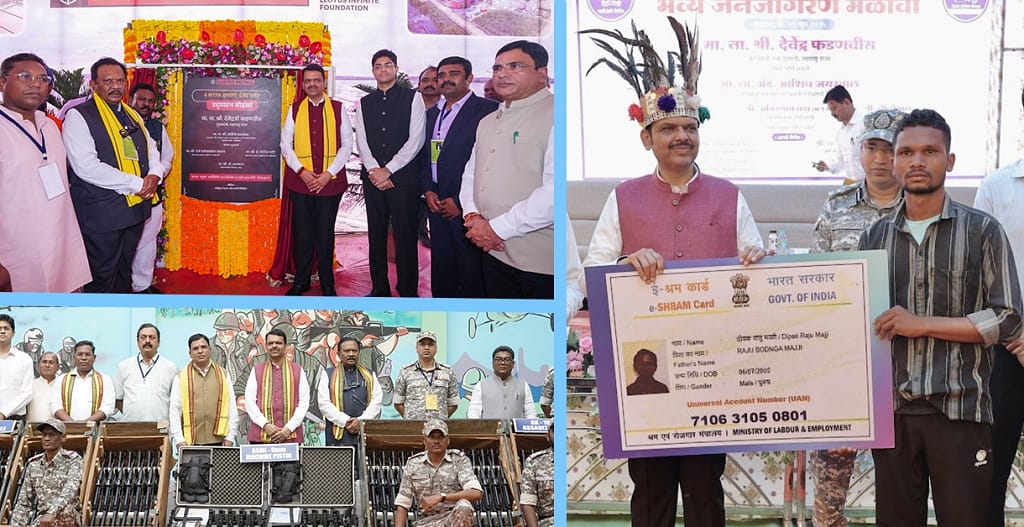
In 2015, the Fadnavis government reviewed the security arrangements in Gadchiroli district and initiated modernization of the police force by providing state-of-the-art weaponry, enhancing mobile connectivity in the forests, and establishing a network among the police stations. Also, new police stations were established in areas like Gardevada, Vangeturi, Gatta, and Aheri to conduct joint operations with the CRPF and special purpose commando teams under the central home ministry. In villages under Naxalite intimidation, the police took initiatives to become “friends of the people” by communicating with the people through initiatives like the Dadalora Khidki. These processes over time helped the tribal community of Gadchiroli get over the fear and participate in the government’s developmental initiatives.
But security alone wasn’t enough to bring transformation to Gadchiroli; it required infrastructure, education, health, and employment opportunities. Devendra Fadnavis appointed the Gadchiroli MLA as the district’s guardian minister from 2014 to 2019 for setting priorities and actions. Then, in 2022, as the Deputy CM and Home Minister, Fadnavis himself assumed the responsibility of Gadchiroli’s guardian minister, which he continues even to date alongside the Chief Ministership of the state. During this period, he personally visited the most remote areas, interacting directly with tribals and other populations in the district to assess the security, governance, and developmental drives. His personal involvement pivoted infrastructure developments in Gadchiroli with roads, schools, healthcare, and clean water, as well as electricity and mobile networks reaching every village. As a result of these efforts, Naxalite recruitment has significantly declined in recent years, with many Naxalites surrendering and joining the mainstream. Gadchiroli’s youth are now turning to education, skill development, and employment instead of guns.
Gadchiroli has a wealth of mineral resources, which can turn it into a major industrial town in the country to ramp up growth of the entire region. A determined CM Devendra Fadnavis adopted a strategy for the industrialization of Gadchiroli district by conducting mining operations in the district and encouraging companies in the steel, cement, and mineral sectors to set up plants there. This paved the way for the employment opportunities for local youth and Gadchiroli’s economic development. The mega steel project at Surjagad in Konsari is a symbol of this. The groundbreaking ceremony for the Rs 10000 crore Surjagad Steel Company project held on July 17, 2024, was a historic moment in the transformation of Gadchiroli district, creating employment for the youth in the district. In the next phase, the Lloyd Metals and Energy Limited steel plant was inaugurated. Alongside this, the Kali Ammal Hospital, a CBSE school, a skill development centre, police officer quarters, a help centre, and a gymkhana were established. All these projects not only created employment in Gadchiroli but also transformed the social and economic landscape of the area. The foundation bed on which all these projects are standing today was created during Fadnavis’s 1st term as Chief Minister.
Gadchiroli moving from the fear of terror to the happiness of prosperity
A landmark moment in the transformation of Gadchiroli district is setting up a 24X7 police station at the infamous Nelgunda. Once the training place for the extremist recruits, it now has a police station. This is the district’s real victory. In addition, the Nagpur–Mumbai Prosperity Highway has been extended to reach Gadchiroli. Devendra Fadnavis has built an identity not just as the face of the government but as a leader with a bond to the people of Gadchiroli. By attending the mass wedding of surrendered Maoist youth, he sent a message of social rehabilitation. Gadchiroli’s change into a “steel hub” is not merely development—it’s a triumph of confidence.
Today, as the Gadchiroli district’s foundation day marks its 43rd anniversary, the district is on a complete turnaround to have its place among the leading districts of Maharashtra in terms of growth and opportunities. Rising from the shadow of insurgency, Gadchiroli is heading to become a prominent hub for steel and other industries and a centre for education and health—thanks to Devendra Fadnavis’s leadership, vision, and personal commitment to the district.
Related articles:
- How Devendra Fadnavis is transforming Gadchiroli from a dangerous Naxalite territory into a fast-developing district
- Infra Man Devendra Fadnavis’ resolve to transform Gadchiroli into a steel production hub
- Compassionate and Responsive Chief Minister Devendra Fadnavis; Comes to the Aid of a Desperate Family in Gadchiroli!