

Mumbai is known for many legends; one of them is the Dabbawala service. A born-of-the-soil idea of a lunchbox delivery service seeded 135 years ago, which grew into a globally recognized human-run network operating with remarkable accuracy and punctuality, feeding several lakhs of office workers in Mumbai every day. The white-dressed and white-topi-clad dabbawallas whisking through South Mumbai streets with 10-12 tiffin carriers each are a common sight. Today, their diligence and discipline, which are the sole capital for them to run an incredibly efficient network of about 5000 dabbawalas, delivering home-cooked food all by manual process, are a matter of research and have earned them a place in the Guinness Book of World Records.
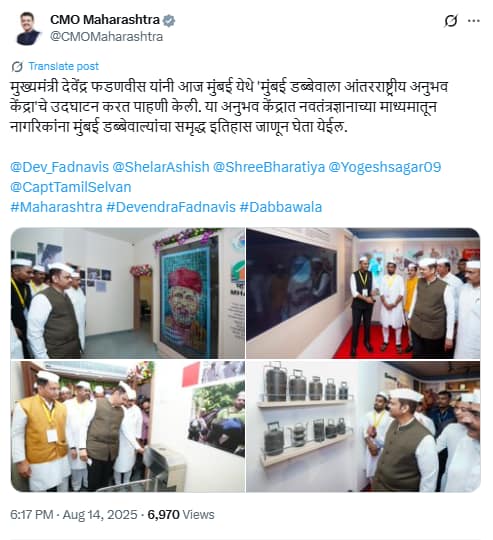
This century-old legacy of unique contribution to society has been recognized by the current Fadnavis government by implementing key initiatives for the Dabbawala community, focusing on housing benefits and the establishment of a museum and experience centre. First, the government initiated a plan to build a housing project for Dabbawalas and the Charmakar (cobbler) community under the Pradhan Mantri Awas Yojana (PMAY), and later on 14 August, 2025, CM Devendra Fadnavis inaugurated the Mumbai Dabbawala International Experience Centre.
The Mumbai Dabbawala International Experience Centre has been developed by converting the historic Dabbawala Bhavan in Bandra into a gallery that depicts their 135-year legacy. The centre uses modern technology and virtual reality to showcase the journey of a tiffin from kitchen to delivery, highlighting their unique management and coding practices that have earned global recognition. Calling the ‘Dabbawala Centre’ a tribute to their extraordinary service, discipline, and the perfect harmony of tradition and innovation that embodies the spirit of Mumbai, CM Fadnavis referred to the inauguration as a “landmark moment” in preserving and showcasing the city’s unique heritage.
What is in the Dabbawala International Experience Centre?
The Mumbai Dabbawala International Experience Centre (MDIEC), a gallery depicting the life, times, and contribution of dabbawalas, has been established in a 3,000-square-foot space in the Harmony Building on Carter Road in Bandra West, Mumbai.
In this experience centre, the visitors will receive an immersive experience—wearing virtual reality goggles, they will be able to simulate a dabbawala’s daily work cycle, i.e., collecting dabbas from homes, transporting them via local trains and other modes of transport, sorting them, and finally delivering them to the right people at different offices. One section of the centre displays the antiques, like tiffin carriers used in different times, bicycles, handcarts, and other paraphernalia associated with the service. A photowall displays memorable photographs related to the dabbawalas. Also, there is an interactive game for the visitor to track a tiffin as it passes hands from one dabbawala to another, using the code typically used by the dabbawalas. The entire tour can take around 25 minutes, with the centre charging a nominal fee from the visitors.
History of Mumbai’s dabbawalas
Mumbai dabbawala history is 135 years old. In 1890, Mahadu Havji Bache, who had come to Mumbai from Rajgurunagar taluka in Pune district to earn a living, first delivered a tiffin to a Parsi banker. That service has grown into the giant dabbawala service of today. According to various newspapers, roughly 1,400 dabbawalas are currently working in Mumbai. Their chain management delivers meals to nearly 100,000 people. A single tiffin that arrives with the dabbawalas changes hands between 3 to 4 people—until it reaches the customer.
Human intelligence-based management of the Mumbai’s dabbawalas
The Mumbai Dabbawala system is a world-renowned example of operational excellence managed almost entirely through human intelligence, discipline, trust, and a unique color-coding system, with minimal reliance on modern technology. This human-centric approach enables them to achieve a near-perfect accuracy rate (Six Sigma level, or one error in over 16 million deliveries) in a complex urban environment. The Indian Postal Department has honored their work and issued a postage stamp in recognition of their service. Following are the key aspects of the human intelligence-based management system of the dabbawalas:
- Decentralized Decision-Making: Each group and individual dabbawala is empowered to make on-the-ground decisions to address real-time challenges like traffic or train delays without waiting for central authority’s approval.
- Unique Coding System: The core of their logistics is a simple, non-verbal alphanumeric and color-code painted on each tiffin box. This visual language indicates the origin station, destination building, floor number, and handling dabbawala, allowing even semi-literate workers to sort and deliver with precision.
- Deep Local Knowledge: Dabbawalas rely on their extensive knowledge of Mumbai’s geography, local train networks, shortcuts, and building specifics, information that is difficult to program into a generic software system.
500 square feet homes for dabbawalas at Rs. 2,550,000
Chief Minister Devendra Fadnavis has taken committed steps over time to improve the living standards of the dabbawalas. To ensure that they can live with dignity in legally owned homes, the Chief Minister’s big announcement for dabbawalas came on September 23, 2024, of a major scheme to provide fully equipped 500‑square‑foot houses to dabbawalas under the Pradhan Mantri Awas Yojana and other programs for just Rs. 25,50,000. These housing projects will include faster and easier access to railway stations, which is vital for the Dabbawalas’ work. Meanwhile, in 2024 an agreement was signed between Mumbai’s dabbawalas, the Leathermakers Association, and Priyanka Homes Realty for building 12000 homes under the MHADA scheme.
Foundation stone laying ceremony and inauguration
Recognizing the dabbawala’s unique contribution to increasing employees’ productivity in Mumbai’s business environment, the Devendra Fadnavis government (both during his tenure as CM and later as Deputy CM) had undertaken two major initiatives—providing low-cost housing for the dabbawalas and establishing a Dabbawala Experience Centre in Mumbai. While the former project is going steady for completion as scheduled, the later project has been completed and inaugurated in time. Devendra Fadnavis laid the foundation stone for Mumbai’s Dabbawala Experience Centre on 30 November 2023, when he was Deputy Chief Minister of the state. In just two to two-and-a-half years the centre was inaugurated by him as Chief Minister. Devendra Fadnavis is widely considered to have a strong record in initiating and accelerating the completion of numerous projects, particularly large-scale infrastructure and water conservation schemes in Maharashtra.
The Dabbawala Museum, or the International Experience Centre, is both a tribute to their extraordinary service and a celebration of Mumbai’s spirit, representing the perfect blend of tradition and innovation. The visitors will come to know about the unique management and coding practices of the dabbawalas, with which they have performed like a well-oiled regiment and earned global acknowledgements. The history and relics of the simple yet highly efficient teamwork by the Warkari people will raise the eyebrows of the visitors.
Related articles: