
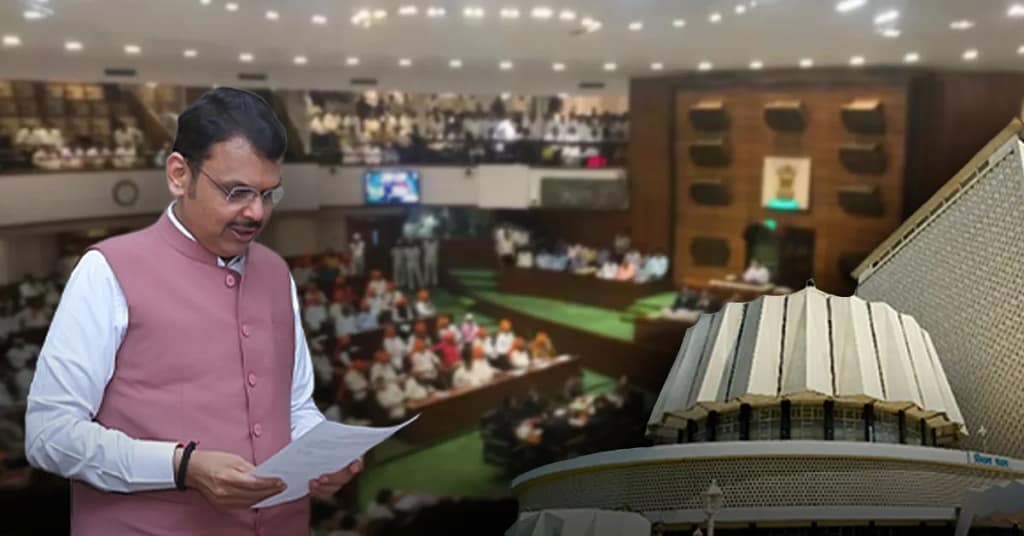
The recently concluded monsoon session of the Maharashtra assembly saw several bills passed by the government, among which four bills were of significant importance, as they would bring key changes to the state’s internal security and legal structures, accelerate developments in Gadchiroli, and help organize the Nashik Kumbh Mela 2027 in a proper manner. These four bills, namely, the ‘Maharashtra Special Public Safety Bill, 2025’; the ‘Gadchiroli District Mining Authority Act, 2025’; the ‘Nashik-Trimbakeshwar Kumbh Mela Authority Act, 2025’; and the ‘Maharashtra Control of Organized Crime (MCOCA), 1999, Amendment Bill,’ will enable the Maharashtra government to introduce powerful laws in the said fields.
The Maharashtra Assembly’s monsoon session 2025 that took place from June 30 to July 18, 2025, at the Vidhan Bhavan in Mumbai, generated considerable discussions on several bills that were introduced. However, the most discussed one was the Maharashtra Special Public Safety Bill, 2025, which aimed at creating a stringent act to curb urban Naxalism and terrorist activities with provisions for stricter punishment and special arrangements for the investigation and trial of crimes committed under it.
Maharashtra Public Safety Bill 2025: To enact appropriate laws against urban Naxalism
The Maharashtra Public Security Bill is meant to eliminate the Naxalite support bases in the urban areas in the state. It seeks to:
- Enable the state to ban organizations suspected of supporting or aiding Maoist/Naxal forces, extend the bans for indefinite periods, and suppress certain information in the public interest.
- Tackle the urban network of Maoist groups providing logistics, safe houses, and ideological support.
The opposition raised several objections to the proposed Public Safety Act Maharashtra 2025. The main allegation was that it would restrict citizens’ freedom of speech. To address this, the state government formed a committee of all party members from both houses, chaired by the revenue minister. The committee went through approximately 12,500 suggestions and objections received and gave its views. Accordingly, the provisions in the bill were fine-tuned. On July 10, 2025, Chief Minister Devendra Fadnavis introduced the bill in the Assembly, and it was passed by a majority.
Similar laws exist in India’s Naxal-affected states, such as Andhra Pradesh, Telangana, and Chhattisgarh. But Maharashtra, despite being heavily Naxal-affected in some parts of Vidarbha, didn’t have such a law. Therefore, the Maoists and their support chains, whenever caught by the police, would be treated like general criminals and offenders by the court and given the benefits of bail, parole, etc. To plug the loopholes, the Maharashtra government introduced a special Public Safety Bill to make tougher laws against the extremist activities in the state with provisions of non-bailability and preventative detentions. This law will help the government in its goal to eliminate the Naxal network in the state that has grown into a big threat to the internal security of the state and the country.
Gadchiroli District Mining Authority Act: A Step Towards Local Development
The mineral-rich Gadchiroli district needed an independent authority to address mining development, tribal rehabilitation issues, environmental protection, fair revenue sharing, and transparent functioning to accelerate its development. Against this backdrop, the Devendra Fadnavis government passed the Gadchiroli District Mining Authority Act, 2025. The authority created under this bill is responsible for issuing mining licenses, revenue planning, protecting tribal interests, and enforcing environmental regulations. Gadchiroli has large reserves of iron ore, hematite, magnetite, limestone, dolomite, and coal. These reserves will be highly beneficial for industrial development. This authority will ensure local people’s rights over these mineral resources and help make Gadchiroli’s development more inclusive and sustainable.
Nashik–Trimbakeshwar Kumbh Mela Authority Act 2025: To create an authority to prepare for and manage the religious mega-event
The Simhastha Kumbh Mela, held every 12 years in Nashik and Trimbakeshwar, is a major religious and cultural event in India, attended by millions of devotees from across the country and abroad. To make the management, security, sanitation, transportation, and basic services of this religious fair more effective, the state government has approved the Nashik–Trimbakeshwar Kumbh Mela Authority Act, 2025.
Similar to the Prayagraj Authority in 2017, established by the Uttar Pradesh government to manage the Kumbh Mela in a planned and disciplined manner, the Maharashtra government created the Nashik Kumbh Mela Authority through an ordinance on June 4, 2025, and placed it in the Legislative Assembly on June 30 for converting the same into a law. The Authority will consist of representatives from various departments involved in civic operations and others, with the Divisional Commissioner of Nashik as its Chairman. The Nashik District Collector and Special Director General of Police will serve as vice chairmen. The authority has been empowered to issue directives to all relevant government agencies regarding infrastructure, safety of devotees, disaster management, sanitation, transportation, and parking arrangements in the 2027 Nashik–Trimbakeshwar Kumbh Mela. This is expected to make the Kumbh Mela more organized and safe.
Amendments to the MCOCA Act; Drug Crimes
The Maharashtra government has decided to further tighten anti-drug laws to take strict action against the growing drug trafficking crime in the state. With this aim, the Maharashtra Control of Organized Crime Act (MCOCA) has been amended to include drug-related crimes. Until now, MCOCA could only be invoked against organized crime and terrorism, but now it can also be applied against syndicates involved in the production, transportation, distribution, and smuggling of drugs. This amendment will empower the police, allowing them to file charge sheets within 180 days, impose stricter bail conditions, and legalize confessions made to police officers. In the past five years, 73,000 drug crimes have been registered in Maharashtra, resulting in the seizure of drugs worth over ₹10,000 crore. To deal with the rapid increase in drug abuse and related crimes, formulating a strong anti-drug Act in Maharashtra was a necessary step.
A ‘Task Force’ to Keep a Close Eye on Drug Trafficking!
In the wake of the growing drug abuse in the state, which is endangering the lives of the youth, Chief Minister Devendra Fadnavis, who is also the Home Minister of the state, has adopted a ‘Zero Tolerance Against Drugs’ policy. Under this policy, stringent actions will be taken against drug trafficking, sale, and storage. To this end, the state government has established a dedicated drug control unit in every police station. Besides confiscating drugs, these units conduct laboratory tests on confiscated items, investigate the supply chain, and take swift legal action. This has expedited the investigation process in such cases, enabling immediate action against the perpetrators.
Under the new provision, criminal gangs involved in drug trafficking will now be dealt with not only under the NDPS Act of the centre but also under the Maharashtra Control of Organized Crime Act (MCOCA). This will ensure stricter punishment for criminals in such cases. The state government has established a special anti-drug task force to prevent the spread of drugs and root out their sources. Furthermore, to ensure that drug cases are not delayed and criminals are punished timely, the state government has requested the central government to establish a special fast-track drug court.
What is the MCOCA law?
MCOCA stands for the Maharashtra Control of Organized Crime Act, 1999. This law was enacted by the Maharashtra government in 1999. Its purpose is to take strict action against organized crime syndicates. It was initially introduced to curb the underworld and terrorist organizations in Mumbai. The MCOCA contains several stringent provisions, including extended periods of detention for accused persons, strict bail conditions, and the admissibility of confessions made before police officers. Also, for serious offences, police are allowed 180 days to file a chargesheet, compared with the standard 90 days under the Code of Criminal Procedure.
The monsoon session of the Maharashtra assembly was very effective, as it passed four crucial bills, which will produce many positives for the state, such as curbing the state’s Naxalite activities and drug trafficking along with the development of Gadchiroli and the planning of religious and cultural events more professionally. In the coming years, these bills are likely to have far-reaching effects on Maharashtra’s social, economic, and administrative spheres.
Related articles: